On the Lighter Side of the Sun
By Piotr Mikus
RP-8-25, Solar Edition (Series):
• Browse the series: RP-8-25, Solar Edition
• Next: Adaptive Lighting
Type II/III/IV/V Distributions for Solar Street Lights: Choosing Optics That Actually Match RP-8-25 Intent
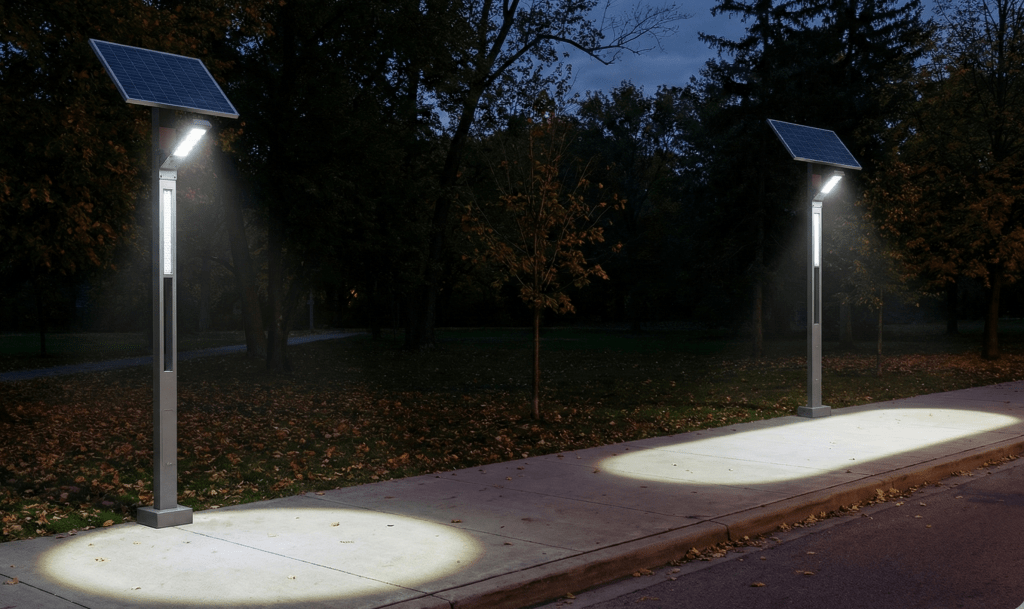
Solar street light optics and Type II–V light distribution determine where your lumens land, which directly drives efficiency, glare control, and real-world performance.
“Lumens emitted” is a press release. “Lumens delivered” is what the pavement gets to keep.
Cheap solar street lights often come with big lumen numbers and small optics. And optics are the part that decides whether those lumens land on the roadway, in someone’s bedroom window, or up in the sky like an accidental tribute to astronomy.
For DOTs, utilities, and municipalities, this is not a style preference. It’s a performance issue. If the distribution is wrong or the optic is low quality, you can meet the spec sheet and still fail the street.
Why Should I Care About Distribution Types?
If your optic throws light everywhere, your battery becomes a charity.
Solar powered roadway and area lighting has a hard limit: the night is long, and the battery is not infinite. When optics waste light, your system pays twice. You lose visibility where you need it, and you burn energy where you don’t.
That’s why “more lumens” is not the fix. If the lens is sloppy, extra lumens often become extra glare, extra uplight, and extra complaints.
Distribution type is the first sanity check that tells you whether a fixture is even shaped for the job.
What RP-8-25 Actually Means by Type II, III, IV, and V
RP-8-25 doesn’t care what you call it. It cares what the beam does.
RP-8-25 classifies transverse distribution using a simple idea: how wide the light pattern reaches across the roadway when the fixture is mounted at the edge of the area.
The key detail most brochures skip: the “Type” is based on where the half-maximum candlepower line lands, measured in multiples of mounting height (MH).
Here’s the plain-English translation for luminaires mounted near the side of the roadway:
Type II
The “useful beam” stays relatively tight. In RP-8-25 terms, it does not cross the 1.75 MH line on the street side.
Type III
Wider reach. It goes beyond 1.75 MH, but does not cross 2.75 MH.
Type IV
Widest street-side reach for edge-mounted roadway lighting. The “useful beam” goes beyond 2.75 MH.
Type V / VS
These are symmetric patterns intended to distribute light around the fixture more evenly (Type VS is the “squarer” symmetry check). They can make sense for area lighting layouts, but they get misused on road edges because “symmetry” sounds safe.
The practical takeaway: Type II/III/IV are about controlling a forward-and-across roadway shape. Type V is often more “area” than “roadway,” unless the geometry truly calls for it.
The Solar Trap: Bad Optics Make Dimming Look Like Failure
A dimming profile can’t rescue a bad beam. It just reveals it earlier.
This is where cheap optics hurt solar projects in a very specific way.
If the distribution is poor, you get bright hot spots and dark gaps. The site looks “uneven” even at full output. Then the system dims later at night (as many solar systems do), and the dark gaps become obvious.
Owners don’t say “your transverse distribution doesn’t match the geometry.”
They say: “These solar lights are weak.”
Often, the solar hardware is fine. The optics are what turned available energy into unusable light.
The Reality vs. the Standard
“Type III equivalent” is what you say when you don’t want anyone opening an IES file.
Here’s what shows up when the optic doesn’t actually match RP-8-25 intent:
1) Not truly controlled at high angles
You see glare from far away, and you get the “why is it so harsh?” feedback. On solar projects, this often triggers after-hours dimming tweaks that reduce safety.
2) “Full cutoff” in the brochure, uplight in the field
Low-quality lenses, poor LED board alignment, or sloppy assembly tolerances can leak light upward.
3) Wrong distribution for the road width and pole geometry
A tight pattern on a wide cross-section creates a bright near side and a starving far side. A wide pattern on the wrong layout can create spill and backlight you never wanted.
4) Accidental tilt changes everything
RP-8-25 warns that upward tilt can change classification. In the real world, bracket angles and installation tolerances can quietly turn a “controlled” optic into a glare generator.
And RP-8-25 makes a blunt point that applies directly here: when people choose fixtures without considering optics control, they can create inefficient lighting with unwanted spill light, sky glow, and glare. Solar projects feel that mistake immediately because the battery pays the bill.
What to Require in Specifications
If you don’t specify the beam, you’re buying whatever showed up in the container.
If you want “lumens delivered,” keep your spec requirements vendor-neutral and enforceable:
- IES photometric file for the exact luminaire configuration being proposed (not “typical,” not “family,” not “similar”).
- Declared distribution type (Type II/III/IV/V or VS) and the assumed installed tilt used for the photometry and calculations.
- Isocandela plot showing the distribution classification basis (so “Type III” is demonstrated, not marketed).
- LCS / BUG style reporting (or equivalent) to quantify uplight and high-angle content instead of relying on the phrase “full cutoff.”
- Roadway/area calculation package showing maintained performance and uniformity on the real geometry (mounting height, offsets, spacing, roadway width).
- House-side control requirement (limit backlight/spill) when near residences, paths, or sensitive receptors.
- Field verification plan (what gets measured, where, and with what instrument), because performance should be checkable after install.
Those seven items force the conversation to become engineering again, which is exactly where public infrastructure belongs.
Closing thought
Solar street lighting is a battery-powered promise. Good optics are how you keep it without raising your voice at a community meeting.
Sources and where to verify
- ANSI/IES RP-8-25 (2025), Part 1: Section 2.6.2.2 (Type II/III/IV definitions for luminaires on near side of area)
- ANSI/IES RP-8-25 (2025), Part 1: Section 2.6.2.1 (Type V and Type VS descriptions)
- ANSI/IES RP-8-25 (2025), Part 1: Section 2.6.3.1 (Upward tilt can change distribution classification; photometer in installed position)
- ANSI/IES RP-8-25 (2025), Part 1: Section 6.2.2.2 (poor optical control can cause spill light, sky glow, and glare; guidance on selecting luminaires with good optical control)
- DarkSky Approved Luminaires Guidelines (uplight and high-angle limits using LCS zones). https://darksky.org/what-we-do/darksky-approved/darksky-approved-luminaires-program/darksky-approved-luminaires-guidelines/
- City of Windsor By-law 146-2025 (Outdoor and Nuisance Lighting; full cut-off requirement). https://www.citywindsor.ca/documents/city-hall/by-laws-online/146-2025%20%28Outdoor%20and%20Nuisance%20Lighting%29.pdf
Quick FAQ
Why do distribution types (Type II/III/IV/V) matter in solar street lighting?
Because they determine where the light lands, which affects roadway visibility, glare, spill light, and battery use.
Can more lumens compensate for the wrong optic?
Usually no. A sloppy optic often turns extra lumens into glare and wasted energy instead of better roadway performance.
What should I require instead of accepting “Type III equivalent”?
Exact IES files, declared distribution type, installed tilt assumptions, and photometric results on the real roadway geometry.
Next in RP-8-25, Solar Edition: Adaptive Lighting in RP-8-25: When Dimming Is Appropriate (and When It Isn’t)
 Solar Lighting Night Shift