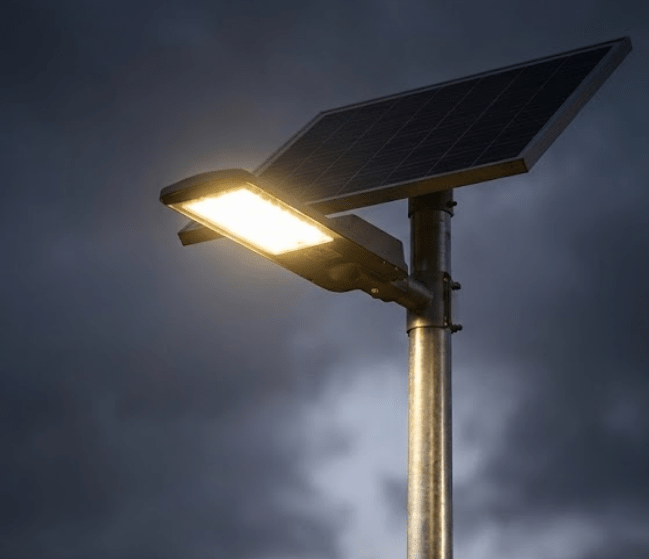
On the Lighter Side of the Sun
By Piotr Mikus
After Dark (Series):
• Browse the series: After Dark
• Previous: One Pole Is Dim, the Next Is Fine
If your energy budget is built from averages, your outage plan will be built from weekends.
A solar street light energy budget compares monthly solar harvest vs nightly load so you can size the panel and battery for the worst month, plus autonomy and recovery margin.
If you’ve ever bought solar street lighting, you’ve seen the same promise in different outfits: a panel, a battery, an autonomy claim, and a dimming profile that reads like a bedtime story. Most of the time the system looks fine at commissioning, because commissioning happens when the sun is cooperative. The real test arrives later, when clouds stack up, days get shorter, and the site starts acting like the site. That’s why the energy budget matters. It is the only place where reality, design, and expectations are forced to sit at the same table.
This isn’t academic. Lighting is a safety system. In the U.S., most pedestrian fatalities occur in dark conditions, which means the hours we rely on lighting the most are also the hours where “it dimmed early” is not a harmless inconvenience. So when a solar proposal says it will deliver a specific output for a specific duration, the energy budget behind that claim should be treated like a performance contract, not a marketing paragraph.
The Call You Get in October
It worked all summer. Then autumn showed up and asked for receipts.
Here’s the familiar sequence. The lights are installed in June. They turn on. Everyone smiles. A nighttime walk-through happens while batteries are full and the charge window is long. Then the first string of gray days hits, the sun angle drops, and suddenly your “dawn-to-dusk” light is negotiating its shift. You start getting calls: “This one is dim at 2 a.m.” “That one shuts off before morning.” Nothing ‘broke.’ The system is simply protecting itself because the daily energy income is no longer covering the nightly energy bill.
A good project prevents that call by defining, up front, what the system must do in the worst months, not the best ones. That means requiring a worst-month energy balance and asking one blunt commissioning question: what happens after multiple low-charge days in a row? If the answer is vague, the risk is not.
Where the Lie Lives
The lie isn’t that the math is wrong. It’s that the math is pretending the site is a postcard.
Most weak proposals don’t contain one catastrophic error. They contain a stack of convenient assumptions that all lean in the same direction. They assume open-sky solar access. They assume losses are a single constant number. They assume batteries accept charge whenever the sun offers it. They assume the luminaire draws what the brochure says it draws. Then they sprinkle a dimming profile on top and call it “resilience.” Individually, each shortcut looks small. Together, they create an energy budget that belongs to a different site and a different season.
If you want to compare vendors fairly and protect your project, force the assumptions to be explicit. Ask for the monthly energy budget inputs, not just the outputs. Ask what losses are included, what temperatures are assumed, what charging limits exist, and what the worst-month margin is. The moment the conversation becomes specific, the ‘lie’ tends to evaporate.
The Four Numbers That Decide Whether a Light Stays On
Solar street lighting fails in four units: watts, hours, degrees, and optimism.
You can simplify most performance debates by asking for four numbers, stated clearly, for the worst month at the actual site. Not “typical,” not “average year,” not “sunny season.” Worst month, real geometry.
- Daily energy harvested (Wh/day), with the solar model and losses stated clearly and seasonally, not as one generic derate.
- Nightly energy required (Wh/night), based on the actual wattage at the delivered output, including control overhead and any communication load.
- Usable stored energy (Wh), based on the battery’s usable capacity window and the system’s low-voltage protection thresholds.
- Charge acceptance limits (temperature and BMS behavior), because many lithium systems restrict or block charging near and below freezing.
That last one is the quiet assassin. A winter day can look ‘bright enough’ on paper, but if the battery is cold and the system blocks charging, your harvest becomes a polite offer the battery refuses. A professional energy budget includes that behavior explicitly.
What a Real Energy Budget Looks Like
A real energy budget is boring. That’s why it works.
A defensible energy budget is not a single table with one annual number. It is a month-by-month balance that shows margin, not just capability. It should also make it easy for an owner to audit. You shouldn’t need to reverse-engineer it from glossy charts.
At minimum, a real budget does three things: it models seasonal solar input, it accounts for site-specific constraints, and it proves that the system can recover after realistic sequences of low-charge days. Tools like NREL’s PVWatts are commonly used as a baseline for estimating monthly production, but the value is not the tool itself, it’s the discipline of stating assumptions and losses so everyone is talking about the same reality.
If you want a simple spec requirement that changes the quality of proposals overnight, require the following deliverables. Not as ‘nice to have,’ as part of the bid package:
- A monthly energy budget (Wh in vs. Wh out) for the worst-month condition, including stated assumptions for losses and temperatures.
- A documented solar access/shading basis at the pole locations (or a defensible sampling plan), especially in urban canyons and under canopy.
- A stated “after consecutive low-charge days” behavior: output levels, runtime, and recovery expectations.
- A commissioning verification plan that includes at least one overnight check after the system has been operating for a period, not just day-one turn-on.
How to Compare Proposals Without Becoming an Engineer
If two bids look identical, ask one question: show me November.
When you’re reviewing bids, your job isn’t to become the engineer of record in a weekend. Your job is to spot which proposal is grounded in measurable assumptions. These questions do that quickly:
- What is the worst-month energy margin (Wh/day), and what assumptions create it?
- What solar model was used, and what losses were applied (soiling, temperature, wiring, controller, battery efficiency)?
- How does the system behave after several low-charge days in a row, and how quickly does it recover?
- What are the battery charge limits in cold weather, and what happens on cold bright days when charging is restricted?
- What data can the system provide (harvested energy, battery SOC trend, dimming events) to diagnose future issues without guessing?
If a vendor answers these cleanly, you’re looking at a design process, not a sales pitch. And if you want an independent review, this is exactly the kind of information that lets me validate a project quickly before the first pole is set.
Closing thought
A solar streetlight is a tiny power plant with bedtime. Don’t let marketing pick the bedtime.
Solar street lighting can be reliable, but only when the energy budget is treated as engineering, not storytelling. If you design for the worst month, validate the site constraints, and demand auditable assumptions, you don’t just get a light that turns on. You get a system you can defend in public meetings and sleep through at night.
If you’d like a sanity check on a project, send a pole list (or map pins), your required runtime/output targets, and any known site constraints. I can tell you which locations are safe, which are risky, and what mitigation is cheapest before procurement locks in assumptions.
Sources and where to verify
- NHTSA, Traffic Safety Facts: 2023 Data – Pedestrians (light condition: 77% of pedestrian fatalities occurred in the dark). https://crashstats.nhtsa.dot.gov/Api/Public/ViewPublication/813727
- NHTSA, Countermeasures That Work – Pedestrian Safety (dark-condition share and trend context). https://www.nhtsa.gov/book/countermeasures-that-work/pedestrian-safety
- GHSA, Pedestrian Traffic Fatalities by State: 2024 Preliminary Data (nighttime fatality share and trend). https://www.ghsa.org/resource-hub/pedestrian-traffic-fatalities-2024-data
- NREL, PVWatts Calculator (monthly energy production estimates and loss inputs). https://pvwatts.nrel.gov/
- NREL, PVWatts Version 5 Manual. https://pvwatts.nrel.gov/downloads/pvwattsv5.pdf
- NREL, Partial-Shading Assessment of Photovoltaic Installations (shading-induced mismatch losses). https://docs.nrel.gov/docs/fy15osti/63765.pdf
- Redarc Electronics Support: Why you should not charge a lithium battery below 0°C / 32°F. https://us.support.redarcelectronics.com/hc/en-us/articles/13856244101007-Why-you-should-not-charge-a-lithium-battery-below-0-C-or-32-F
Piotr Mikus is a roadway lighting designer and specifier focused on solar powered street lighting and controls.
Quick FAQ
What is a solar street lighting energy budget?
It compares monthly solar harvest to nightly load so panel and battery sizing can be checked against the worst month, not just average conditions.
Why do systems often look fine at commissioning and struggle later?
Commissioning usually happens under favorable sun conditions. The real test comes during short days, cloud stacks, and recovery after low-sun periods.
What should an energy budget include besides panel and battery size?
Autonomy target, recovery margin, load profile, and worst-month assumptions that match the site’s real operating conditions.
Also in After Dark: Why Should I Care About Shading?
 Solar Lighting Night Shift