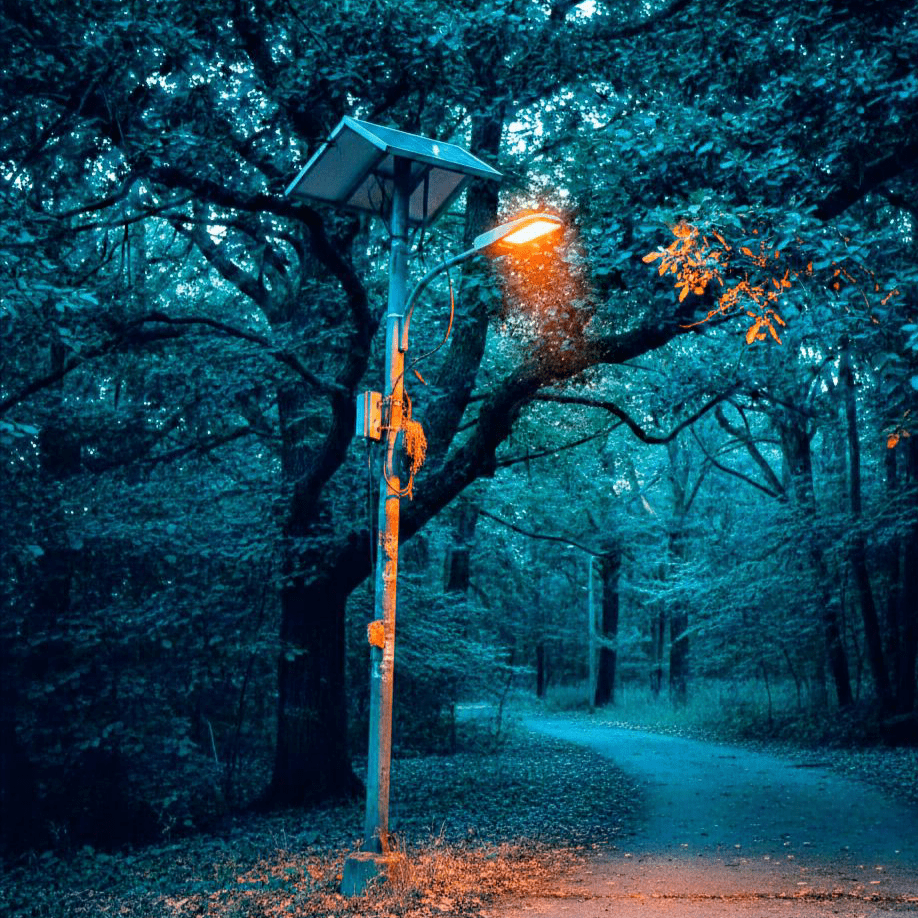
On the Lighter Side of the Sun
By Piotr Mikus
After Dark (Series):
• Browse the series: After Dark
• Next: Energy Budgets
Shade in Urban Canyons and Tree Tunnels: The Solar Street Lighting Trap
Solar street light shading is a leading cause of early dimming and reduced runtime because it cuts the real charging window and battery recovery margin.
Sunlight is free. Solar access is the part you actually have to engineer.
In open terrain, simplified solar sizing can survive. In dense cities and treed corridors, it can’t. Shade turns a confident proposal into a fragile system because it steals charging hours first, then steals battery recovery, and eventually steals light output when the controller has to protect the battery. If you want one quick sanity check as an owner, it’s this: if the proposal can’t show you site-specific solar access, it’s not a design, it’s a bet.
The Spreadsheet Assumption That Breaks Projects
Peak sun hours are a lovely number until your panel never sees them.
Many solar street lighting proposals start with a clean regional solar number, apply a generic derate, and call it done. But the only solar resource that matters is the one your panel actually receives at that pole, on that street, in the worst month. The professional way to buy these systems is to require a location-based solar access assessment (even a simple horizon/obstruction profile) and a monthly energy budget that proves the battery can recover after consecutive low-charge days.
When clients ask me what to request, I keep it simple: show the available sun window, show the expected daily harvest by month, show the nightly load, and show the margin. If a vendor can only give you one annual average number, you’re not looking at engineering, you’re looking at optimism.
Urban Canyons: When the Sun Becomes Directional
In a city street, the sun doesn’t rise. It peeks around corners.
In an urban canyon, sunlight behaves like a spotlight. Building edges and street orientation decide when the panel gets its brief performance, and winter sun angles shorten the show even more. That’s why a system that looks heroic in June can become fragile in November, not because anything failed, but because geometry stopped being polite. The fix is to treat solar access as directional: measure it by azimuth and altitude, size using the real charge window, and then design around the constraint by shifting the pole, adjusting PV tilt/azimuth to match the window, or placing the PV where the sky view is better even if the luminaire must stay in the canyon.
Treed Corridors: The Canopy Keeps Growing After Commissioning
Trees are the only subcontractor that keeps working after the punch list is signed.
A location can feel acceptable on installation day and quietly become a problem two seasons later. Canopies grow, leaf density changes, and a “mostly sunny” site turns into daily partial shade with too little recovery time. Good projects treat vegetation like a lifecycle input: document a canopy growth assumption, define who owns trimming and clearances, and avoid placing panels where a few years of growth will predictably block the charge window. When the corridor is valuable but the sky view is not, the clean solution is often simple geometry again: choose a better nearby solar exposure point or use a mounting approach that keeps the PV out of the shade while the light stays where it needs to be.
How Shade Shows Up at Night
Solar lights rarely fail loudly. They fade, politely, until someone gets angry.
Shading problems announce themselves through behavior: chronic undercharge, earlier dimming, shorter runtime, and inconsistent performance from pole to pole even with identical hardware. If you want to catch this early, require basic operational data or commissioning checks that make the energy budget visible: harvested energy trend, battery state-of-charge trend, and any dimming or low-voltage events. That one decision turns future complaints from guesswork into a quick diagnosis.
What to watch for on a site walk
- Poles that look fine at noon but sit in shade during the primary charge window: ask for a solar access snapshot from the pole location, not a regional average.
- Systems that “work” in summer and struggle in fall: ask to see the worst-month energy budget and the recovery plan after consecutive low-charge days.
- Corridors where one pole dims and the next doesn’t: compare sky view and charge history before replacing components.
- Sites where trees are ‘someone else’s problem’: write vegetation responsibility into the project scope so performance doesn’t depend on luck.
A Shading Workflow That Actually Works
Measure first, then size. Not the other way around.
You don’t need a science fair to do this well; you need a repeatable workflow. Start by screening locations for obvious blockers (buildings, mature trees, north-facing canyons). Then document solar access at the proposed PV position, convert that into a monthly charging estimate, and run an energy budget against the actual load profile. If the margin is thin, mitigate in the cheapest order: relocate the pole or PV position, adjust geometry, refine the load profile, and only then talk about upsizing hardware. Finally, verify performance with commissioning checks and basic monitoring so you can prove the system is operating on the energy budget it was sold on.
What to Put in the Spec
If shading isn’t a deliverable, it isn’t designed. It’s a surprise.
Owners can prevent most shading failures by requiring a few specific deliverables up front. These requests are vendor-neutral, easy to evaluate, and they force real engineering into the proposal. - Site-specific solar access documentation for each pole location (or a defensible sampling plan for large projects).
- Monthly energy budget showing expected harvest versus load, including the worst-month condition and recovery after consecutive low-charge days.
- A clear minimum performance commitment: runtime and output the system will maintain under the stated worst-month assumptions.
- Vegetation and future obstruction assumptions, including responsibility for trimming and clearance targets.
- Commissioning verification steps tied to charging behavior, plus basic performance telemetry (harvested energy, SOC trends, dimming/low-voltage events).
Closing thought
The sun is not your problem. Your assumptions are.
Solar street and area lighting can be reliable in complex environments when it’s designed like infrastructure, not like a brochure. If you want a fast second opinion on a site or a proposal, send a pole list (or map pins), the operating requirements, and a few photos looking up from the pole locations. I can tell you which locations are safe, which are risky, and what mitigation is cheapest before anything gets installed.
References and further reading - National Renewable Energy Laboratory (NREL): publications on PV performance under partial shading and mismatch losses.
- IEC and UL guidance related to PV module behavior, bypass diodes, and system design considerations for shaded conditions.
- Manufacturer data sheets and controller manuals: dimming logic, low-voltage behavior, and battery protection profiles (these usually explain the ‘why’ behind field complaints).
Quick FAQ
Why does shading cause early dimming in solar street lighting?
Because shading cuts the real charging window and reduces battery recovery margin, which shows up later as reduced runtime and earlier dimming.
Why is shading such a trap in cities and treed corridors?
Dense obstructions can quietly steal charging hours, especially in urban canyons and “tree tunnel” conditions where simplified sizing assumptions break down.
What is one quick owner-level sanity check for a proposal?
If the proposal cannot show site-specific solar access/shading analysis, it is a bet, not a real design.
Next in After Dark: One Pole Is Dim, the Next Is Fine
 Solar Lighting Night Shift