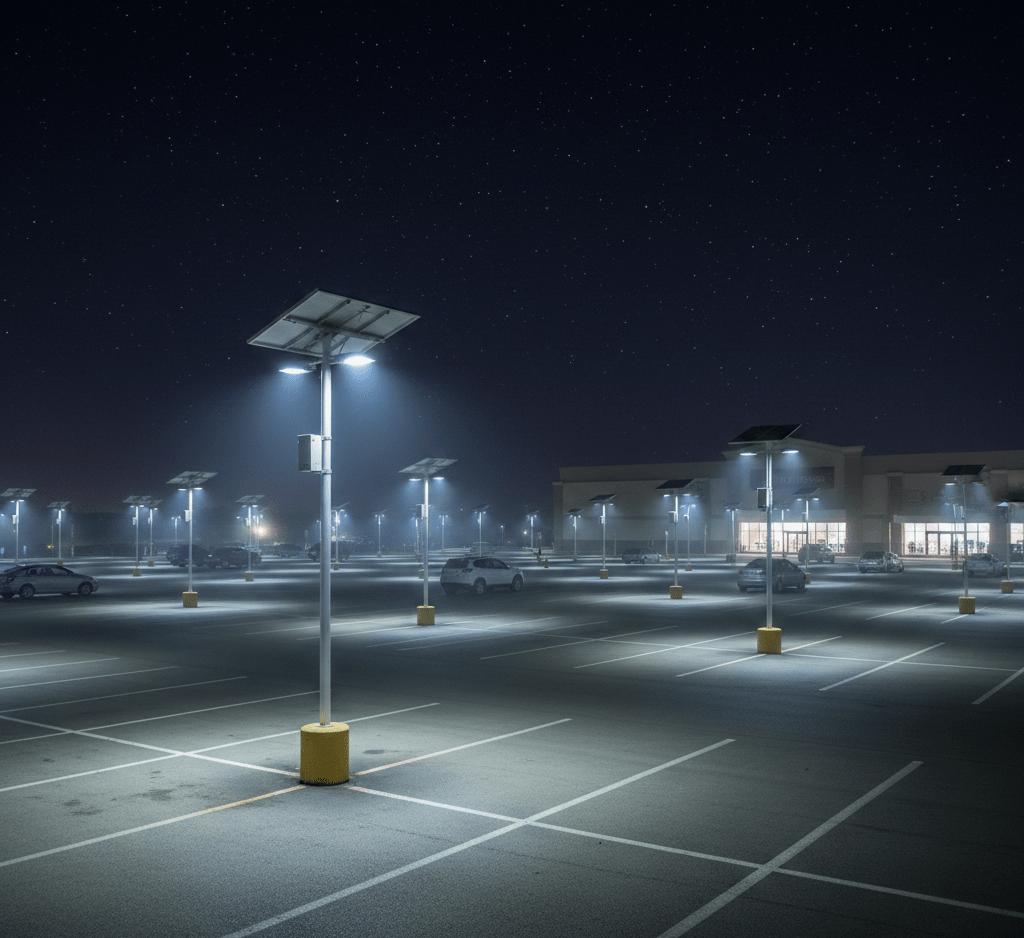
On the Lighter Side of the Sun
By Piotr Mikus
RP-8-25, Solar Edition (Series):
• Browse the series: RP-8-25, Solar Edition
• Previous: Solar Street Light Dimming (RP-8-25)
(what to demand in a solar parking lot lighting proposal):
- Avg, Min, Max (not average only)
- Avg/Min and Max/Min at full output and at the dimming floor
- False-color/isolux plot + exact IES files
- Battery protection behavior after multiple low-sun days
“0.2 footcandles average” is not a lighting plan. It’s a number that looks good on a quote. Solar parking lot lighting uniformity is what separates a real design from a pretty average, because people experience the minimums and the dark gaps.
Solar parking lots are where solar area lighting gets approved quickly and regretted slowly. Someone says “RP-8-25,” someone repeats “0.2 fc average,” and the review ends right there. The problem is that an average can be “met” while the lot still feels patchy, uncomfortable, and risky because the minimums and uniformity were ignored.
Solar parking lot lighting uniformity matters more than the average footcandles, because people experience the minimums and the gaps.
In solar, that mistake gets amplified because you can’t just throw more watts at it forever without paying for it in battery life and winter performance.
This post is about uniformity, the part cheap designs avoid because it’s hard to fake. If the lighting looks bright under poles and dark between them, people don’t complain about “ratios.” They complain that the lot feels sketchy, and the project gets labeled “bad solar lighting” even when the real issue is layout and optics.
Solar Parking Lot Lighting: The “0.2 fc Average” Trap
Designing only to average is like grading a meal by the weight of the plate.
An average value is easy to hit with a few bright hot spots. Put a lot of light right under the luminaire, let the spaces between poles sink into darkness, and the math can still look “fine.” That’s why “0.2 fc average” is the perfect hiding place for low-quality optics and stretched spacing. The average becomes a marketing shield, while the human experience of the lot becomes a patchwork.
Solar projects are especially vulnerable to this trick because the design often includes planned dimming after peak hours, plus battery-protection behavior after a few poor solar days. A layout that looks barely acceptable at 100% output often becomes clearly unacceptable at the dimmed floor. The average may still look defensible on paper, but the minimums become embarrassing in the real world.
Uniformity Ratios Explained: Avg/Min vs Max/Min (Plain English)
Uniformity is whether your light behaves like a blanket… or like a polka-dot shirt.
Uniformity is simply how consistent the light is across the area people actually use. Most reports will show two ratios that matter:
- Average-to-Minimum (Avg/Min): How deep are the darkest points compared to the average?
- Maximum-to-Minimum (Max/Min): How extreme are the hot spots compared to the darkest points?
That second one is the lie detector.
A proposal can “buy” an average with a few very bright points. Max/Min shows you whether the design is smooth and usable or just spiky and theatrical.
In parking lots, poor uniformity doesn’t just look bad. It hides curbs, islands, wheel stops, pedestrians, and trip hazards in the exact places people drift while driving slowly or walking distracted.
Why Uniformity Fails First in Solar Lots (Spacing, Optics, Dimming, Battery Protection)
The battery doesn’t care how your lot looked at 8:30 PM. It cares what you asked it to do all night.
Here’s why uniformity problems show up more often in solar parking lots than in grid-tied lots:
- Spacing gets stretched to save poles.
Fewer poles reduces cost, sure, but it also increases the dark gaps that uniformity ratios are meant to control. If the optics aren’t strong, the gaps become the dominant feature of the lighting. - Optics quality becomes everything.
Cheap optics don’t shape light well. They spill light where it doesn’t help (glare, uplight, wasted spill), and then you pay for that wasted light with battery energy. That’s the “lumens emitted vs lumens delivered” problem showing up as ugly uniformity. - Dimming makes weak layouts obvious.
Planned dimming is common in solar parking lots, and it can be perfectly reasonable. But if the design only meets expectations at full output, dimming doesn’t “save energy safely,” it just reveals the dark holes sooner. The lot starts looking like isolated bright circles instead of a coherent space. - Battery protection creates uneven behavior.
One pole can enter reduced output while the next stays normal after multiple cloudy days, shading, or battery aging. That doesn’t just reduce light. It makes the lot inconsistently lit, which people notice immediately. In parking lots, inconsistency reads as “something is wrong here.”
What to Demand in a Solar Parking Lot Lighting Proposal (Uniformity at Full and Dimmed Output)
If the report shows only averages, you’re not reviewing a design. You’re reviewing a brochure with math.
Ask for deliverables that force the design to show its real performance:
- A report showing average, minimum, and maximum values (not average only)
- Avg/Min and Max/Min uniformity ratios for the parking lot grid
- A false-color / isolux plot (so dark holes are visible instantly)
- IES photometric files for the exact fixture and optic being proposed
- Results at full output and at the planned dimming floor (lowest normal operating level)
- A written explanation of battery protection behavior (what happens after multiple low-sun days)
- Clear assumptions: mounting height, spacing, orientation, tilt, and control schedule used in the calculation
If a vendor can’t provide uniformity ratios at the dimmed floor, the honest interpretation is simple: the lot wasn’t designed to look like real lighting after midnight.
Three Questions That Expose “Average Only” Designs
These questions are polite. The answers will tell you if the project is real.
- What is the minimum point, and where is it? (Show it on the plot.)
- What are Avg/Min and Max/Min at full output AND at the dimmed floor?
- What happens after three bad solar days? (Battery protection behavior, not best-case.)
If those answers are vague, the project is being sold on averages, not performance.
Closing Thought
Solar parking lot lighting can be excellent. But you don’t get there by buying the average.
If you remember one thing, remember this: people experience the minimums, and they complain about the gaps. Don’t let “0.2 fc average” be the finish line. Make uniformity the part that keeps the design honest.
Sources and Where to Verify
- ANSI/IES RP-8-25 (2025), Part 2: criteria framework emphasizing maintained performance and the role of uniformity ratios (Avg/Min and Max/Min) in visibility-based recommendations.
- ANSI/IES RP-8-25 (2025), Part 2: discussion of visibility impacts when uniformity and glare are outside recommended limits.
- Common IES practice for parking facility reviews: minimums and uniformity are expected as part of responsible design evaluation, not average alone.
Quick FAQ
Why is “0.2 fc average” not enough to judge a solar parking lot design?
Because a few bright hot spots can make the average look fine while dark gaps and poor minimums make the lot feel patchy and unsafe.
Which uniformity ratios matter most in parking lots?
Avg/Min and Max/Min. Max/Min is often the lie detector when a design “buys” the average with hot spots.
Why do weak solar parking lot layouts fail faster at night?
Dimming and battery-protection behavior expose dark gaps sooner, especially when spacing is stretched or optics are poor.
Also in RP-8-25, Solar Edition: Solar Street Light Dimming (RP-8-25)
 Solar Lighting Night Shift