On the Lighter Side of the Sun
By Piotr Mikus
Pedestrian Lighting:
Faces, Not Footcandles: Vertical Light After Dark
Because “low activity” is not the same as “low consequence.”
Energy savings are not a safety plan, especially where vehicles and pedestrians share the right of way.
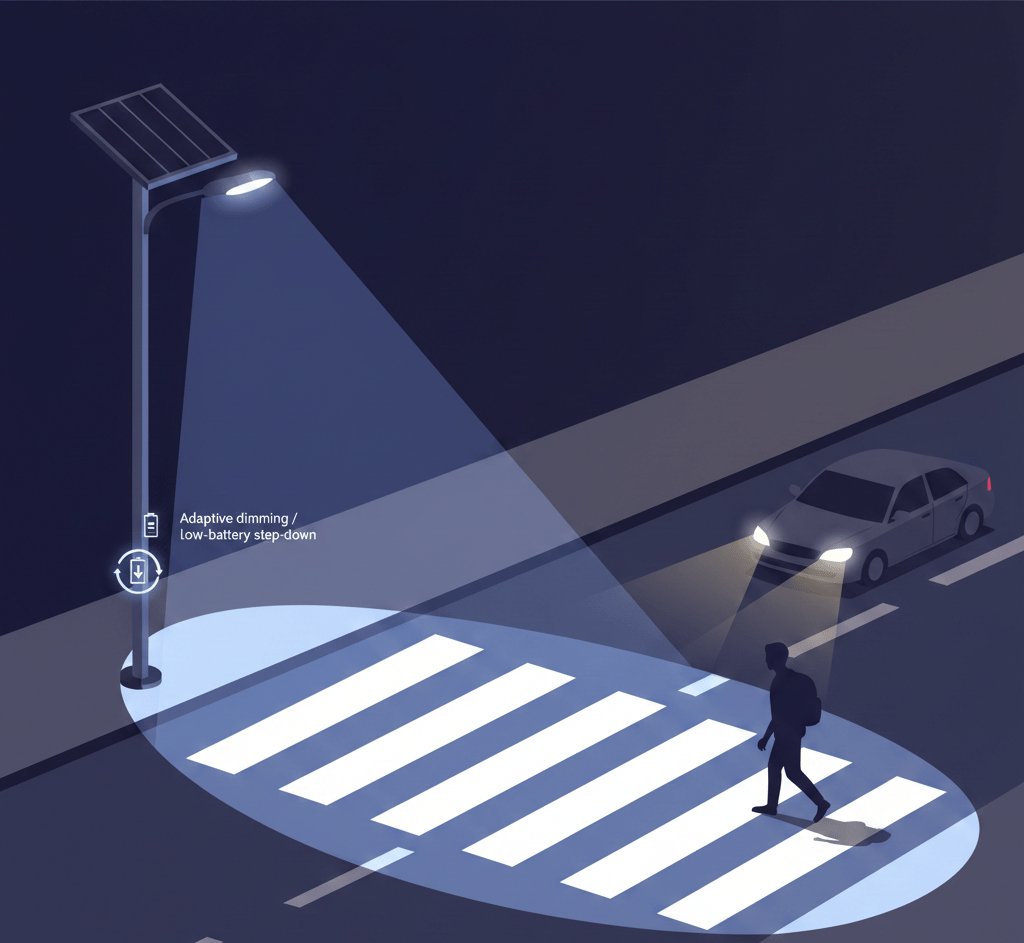
A crosswalk is not just another spot on the site plan. It’s a conflict point. The lighting isn’t there to make the pavement look nice. It’s there to help drivers and pedestrians see each other soon enough to make good decisions.
And this is where solar projects get into trouble: the crosswalk often gets the same dimming profile as the rest of the corridor or parking-lot aisle. That’s how you end up with a system that looks fine early in the evening, then quietly under-delivers when it matters most.
What RP-43-25 is pointing at (without shouting)
Crosswalk visibility is about people, not paint.
RP-43-25 calls out the safety benefit of higher vertical illuminance on pedestrians in crosswalk-type conditions. The goal is straightforward: improve visibility of the person in the conflict zone. But it also warns about glare. If the luminaire introduces discomfort glare, you can lose visibility and force higher ambient light to compensate. That’s the worst deal possible in solar: spending more energy to fight a problem you created.
One of the most useful practical takeaways is this: low-glare luminaires can achieve equivalent visibility under lower light levels. That matters because solar systems live in “lower light levels” for a big portion of their operating life.
Why solar makes the crosswalk problem worse
Solar doesn’t fail evenly. It fails exactly where you didn’t protect the floor.
Crosswalk risk doesn’t disappear late at night. What disappears is the energy margin.
In solar lighting, these realities show up fast:
Dimming is normal, and many systems spend most of the night below “full.”
After cloudy runs or winter weeks, the system can step down earlier or harder.
Battery protection behavior can override your “nice looking” profile.
If your crosswalk lighting is only “good” at full output, you don’t have a design. You have a temporary condition.
The common misapplication
Treating a crosswalk like midblock is like treating a stop sign like a decoration.
The cheap approach often looks like this:
Same profile everywhere, because it’s easy to program.
Reliance on motion sensors that respond late, trigger inconsistently, or miss detection zones.
Optics chosen for lumen claims rather than controlled distribution, which creates glare without improving recognition.
No declared minimum level for the crosswalk zone, so nobody can enforce performance when the system dims.
In pedestrian spaces, “pools of light” can work when they’re intentional and comfortable. But a crosswalk is not the place to gamble on patchy illumination, harsh glare, or slow ramp-up.
What to Require in a Specification (especially for solar)
If the crosswalk is important, it needs its own rules.
Make the crosswalk enforceable in the spec by requiring:
A defined crosswalk control zone (separate from midblock or general aisle lighting).
A declared minimum operating level for that zone, including how it behaves under low state-of-charge conditions.
A description of triggers (time, occupancy, radar/PIR, schedule) and the validation logic behind them.
Ramp rates and transitions that don’t create “blink” behavior or unpredictable lighting.
Photometric deliverables (IES + calculation) that demonstrate performance at the minimum operating level, not only at full output.
Glare control expectations: no “high-lumen” substitution for controlled optics.
A commissioning checklist: zone mapping verified, sensor aim verified (if used), and the profile confirmed at night.
If you only remember one spec sentence, make it this: show me performance at the lowest operating level, and show me the crosswalk is protected.
Closing thought
If the crosswalk is dim, the rest of the project doesn’t matter.
Solar lighting can be excellent at conflict points, but only when the design treats them like conflict points. Protect the floor, control glare, and verify the behavior that will actually run after dark.
References (at end only)
ANSI/IES RP-43-25 (2025), Recommended Practice: Lighting Design for Outdoor Pedestrian Applications (crosswalk safety, glare impacts, adaptation, illuminance guidance).
ANSI/IES RP-8-25 (2025), for conflict-area thinking where roadway and pedestrian zones intersect and where controls must not undermine safety intent.
Author
Piotr Mikus is a roadway lighting designer and specifier focused on solar powered street lighting and controls.
Quick FAQ
Why can’t crosswalks use the same dimming profile as midblock areas?
Because a crosswalk is a conflict point, and “low activity” does not mean “low consequence” when drivers and pedestrians interact.
What goes wrong when crosswalk lighting dims like the rest of the corridor?
The system may look fine early in the evening but under-deliver visibility later, right when safe driver-pedestrian recognition still matters.
What is the core design principle for solar crosswalk controls?
Treat energy savings and safety as separate design goals, and protect pedestrian visibility without creating glare.
More in Pedestrian Lighting:
 Solar Lighting Night Shift