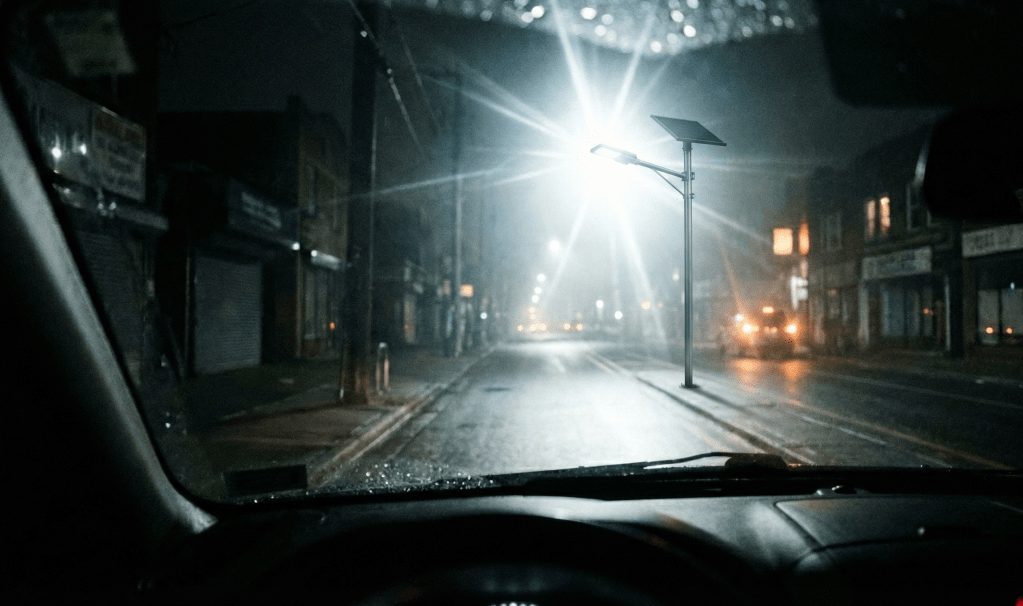
On the Lighter Side of the Sun
By Piotr Mikus
RP-8-25, Solar Edition (Series):
- Browse the series: RP-8-25, Solar Edition
- Previous: Solar Parking Lot Lighting Uniformity: Why “0.2 fc Average”
(what to demand in a solar roadway lighting proposal when “harsh” is the complaint):
- Veiling Luminance Ratio (LV,max/Lavg) results, not just average values
- Table-based criteria reference (street classification + pedestrian activity assumptions)
- IES file for the exact luminaire configuration and optic
- Installed tilt/orientation stated clearly (and verified in the field)
- Results at full output and at the programmed dimming floor
- BUG/LCS style reporting (or equivalent) to expose high-angle content
- A field verification plan (because glare complaints are always “field conditions” until you measure them)
“Harsh” is rarely a mystery. It is usually the moment your optics stop behaving like a tool and start behaving like a spotlight.
Solar powered roadway lighting makes this more delicate, not less. A battery is a hard budget. If your optic wastes light at high angles, the battery still pays. Then the community pays again — in complaints and retrofit pressure.
This post is about the part cheap proposals avoid because it is harder to brochure your way through: disability glare control using veiling luminance ratio.
Solar Roadway Lighting: The “Harsh Light” Complaint
“Too bright” is often what people say when they mean “I can’t see comfortably.”
Harshness tends to show up like this:
- You notice the luminaire more than the roadway
- The scene feels washed out, even when the numbers look fine
- People describe it as glare, headache light, prison-yard light, or “why is it shining at me?”
- The first “fix” becomes dimming — which creates new problems if the design was never solid at the floor
Solar projects get labeled harsh faster because many designs stretch spacing to save poles, then push intensity and angle to make the math work. You can hit an average and still fail the experience.
Disability Glare Explained (Plain English)
Glare is not just annoyance. It is contrast theft.
Disability glare happens when bright sources scatter stray light inside the eye, casting a veil across the retina. The pavement can be lit, but the scene becomes harder to read because contrast gets crushed. The roadway is there. Your ability to interpret it is not.
That is why glare can feel like thin fog that only your eyeballs can see — and why more light does not automatically mean more visibility. Add the wrong light at the wrong angles, and you make the roadway harder to read, not easier.
Why Glare Shows Up First in Solar Roadway Projects
The battery does not care whether your light is useful. It only cares whether your LEDs are on.
Here is why harshness complaints cluster around solar roadway lighting:
Spacing gets stretched to save poles. Fewer poles force each luminaire to cover more geometry. To reach, the beam climbs into higher angles. That reach becomes glare.
Optics quality becomes everything. A sloppy optic wastes light into places that do not help drivers. In solar, wasted light is not just a nuisance. It is energy you never get back.
Peak output happens when people are paying attention. Many systems run highest earlier, then dim later. That means the harsh period often aligns with higher activity, more traffic, and more eyes on the system.
Tilt turns into a glare multiplier. A few degrees of upward tilt can change how the distribution behaves. If the photometric assumptions and the installed reality do not match, the project you approved on paper is not the project you built.
What RP-8-25 Uses to Control Glare
RP-8-25 does not treat glare as a vibe. It treats glare as a metric.
For street lighting, RP-8-25 uses luminance-based criteria and includes a glare limit expressed as Veiling Luminance Ratio (LV,max/Lavg).
Plain-English translation:
- LV,max represents the glare “hit”
- Lavg represents the roadway “background brightness”
- The ratio keeps luminaire brightness from overpowering the roadway brightness as the driver experiences it
Typical maximum recommended veiling luminance ratios in the street-lighting criteria are:
- 0.3:1 for major streets (depending on activity category)
- 0.4:1 for collector and local streets (depending on activity category)
Now the uncomfortable truth: glare is not a level playing field. RP-8-25 explains that age-related changes increase light scattering in the eye, which amplifies the impact of veiling luminance. The same installation can feel tolerable to one driver and punishing to another.
That is why “nobody else complained” is not a technical argument.
It is a demographic coincidence.
The Reality vs. the Standard
This is what shows up in solar roadway proposals that later get called harsh:
No veiling luminance ratio results. If VLR is not calculated, you are approving glare blind.
“Full cutoff” language without high-angle reporting. Cutoff claims do not replace data. High-angle content is where harshness lives.
No declared installed tilt. If the report assumes level and the field install is not, your glare risk is undocumented.
Dimming used as a comfort bandage. If the only way to reduce complaints is to dim the system into weakness, the design needed better optics and better glare control from day one.
What to Require in Specifications
If you do not require glare documentation, you are silently accepting it.
Keep it vendor-neutral and enforceable:
- Veiling luminance ratio (LV,max/Lavg) results tied to the applicable street criteria
- The street classification and pedestrian activity assumptions used to select the criteria
- IES file for the exact luminaire configuration proposed (not “equivalent”)
- Declared installed tilt and orientation used in calculations
- BUG/LCS style reporting (or equivalent) to quantify uplight and high-angle content
- Photometric results at full output and at the programmed operating floor
- A field verification plan (including how tilt is verified and what constitutes pass/fail)
Those requirements turn “harsh” into something measurable — and measurable problems can be solved without turning the whole project into a dimming argument.
Three Questions That Expose “Harsh” Designs
These questions are polite. The discomfort is intentional.
What is the veiling luminance ratio result (LV,max/Lavg), and what criteria is it being compared to?
What installed tilt was assumed, and how will you verify that tilt after installation?
What happens at the operating floor — the level the system actually runs most nights?
If those answers are vague, the design is being sold on averages, not visibility.
Closing Thought
Solar roadway lighting can be excellent. But if your optics waste light into driver sightlines, your battery becomes a charity and your project becomes a complaint magnet.
Make glare a calculation, not an argument.
Sources and Where to Verify
- ANSI/IES RP-8-25 (2025), Part 2: Street Lighting criteria section and Table 11-1 (includes maximum recommended veiling luminance ratio LV,max/Lavg by street classification and pedestrian activity category)
- ANSI/IES RP-8-25 (2025), Part 1: Veiling luminance explanation and veiling luminance ratio definition (disability glare and contrast reduction)
- ANSI/IES RP-8-25 (2025), Part 1: Effect of age on veiling luminance and age factor table
- ANSI/IES RP-8-25 (2025), Part 1: Upward tilt note (distribution behavior can change; photometry should match installed position)
- ANSI/IES RP-8-25 (2025), Part 1: Optical control guidance (unwanted spill light, sky glow, and glare; importance of optics and appropriate BUG ratings)
Piotr Mikus is a roadway lighting designer and specifier focused on solar powered street lighting and controls.
Quick FAQ
Why do solar roadway lights get called “harsh” even when average values look okay?
Because average values can look acceptable while glare and high-angle light still reduce comfort and visibility.
Does dimming fix harshness complaints?
Sometimes it reduces complaints, but if the optic/distribution is the real problem, dimming becomes a bandage instead of a fix.
What should I ask for when “harsh light” is the complaint?
Ask for veiling luminance ratio (LV,max/Lavg), exact IES files, installed tilt/orientation, and results at both full output and the programmed dimming floor.
Also in RP-8-25, Solar Edition: Solar Street Light Dimming (RP-8-25)
 Solar Lighting Night Shift