On the Lighter Side of the Sun By Piotr Mikus
RP-43-25, Pedestrian Lighting (Series):
• Browse the series: RP-43-25, Pedestrian Lighting
• Previous: Crosswalks Don’t Dim Like Midblock
(What to demand in a solar pedestrian lighting proposal when terrain safety is on the line):
- Illuminance target tied to lighting zone (Lz1/Lz2/Lz3) — not a generic average
- Confirmation that hazard detection is met at the dimming floor, not just full output
- Uniformity across the entire path, including the gaps between fixtures
- Stair and elevation change treatment documented separately — not assumed
- Glare control stated explicitly: contrast detection fails when glare is present
- Material and reflectance assumptions declared (lighting alone doesn’t create contrast)
- Battery protection behavior modeled: what does the path look like after two cloudy days?
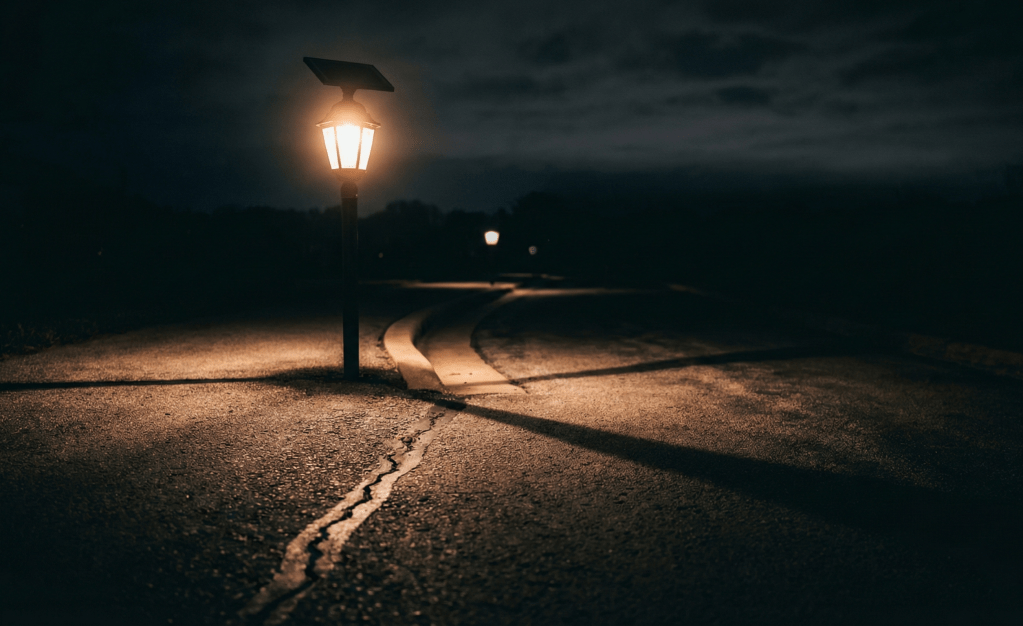
“Adequate average illuminance” is not a terrain safety plan. A 10mm curb edge in a dark gap between two solar fixtures doesn’t care about your average.
The Number That Changes Everything
People don’t trip over inches. They trip over fractions of an inch — and your lighting has to show those fractions.
For a long time, the rule of thumb in pedestrian safety was that a 25mm (1 inch) step or change in elevation was the critical trip hazard threshold. That number shaped how lighting was specced, how paths were designed, and what “good enough” looked like after dark.
RP-43-25 throws that number out.
Research cited in Section 8.6.1 — analyzing accident data and foot clearance studies — concluded that the actual critical height for a pedestrian trip hazard is 10mm. That’s 0.4 inches. Less than half a centimeter. The kind of height difference you’d barely notice in daylight, in good shoes, paying full attention. After dark, on a dimmed solar path, with your eyes adapted to mid-range light levels, that 10mm edge is a liability waiting for someone to find it.
The standard goes further. It notes that in the absence of pedestrian glare, 1 lux is sufficient for pedestrians of all ages to safely detect trip hazards under any light source. That sentence sounds reassuring until you read what’s in front of it: in the absence of pedestrian glare. Glare doesn’t just annoy. According to RP-43-25, it actively prevents the contrast detection that terrain safety depends on. A bright fixture in a dark environment can disable exactly the visual function the lighting was supposed to support.
What Solar Does to Terrain Detection
The battery doesn’t know there’s a pothole at the end of the path. It only knows how much charge is left.
Solar pedestrian lighting creates a specific set of terrain safety risks that grid-tied systems don’t face in the same way. They’re worth naming directly because they show up in proposals as features, not as problems.
Dimming reduces contrast, not just light level. When a solar fixture steps down to its operating floor — whether that’s 30%, 20%, or whatever the energy budget requires that night — it doesn’t just reduce average illuminance. It reduces the shadow depth and brightness contrast that allows pedestrians to see a curb edge, a manhole cover, or a pothole. RP-43-25 Section 8.6.1 is explicit that terrain hazard detection depends on contrast and shadow, not just on raw light level. A flat, uniform, low-output scene can hit 1 lux and still fail a pedestrian who needs to see a 10mm step edge.
Fixture spacing creates detection gaps. Solar pole counts get trimmed to control cost. Wider spacing is the result. Between fixtures, the illuminance drops — sometimes significantly. That gap is exactly where terrain uniformity breaks down, and it’s exactly where a pedestrian’s adapted eyes are least prepared to catch a small hazard. Eye tracking research cited in RP-43-25 tells us pedestrians scan for terrain hazards about 3 to 4 meters ahead. If that 3-meter window ahead of them falls in a dark gap between fixtures, the scan doesn’t help.
Glare from the fixture itself kills contrast at the hazard. A solar fixture running at full output in an otherwise dark environment can introduce enough high-angle luminance to cause adaptation issues for the pedestrian looking down the path. The pavement appears relatively darker against the bright source. That’s not dramatic language — that’s the disability glare mechanism described in RP-43-25 Section 3.1 and repeated in Section 8.6.1. The fix is controlled optics, not more lumens.
The Stair Problem Nobody Puts in the Spec
A stair is not just a terrain change. It’s a terrain change happening in three dimensions, in low light, with a pedestrian in motion.
RP-43-25 gives stairs their own treatment within Section 8.6.1, and the standard makes a point that most solar proposals ignore entirely: tread and riser contrast is not solely a lighting problem. Material color, surface reflectance, and the consistency of shadow on each step all contribute to whether a staircase is safely navigable after dark.
The standard recommends designing for consistent, repetitive shadows that help reveal tread geometry. It also cautions that complete uniformity on stairs — where every tread and riser is the same brightness — can actually eliminate the contrast cues a pedestrian needs to judge depth and height.
For solar, this creates a real design obligation. A path fixture mounted for horizontal illuminance at mid-path does not necessarily illuminate a staircase descending to one side at the geometry that creates safe tread contrast. A stair needs its own photometric treatment — its own aim, its own fixture, or at minimum its own calculation check — not just spill from a nearby pole.
If the proposal doesn’t mention stairs specifically, the stairs weren’t designed. They were hoped for.
The Elderly Pedestrian Problem
40% of Americans over 65 fall at least once a year. Half of those falls happen outdoors. This is the population walking your path at dusk.
RP-43-25 Section 8.6 is direct about this: terrain trip-and-fall accidents are more frequent among the elderly due to reduced peripheral vision and slower balance recovery. The standard notes that elderly pedestrians may deliberately choose a longer, less direct route to avoid terrain they’re uncertain about — which tells you something important about what dim, glarey, or non-uniform lighting actually costs people.
This matters for solar specifications because the “acceptable” operating floor in many proposals was calculated against a generic user in ideal conditions. The standard asks you to consider who is actually on the path. A system that delivers adequate contrast for a 30-year-old with full peripheral vision may leave a 70-year-old reading the terrain by guesswork.
The curb visibility research cited in RP-43-25 Section 8.6.1 found that visual performance for curb and walkway detection plateaued at 2 lux — meaning performance improved up to that level, and additional light above 2 lux added little benefit. That’s a useful design anchor. It also means a solar fixture dimmed to 0.5 lux in a battery-protection event is not just suboptimal. It is operating below the threshold where terrain detection works.
What to Require in a Specification (Especially for Solar)
If your proposal doesn’t distinguish between the illuminated path and the gaps between fixtures, it wasn’t designed for terrain safety. It was designed for a photometric average.
Keep it enforceable:
- Illuminance target referenced to RP-43-25 Annex A lighting zone table — not a generic footcandle number pulled from a product brochure
- Minimum point illuminance confirmed across the full path, including between fixtures — not average only
- Uniformity ratio (Avg/Min) demonstrated at the dimming floor, not at full output
- Stair and grade change locations identified separately with their own photometric treatment
- Glare control documented: optic BUG rating or equivalent, with high-angle emission limits stated
- Material and reflectance assumptions declared in the calculation (what surface was assumed, what reflectance value was used)
- Battery protection behavior stated: what illuminance level does the path reach under low state-of-charge conditions, and is it above the 2 lux detection floor for curb visibility?
Three Questions That Expose Terrain Safety Gaps
These questions are polite. The answers are not always comfortable.
What is the minimum point illuminance between fixtures at the dimming floor — and where is it on the plan?
How were stairs and elevation changes treated in the photometric model — and can you show me that calculation separately?
What does the path look like after two consecutive cloudy days, and is the minimum still above the terrain detection threshold?
If the answers are vague, the proposal was designed for the average. Not for the 70-year-old walking toward the stair at the end of the parking lot at 9 PM in January.
Closing Thought
A 10mm curb edge in a dark gap is not a design problem. It’s a liability. The lighting decides which one it is.
Sources and Where to Verify
- ANSI/IES RP-43-25 (2025), Section 8.6 (Pedestrian Hazard Safety — terrain hazards as a primary cause of non-vehicular pedestrian accidents; elderly vulnerability; frequency of outdoor falls)
- ANSI/IES RP-43-25 (2025), Section 8.6.1 (Terrain Hazards — 10mm critical trip hazard height; 3–4 meter pedestrian scan distance; 1 lux sufficiency threshold in the absence of glare; stair contrast and shadow requirements; curb detection plateau at 2 lux)
- ANSI/IES RP-43-25 (2025), Section 8.6.2 (Object Hazards — static and moving object detection requirements)
- ANSI/IES RP-43-25 (2025), Section 3.1 (Glare — disability glare mechanism and its effect on contrast detection)
- ANSI/IES RP-43-25 (2025), Section 3.3 (Adaptation — transition times, age-related adaptation differences, and the safety implications of moving from lit to dark zones)
- ANSI/IES RP-43-25 (2025), Annex A, Table A-3 (Illuminance recommendations for adjacent and nonadjacent walkways by lighting zone)
Piotr Mikus is a roadway lighting designer and specifier focused on solar powered street lighting and controls.
Quick FAQ
What is the actual critical height for a pedestrian trip hazard according to RP-43-25? 10mm (0.4 inches) — significantly lower than the previously assumed 25mm threshold, and much harder for lighting to reveal under low-contrast conditions.
Why does glare make terrain detection worse, not better? Because disability glare reduces the contrast the pedestrian’s eye needs to detect small changes in surface height. Brighter isn’t safer when the brightness is coming from the wrong place.
What’s the minimum illuminance for safe curb and walkway detection in solar pedestrian lighting? Research cited in RP-43-25 found that visual performance for curb detection plateaued at 2 lux — meaning below that threshold, detection degrades. A solar system in battery-protection mode may operate well below that level.
 Solar Lighting Night Shift