On the Lighter Side of the Sun | By Piotr Mikus
After Dark (Series): Browse the series: After Dark
Previous: Cylindrical Solar Poles: When the Marketing Meets the Math
(What to demand before you specify or accept a solar street light battery)
Documentation of the battery management logic used in the system: how state of charge is monitored, how charging is controlled relative to battery temperature, and whether the system can be adjusted remotely after commissioning
A temperature capacity derate applied to available battery capacity in the worst-month energy budget, not just to the panel output
Confirmation that the BMS low-temperature charge cutoff is enabled and set to the correct threshold, verified at commissioning
The battery in a solar street light is the only component with a hard expiry date. The panel degrades slowly. The LED wears gradually. The battery either holds charge or it does not, and when it does not, the light goes dark before morning and you get a call.
Most of the industry treats that call as a warranty problem. It is not. It is a battery management problem, and it starts the day the system is commissioned.
What the Spec Sheet Promises
That number is real. It just does not describe your installation.
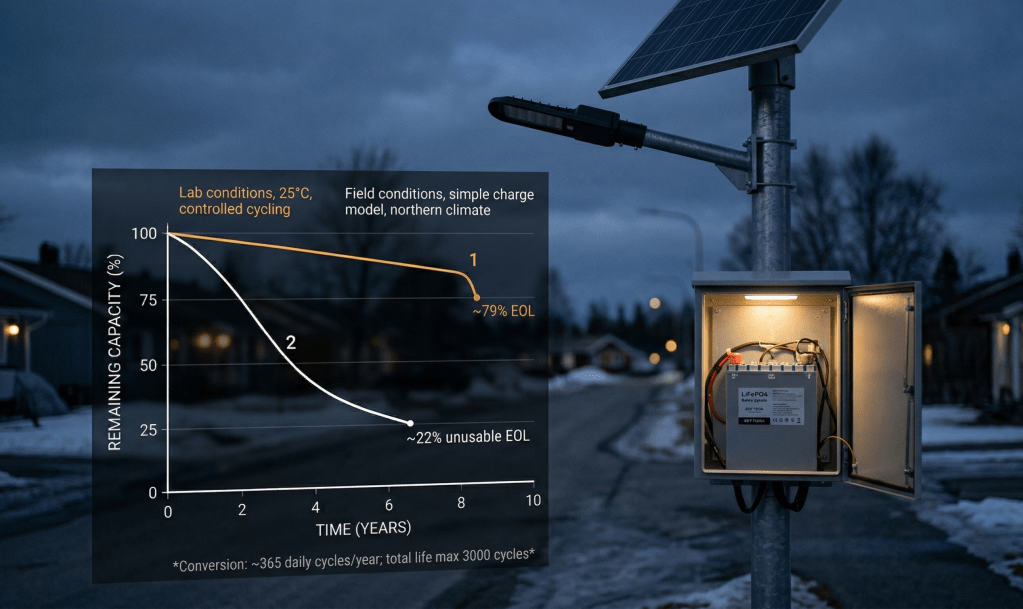
Every LiFePO4 battery ships with a cycle life, typically 2,000 to 3,000 cycles, measured at 25 degrees Celsius, at a controlled charge rate, with the battery cycled in a way that no solar street light in the field ever replicates.
The cycle life assumes the battery knows where it is in its charge window at all times, is never pushed into temperatures that damage it, and is never discharged deeper than the test protocol allows. In the field, most systems guarantee none of those things. They charge when the sun is up and discharge until the load cuts off. That is the whole model. And that model is what shortens battery life from a decade to four or five years, sometimes less.
What a Simple Charge Model Actually Does to a Battery
Fill it, empty it, fill it again. That is the whole logic. The battery disagrees.
Most solar street lights on the market today use a straightforward charge and discharge cycle. Sun comes up, the controller pushes current into the battery. Sun goes down, the battery powers the light until it hits the low-voltage cutoff. Repeat every day for years.
A LiFePO4 battery has a chemistry that responds differently depending on where it sits in its charge window, how fast current is being pushed into it, and what temperature it is at when that happens. A battery that regularly cycles between 95 percent and 10 percent state of charge degrades faster than one managed to stay between 80 and 20 percent. That is not a marginal difference. It is the difference between a battery that reaches its rated cycle life and one that loses usable capacity well before the warranty period ends. The simple model does not account for this. It just fills and empties.
Cold makes this worse. At minus 10 degrees Celsius, a LiFePO4 battery has roughly 70 to 75 percent of its rated capacity available. A battery sized for a full December night is running out of usable energy before the night ends, not because it failed, but because the sizing model assumed 25 degrees Celsius and the street does not.
The damage side is the charging. LiFePO4 cells cannot be safely charged below 0 degrees Celsius at normal charge rates. When the sun rises on a cold winter morning and the panels start generating before the ambient temperature has climbed above zero, the charge controller pushes current into the battery regardless. In a simple system, there is nothing stopping it. The BMS may have a low-temperature charge cutoff in the configuration menu, but in many installations it was never enabled. Nobody turned it on at commissioning. Nobody checked it before the first winter. The battery absorbs those cold charge cycles silently, and the capacity loss that results looks like normal aging until the system starts running short on December nights in year two or three.
Why the Cheaper Product Looks So Attractive (And Why That Math Falls Apart Quickly)
A lower price is very visible on a proposal. What is not visible is the thinner wallet that comes with replacing batteries that were never going to last.
The reason simple charge models are so widespread is straightforward: building proper battery management into a solar street light costs money. The algorithm, the firmware, the sensors, the remote connectivity, the engineering time to develop and validate it against real field conditions, none of that is free. A manufacturer that skips all of it can offer a lower price, and on a line-item comparison that lower price wins bids.
The pricing logic most buyers apply is linear: a system priced 20 percent lower will deliver roughly 20 percent less. That would be acceptable. The real relationship is not linear. A battery cycled without state of charge management, without temperature-aware charging, without any way to adjust behavior after commissioning, does not deliver 80 percent of the life of a well-managed battery. It may deliver 40 or 50 percent, and in a harsh northern winter where cold morning charging goes uncontrolled, the degradation can be severe enough that the system is visibly underperforming within two or three years of installation.
This is not a theoretical risk. It is the reason solar street lighting spent years earning a reputation as a temporary solution, something you installed where grid power was impractical and accepted that it would need attention, replacement, or apology within a few years. That reputation was not built on bad panels or weak LEDs. It was built on batteries that died early because nobody in the product development process invested in keeping them healthy.
The price gap between a system with serious battery management and one without does not represent 20 percent less performance. It represents the cost of the technology that keeps the battery alive long enough to deliver the lifecycle the spec sheet promised. When that technology is absent, the battery does not gradually underperform. It degrades in ways that accelerate over time, and by the point the failure is obvious enough to see from the street, the damage has been building for years.
What Proper Battery Management Looks Like
Not magic. Not exotic. Just logic that was actually built in.
A system built around actual battery management does not just fill and empty. It monitors state of charge continuously and keeps the battery within a defined operating window that maximizes cycle life. It adjusts charge current based on battery temperature, reducing or stopping charge when the cell is too cold rather than pushing current regardless of conditions. It tracks the battery over its lifetime and can be adjusted remotely when conditions change or when the battery’s real-world behavior diverges from the original sizing assumptions.
None of this requires exotic technology. The intelligence is in the algorithm and the control logic, not the hardware. But it requires that someone built that logic into the system intentionally, tested it against real field conditions, and provided a way to verify it is working after the system is in the ground.
A simple charge-and-discharge controller cannot do this. It does not know the battery’s state of charge precisely enough to manage the window. It does not adjust for temperature. It cannot be updated or corrected remotely. Once it is in the pole, what you specified is what you get for the life of the installation, and the battery ages accordingly.
What to Require Before You Specify
If the answers to these questions are vague, the system uses a simple charge model and the battery will age accordingly.
- How does the system monitor battery state of charge, and what range does it maintain during normal operation?
- How does the charge controller respond when battery temperature drops below 0 degrees Celsius?
- Can the battery management parameters be adjusted remotely after commissioning, and what does that process look like?
- What does the worst-month energy budget show for available battery capacity after applying a temperature derate at the actual expected overnight temperatures for the project location?
Three Questions Worth Asking
How does your system determine state of charge, and what charge window does it maintain to maximize battery cycle life? If the answer describes a voltage-based cutoff with no active window management, that is a simple charge model.
What happens when the battery temperature drops below 0 degrees Celsius during early morning charging? If the answer does not reference a specific cutoff threshold confirmed active at commissioning, ask for the BMS configuration documentation.
Can the battery management settings be adjusted remotely after the system is installed? The answer tells you whether the system can respond to real-world conditions or whether it is locked into what was programmed at the factory.
Closing Thought
The battery warranty period printed on the spec sheet describes a battery managed the way the manufacturer tested it, at 25 degrees Celsius, within a controlled charge window, with clean cycles. The battery in the pole is charged and discharged by whatever logic the manufacturer built into the controller, in whatever temperature the street provides, with whatever settings were or were not configured at commissioning.
The gap between those two things is where battery life goes.
Piotr Mikus, MIES, is a roadway lighting designer and solar lighting specifier. He writes about solar street and area lighting standards, system sizing, and real-world performance at solarlightingnightshift.com.
Also in After Dark: Cylindrical Solar Poles: When the Marketing Meets the Math | The Sun Does Not Follow Your Pathway | Solar Street Light Dimming: One Pole Is Dim, the Next Is Fine
Standards Referenced
- UL 1973: Standard for Batteries for Use in Stationary, Vehicle Auxiliary Power and Light Electric Rail Applications
- IEC 62619: Safety Requirements for Secondary Lithium Cells and Batteries for Use in Industrial Applications
Quick FAQ
Q: Does reduced capacity in cold temperatures permanently damage the battery? A: No. Capacity reduction from cold discharge is reversible, the battery warms up and capacity returns. The permanent damage comes from charging below 0 degrees Celsius, not from discharging in the cold. Those are two different problems and only one is recoverable.
Q: If the system has a BMS, is the battery not already protected? A: A BMS provides protection against hard failure: overvoltage, undervoltage, overcurrent, short circuit. It does not manage battery health over time. State of charge window management, temperature-aware charging, and long-term cycle optimization are charge controller and algorithm functions, not BMS functions. Having a BMS does not mean the system manages the battery well.
Q: How much does state of charge window management actually matter for cycle life? A: Significantly. The difference between cycling a LiFePO4 battery between 100 and 0 percent versus keeping it within a managed window can represent thousands of additional cycles over the battery’s life. The spec sheet cycle life assumes the battery is managed correctly. A simple fill-and-empty model does not manage it correctly.
 Solar Lighting Night Shift