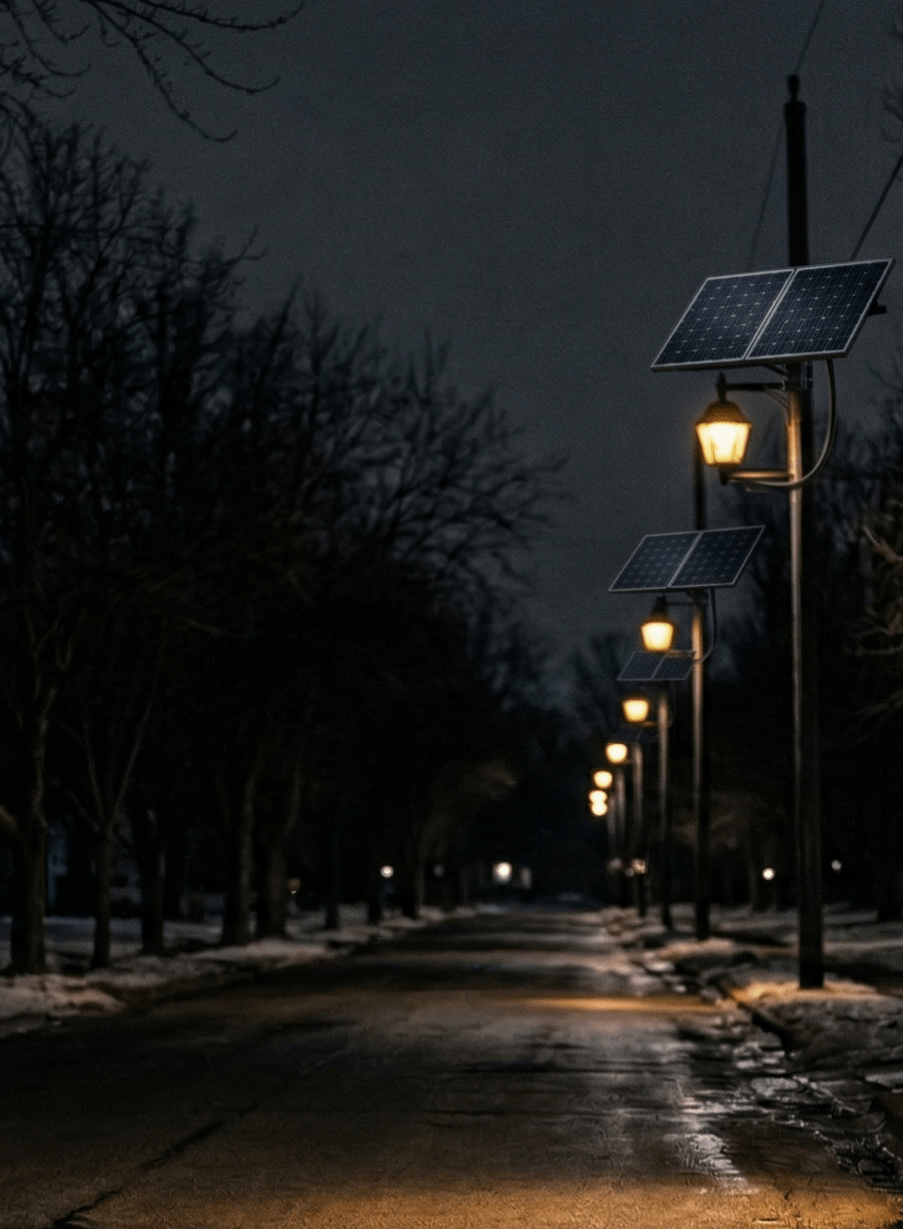
On the Lighter Side of the Sun
By Piotr Mikus
RP-8-25, Solar Edition (Series):
Browse the series: RP-8-25, Solar Edition
Previous: Roadway Classification Is Not a Formality
(What to demand in a residential solar street lighting proposal before you sign anything:)
- Street classification and pedestrian activity level stated in writing, referenced to the jurisdiction’s functional classification records, with the Table 11-1 criteria row identified for each segment.
- Photometric calculations at full output and at the lowest programmed operating level, both compared against Table 11-1 illuminance and uniformity criteria.
- Energy budget modeled for the coldest month with low-temperature battery derate applied, showing criteria compliance under reduced capacity.
- Dimming floor stated as a maintained illuminance value in footcandles from Table 11-1, not as a percentage of full output.
- Year-three battery performance modeled at 80 percent of rated capacity, with criteria compliance confirmed at that degraded state.
Low criteria and a small budget. That sounds like the easy solar job. It is not.
Residential and local streets carry the lowest maintained illuminance targets in RP-8-25 Table 11-1. That makes them look like the forgiving application. In practice, the lowest classification is the least tolerant of anything that goes wrong. A system operating at the bottom of Table 11-1 has almost no margin for cold weather, cloudy day sequences, or a dimming profile that was never tied to any criteria.
What RP-8-25 Is Actually Saying (or Trying to Protect)
The criteria are low because the visual task is low. Not because the standard is being lenient.
RP-8-25 classifies roadways by function and sets maintained illuminance targets accordingly. Table 11-1 defines those targets for each combination of classification and pedestrian activity level. For a local or residential street with low pedestrian activity, the average maintained horizontal illuminance sits at the bottom of the table, with a uniformity ratio of 4:1 Eavg/Emin.
Those numbers reflect a real visual task. A driver on a quiet residential street moves slowly through low-conflict, low-density conditions. The standard calibrated the criteria to that task. What it did not build in is a buffer for the energy constraints of a solar system.
At the lowest criteria level in Table 11-1, every tenth of a footcandle matters. A collector street absorbs a dimming step and still clears the floor. A residential street at the bottom of the table does not.
The Solar-Specific Reality Nobody Puts in the Headline
Small numbers, small margins. The residential street is the first to fall short and the last one anyone checks.
LiFePO4 batteries derate in cold weather. At minus 10 degrees Celsius, available capacity drops to roughly 70 to 75 percent of rated value. A system sized to deliver the Table 11-1 residential criteria at full battery output in October is not delivering those criteria after three overcast days in January at 75 percent capacity. A criteria with no margin to begin with now has less than none.
RP-8-25 Section 6.10.2.2.2 establishes a dimming floor for solar-powered luminaires on collector and major streets, requiring that the system not dim below the lowest applicable Table 11-1 criteria row. That protection is written for collector and major streets. Residential and local streets are not covered by the same explicit language. The dimming floor on a residential solar installation is wherever the controller vendor set it before the unit shipped. No one derived it from Table 11-1. No one verified what 50 percent output looks like at the installed pole spacing.
Uniformity compounds the problem. When output drops, minimums fall faster than averages. The system fails the 4:1 Eavg/Emin requirement before it fails the average target. A residential solar system is out of compliance at 11 p.m. while the average illuminance still looks acceptable on paper.
Where the Disconnect Usually Lives
The full-output photometric report passed. Nobody checked 2 a.m. in February.
The disconnect starts in the photometric submission. A residential solar proposal shows full-output calculations that meet Table 11-1. The dimming schedule sits in a separate section, expressed as time-based percentage steps. No one connects those two documents. There is no calculation at the dimmed level, and no verification that the 4:1 uniformity ratio holds at 60 percent output before sunrise.
The second failure is in the energy budget. Residential systems are often specified at the bottom of the product lineup because the criteria look easy to meet. That assumption ignores winter derate, cloudy day sequences, and three years of battery degradation. A system sized to just clear the Table 11-1 floor under ideal conditions will not clear it under real ones, and the already-low criteria leave nothing to absorb the shortfall.
What to Require in a Specification (especially for solar)
The specification is where the margin gets built in. Or does not.
- Require the Table 11-1 criteria row to be identified for each segment, with the illuminance target and uniformity ratio stated as the compliance threshold throughout the submission.
- Require photometric calculations at the lowest programmed operating level, showing average illuminance and Eavg/Emin on the same grid as the full-output submission.
- Require the dimming floor stated as a maintained illuminance value from Table 11-1, verified in a photometric calculation at the installed geometry.
- Require the energy budget to apply cold-weather battery derate for the coldest month, with criteria compliance confirmed at the derated capacity.
- Require year-three performance modeled at 80 percent of rated battery capacity, with the Table 11-1 floor still met at that state.
- Require the controller’s step-down logic documented, with each step stated in lumens or footcandles against the applicable criteria row.
Three Questions That Expose the Margin Problem
What does the photometric grid look like at the lowest programmed output level, including the Eavg/Emin uniformity ratio?
A vendor who cannot produce this has not verified compliance at the condition that defines most of the night. Full-output results tell you what the system does under ideal conditions. Dimmed-level results tell you what it does at 2 a.m. in February. On a residential street with no margin to spare, that is the gap where the system goes dark.
How was the dimming floor set, and what is it in footcandles at the installed pole spacing?
If the answer is a percentage of full output, no criteria was referenced. The correct answer names a maintained illuminance value, references the applicable Table 11-1 row, and confirms the minimum step delivers the required floor at the most distant point between poles. Most vendors will not have this answer ready.
What does the energy budget show when battery capacity is modeled at 75 to 80 percent of rated?
A battery at 80 percent capacity is not a failure scenario. It is year three on a residential system where cost pressure is highest and margins are thinnest. If the vendor has not modeled it, the street drops below criteria before the end of the useful life, and no one in the specification process saw it coming.
Closing Thought
The lowest criteria are not the easiest target. They are the one with the least room for anything to go wrong.
Residential and local streets are where most people live and walk every evening. The criteria exist to match the visual task on those streets. A full-output submission that passes in October tells you nothing about a January night with a three-year-old battery and three overcast days behind it.
Sources and Where to Verify
ANSI/IES RP-8-25, Roadway and Area Lighting: Table 11-1 defines maintained illuminance criteria and uniformity ratios by roadway classification and pedestrian activity level, including the lowest rows applicable to local and residential streets. Section 11.3.1 establishes the relationship between lighting classification and jurisdictional functional classification. Section 11.3.2 defines pedestrian activity levels and the default assumption when count data is unavailable. Section 6.10.2.2.2 establishes the criteria-based dimming floor for solar luminaires on collector and major streets.
Quick FAQ
Q: Why does the lowest RP-8-25 classification create the tightest constraint for solar?
A: Low criteria mean low tolerance for any shortfall. A collector street with a higher target has room to absorb a dimming step or cold-weather derate and still clear the floor. A residential street at the bottom of Table 11-1 does not. The same battery shortfall that is invisible on a collector street pushes a residential system below criteria.
Q: Does RP-8-25 Section 6.10.2.2.2 protect residential streets from solar dimming?
A: Section 6.10.2.2.2 is written for collector and major streets. Residential and local streets are not covered by the same explicit dimming floor language. A residential solar system can dim to whatever the controller firmware allows unless the specification requires otherwise.
Q: How quickly does the uniformity ratio fail compared to average illuminance as a solar system dims?
A: Faster. Minimums occur at the most distant points from the luminaire where levels are already lowest. A system meeting 4:1 Eavg/Emin at full output can fail that ratio before the average illuminance drops below its target. Uniformity goes first. The average looks fine until it does not.
Piotr Mikus, MIES, is a roadway lighting designer and solar lighting specifier. He writes about solar street and area lighting standards, system sizing, and real-world performance at solarlightingnightshift.com.
Also in RP-8-25, Solar Edition: Roadway Classification Is Not a Formality | Battery Budgets, Bad Optics: Why Solar Roadway Lights Get Called Harsh | Adaptive Dimming and RP-8-25
 Solar Lighting Night Shift