| After Dark | Solar Lighting Night Shift | By Piotr Mikus
Browse the series: After Dark
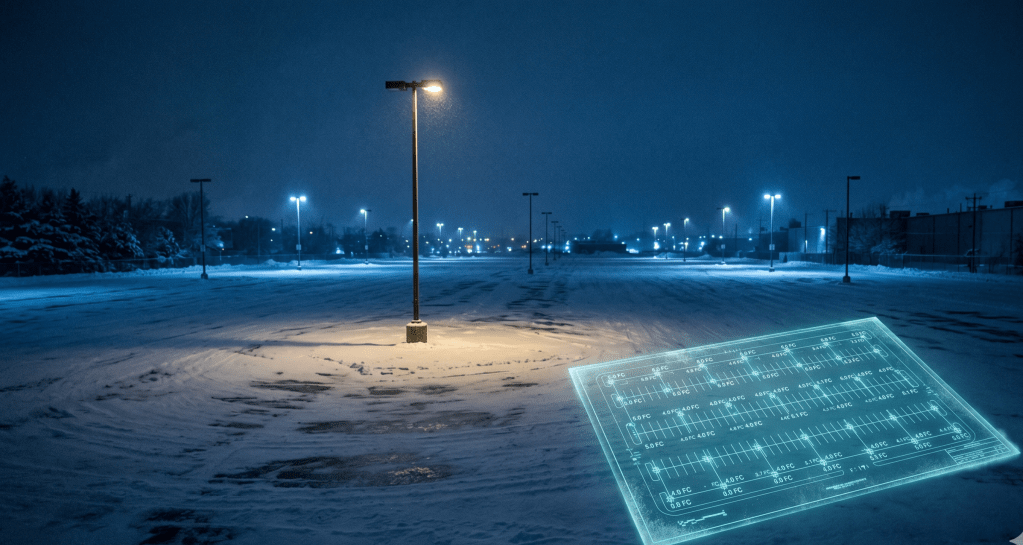
The stamp on the drawing says approved. The parking lot says otherwise.
Let me be direct with you about something the solar lighting industry would prefer you never notice. The people reviewing solar lighting submittals, stamping the drawings, accepting the photometric plans, and signing off on commissioning were trained on a technology that connects to the grid. The criteria are clear, the load is fixed, and the performance does not change between Tuesday and Saturday based on how many clouds passed over the site last week.
Solar is not that. Solar is an energy system masquerading as a lighting fixture, and the submittal review process has not caught up.
This is not an attack on engineers. It is an honest description of a gap the industry created by selling solar lighting as a product swap instead of what it actually is. Nobody taught the review process how to read a solar energy budget. Nobody taught the specifier what questions expose a fabricated runtime claim. And the vendor, who absolutely knows the difference, is not volunteering the lesson.
The submittal looks familiar. That is the problem.
A solar lighting submittal arrives and it looks exactly like every other lighting submittal. Cut sheet. Photometric plan. BUG rating. Pole schedule. Lumen output. Maybe a warranty card. The reviewer checks the boxes that have always needed checking. The footcandle averages look compliant. The uniformity ratios pass. The fixture is UL listed. Approved.
Here is what a real project submittal looked like recently. A large site. Over eighty poles. A mix of single and dual-head all-in-one solar fixtures, rated at 120 watts, specified for a 14-hour runtime. The photometric plan showed compliant footcandle levels across every calculation zone. The submittal was complete by every standard measure.
What it did not show was a single number about energy. No harvest calculation. No battery sizing verification. No runtime curve. No documentation of what happens at hour eight on a January night. The submittal answered every question the review template asked. It answered none of the questions that actually matter for a solar system.
That is not an unusual submittal. That is a typical one.
The photometric plan is a photograph of one perfect moment that will never exist again.
Here is what the photometric plan on that project actually represented. It showed the output of a 120-watt fixture aimed perfectly downward, fully charged, in software with no weather, no battery state, no temperature, and no time of night. It was a static calculation of a dynamic system frozen at its theoretical best.
The plan passed review because the footcandles looked right. What it could not show was what those same poles deliver at hour six of a January night in a northern climate, with the battery at 60 percent of rated capacity because it is minus 15 outside and LiFePO4 does not perform at rated spec in the cold. It could not show the dimming floor engaging at midnight because the controller decided the battery needed protection. It could not show the gap between what was calculated and what is actually hitting the ground at 3 a.m.
Now here is the part nobody talked about at the review meeting. That 120-watt fixture was rated for 22,200 lumens at full output. The specification also noted it dims to 30 percent under its adaptive control profile. At 30 percent, the fixture is operating at 37 watts. The photometric plan was calculated at full output. The system operates at 37 watts for most of the night. Nobody checked whether 37 watts at that pole spacing and mounting height actually delivers the footcandle levels shown on the plan. It does not. The numbers were modeled at full power and accepted at face value. The dimming floor was not a lighting design decision. It was a battery survival decision made at the factory, and it showed up on the approved drawing as a compliance checkmark.
The panel faces wherever the pole faces. No document will ever show you that.
This is the part of a solar submittal that does not exist in any template, any cut sheet, or any photometric plan, and it is the part that determines whether the system actually harvests enough energy to do its job.
In an all-in-one solar fixture, the solar panel and the LED are a single rigid assembly. The panel faces wherever the fixture faces. On that eighty-pole project, the poles were placed to serve the photometric layout. Fixtures along different drive aisles faced east, west, north, and every azimuth in between. Each one harvested a different amount of solar energy every single day. A 30-degree deviation from true south costs roughly 13 percent of daily harvest. At 45 degrees the loss is around 30 percent. At 60 degrees you lose half. A panel running parallel to a north-south drive aisle is operating near the worst end of that range for most of the charging day.
The consequence is not just reduced energy. It is inconsistent energy across every pole on the project. Each fixture reaches its battery protection threshold at a different time of night. One dims at midnight. The next stays bright until 2 a.m. The one after that cuts out by 11 p.m. The result is not a uniformly lit site. It is a patchwork of bright spots and dark gaps that shifts night to night depending on recent weather.
No submittal document addresses this. The IES file used for the photometric calculation assumes one fixture, fully charged, perfectly aimed, on the best night of the year. The pole-by-pole azimuth reality of a real parking lot layout is invisible to the review process from start to finish. The engineer stamps a drawing that describes a system that does not exist in the field. Not because the engineer was careless. Because the submittal was never required to show it.
The energy math that nobody ran.
The battery specification on that 120-watt system was a 36 Ah, 25.6-volt LiFePO4 pack. Nominal capacity 921.6 watt-hours. Usable at 80 percent depth of discharge, approximately 737 watt-hours.
Running a 120-watt LED for 14 hours requires 1,680 watt-hours. That is more than double what the battery can deliver in a single night before any system losses are applied. Even the upgraded 48 Ah variant falls well short.
The harvest side is no better. A south-facing panel at 3.5 peak sun hours generates roughly 595 watt-hours in winter. A panel facing 60 degrees off south, which is exactly what happens on a north-south drive aisle, generates approximately 300 watt-hours. The nightly deficit at full rated power is at minimum 945 watt-hours. The system cannot do what the spec sheet says it can do. The submittal said nothing about any of this. The review process had no mechanism to catch it. The stamp went on the drawing.
The manufacturer’s fine print qualifies the 14-hour runtime claim with “alternate working modes.” That is the specification acknowledging that the fixture cannot run at 120 watts for 14 hours. In practice the system survives the night by dimming aggressively. The 22,200 lumen output is a peak rating at full power, not a sustained operating condition. For a project where the photometric design was built around a target footcandle level, the difference between peak and sustained output is not a footnote. It is the entire basis of whether the design works.
“Remote monitoring” is a beautiful phrase. Ask what it actually monitors.
The proposal said the system includes remote monitoring and app-based controls. The engineer read this as a performance assurance feature. It is not.
On most budget solar systems, remote monitoring means you can see whether the fixture is on or off. Sometimes you get a battery percentage, estimated by the controller from a voltage curve that drifts with temperature and age. Sometimes you can adjust the dimming schedule remotely, assuming the app works, the firmware is current, and you can reach someone who knows the system on the other side of the world.
What remote monitoring almost never tells you is whether the system is meeting the lighting criteria it was specified to maintain. It tells you the light is on. It does not tell you the light is on at 28 percent output, delivering half the footcandles the photometric plan showed, because the battery was undersized for the actual winter load and the controller is compensating silently every night.
A system that dims itself into non-compliance and reports “operational” is not a monitoring feature. It is a liability dressed up as a dashboard. And when the client calls to say the parking lot is dark at midnight, the dashboard will tell you everything is fine.
The document that does not exist is the only one that matters.
Every solar lighting system runs on an energy budget. Energy in from the panel, energy stored in the battery, energy out to the LED across the night. In a properly engineered system that budget is calculated for the worst month at the project location, derated for temperature, soiling, wiring losses, battery round-trip efficiency, driver efficiency, and crucially, the actual panel azimuth at each pole location.
That last item, pole-by-pole azimuth, never appears in a submittal. Ever. A single project-wide energy number assumes all panels harvest equally. In any real parking lot layout they do not. The variance between a south-facing pole and a north-facing pole on the same project can be 50 percent or more. That variance does not appear on the cut sheet, the photometric plan, the BUG rating table, or the warranty card. It appears at 1 a.m. in January when half the poles dim two hours earlier than the other half and nobody can explain why the lot looks like a checkerboard.
The energy budget document should be part of every solar lighting submittal. It almost never is. Because if it were, the gap between rated performance and real performance would be visible to everyone in the room before the stamp goes on the drawing.
The stamp is not the problem. The gap is.
Engineers are not failing because they are careless. They are working with a review process built for a different technology, evaluating submittals designed to look complete without being complete, approving systems the vendor already knows will underperform in winter.
The fix is not to blame the engineer. The fix is to change what the submittal is required to contain. Write the energy budget requirement into the specification. Require the worst-month runtime calculation as a submittal deliverable. Require pole-by-pole azimuth documentation and a harvest penalty table. Tie the dimming floor to a documented criteria value. Make the information that exposes the gap a mandatory part of the package.
Three questions worth putting to any vendor before the submittal is accepted. What is the panel azimuth at each pole location in this layout, and what is the harvest penalty at each one relative to true south? What is the pole-by-pole energy budget across this project using actual winter peak sun hours and actual panel orientation? Can you provide a battery state-of-charge curve across a full winter night at the project latitude showing the system stays above its protection threshold until the end of the operating window?
If those questions cannot be answered with documented numbers, the proposal is built on bench geometry and best-case assumptions. Not on what will actually be installed and operating on this site.
The vendor will not volunteer it. The submittal template will not prompt for it. The review process will not catch its absence unless someone in the room knows what to look for.
That is the gap. It lives between the approved drawing and the dark parking lot at 2 a.m. in January. And it will keep living there until the people reviewing these submittals know what questions to ask.
Views are the author’s own and do not represent any employer or affiliated organization. See site Disclaimer.
Piotr Mikus, MIES, is a roadway lighting designer and solar lighting specifier. He teaches solar lighting submittal review as part of continuing education for licensed engineers. He writes about solar street and area lighting standards, system sizing, and real-world performance at solarlightingnightshift.com.

