On the Lighter Side of the Sun By Piotr Mikus
Solar Technology Series: Browse the series: Off-Road Tech
Solar lighting has always been a three-legged stool. How much energy the panel can harvest. How much usable energy the battery can store. How carefully the controller spends it. Kick any one of those legs and the whole thing falls over. Right now, all three are being quietly rebuilt.
This is not about a new shape. Not a revolutionary product launch. Not a cylindrical pole wrapped in marketing language and physics violations. The change is inside the energy package, and it is real enough that a specification written today around current hardware may be underselling what the same pole and housing can do by 2028.
Here is what is actually moving and what it means for a real light on a real project.
The current package is good. It is also mature.
Most serious solar street and area lights today run on Lithium Iron Phosphate batteries, monocrystalline silicon panels, MPPT charging, and programmed dimming. That architecture earned its place. It is stable, available, serviceable, and well understood.
It is also approaching the ceiling of what it can deliver within a fixed physical envelope. When the panel footprint and battery enclosure stay in the same class, there is only so much load the system can carry. That is not a criticism. That is physics. And it is exactly why the next round of improvements matters, because they are not about changing the whole fixture. They are about getting more out of the same package.
The battery is getting better in a way that actually helps solar lighting
Lithium Iron Phosphate became the standard for a reason. Safe. Durable. Suited to outdoor infrastructure. Nobody serious is arguing against it.
Lithium Manganese Iron Phosphate is the next step in the same family. It raises the operating voltage and improves energy density while keeping the stable phosphate chemistry that made LFP popular in the first place. Recent technical work puts the energy density gain at roughly 10 to 20 percent over LFP, with some reviews describing a theoretical improvement near 21 percent.
For solar lighting that translates directly. More battery in the same box. Or the same battery in a smaller box. In a small standalone solar system where every cubic centimetre of housing is spoken for, that room matters enormously.
Sodium-ion is the chemistry that is harder to ignore with every passing quarter. Sodium is abundant. The supply chain looks nothing like lithium. And the cold weather behaviour may reduce the charging penalty that quietly bleeds northern installations every winter morning before a single useful watt goes into the load. In 2026, Reuters reported a major 60 GWh sodium-ion energy storage supply agreement. That is not a lab announcement. That is manufacturing scale.
Sodium-ion is not automatically better than Lithium Iron Phosphate everywhere. What it may be is better where cold recovery matters, and that is a real problem in a real category of installations that has never had a clean solution.
The panel is getting more efficient without getting bigger
When panel area is fixed, efficiency is oxygen. You cannot negotiate with the roof of a luminaire housing.
Current monocrystalline silicon panels are already performing well. The next step is perovskite-silicon tandem architecture, which stacks two absorber layers instead of one. The perovskite layer captures one portion of the spectrum. The silicon layer captures another. More of the same panel area becomes useful charging energy without the panel growing at all.
Commercial-size tandem cells have already reached 28.6 percent efficiency in independently verified testing. Long-term outdoor durability and manufacturing scale still decide when this becomes normal in solar lighting products, but the efficiency trajectory is not theoretical anymore. It is in production.
For a fixed panel footprint on a fixed pole, higher efficiency creates three choices: support more load, use a smaller panel, or carry more reserve into the night. Any one of those is a meaningful improvement on a system that is already pushing its limits.
Here is what the package shift looks like on a real example
The 40 Watt load in the table below is an illustration, not a prescription. The point is the direction of change across the energy package.
| Generation | Battery Technology | Solar Technology | Same 40W Example Load | Same Hardware Could Support |
|---|---|---|---|---|
| Available now | Lithium Iron Phosphate | Monocrystalline Silicon, about 20-22% module efficiency | Baseline battery and panel class | About 40 Watts |
| Near term | Lithium Manganese Iron Phosphate or improved lithium phosphate | Higher-efficiency monocrystalline silicon, about 22-24% module efficiency | Smaller battery, smaller panel, or more reserve may be possible | About 50 Watts |
| 2027-2028 | Sodium-Ion or advanced Lithium Manganese Iron Phosphate | Higher-efficiency silicon or tandem PV, roughly 24-27% module-class target | Smaller hardware, better reserve, or stronger recovery may be possible | About 60 Watts |
The left side tells you what the hardware burden looks like as the package improves. The right side tells you what becomes possible if the hardware stays the same. Neither column is a guarantee. Both columns are where the technology is heading, and heading on a timeline that overlaps with infrastructure contracts being written right now.
The controller is what turns hardware gains into real performance
MPPT charging is already expected in any serious solar lighting specification. The next step is smarter battery management, better low-temperature protection, and more adaptive dimming logic.
The controller does not create energy. It decides how much energy gets wasted. That distinction becomes more important as the battery and panel improve, because a better chemistry and a higher efficiency panel still need a control system that can manage charging precisely, protect the cells at temperature extremes, and spend the load budget intelligently through a long winter night.
The future package is not only better chemistry and better PV. It is better coordination between all three.
What is still earning its place
Lithium Manganese Iron Phosphate is the nearest-term improvement because it builds directly on the Lithium Iron Phosphate supply chain. Sodium-ion is promising but solar lighting products need field history before it belongs in every specification. Tandem PV is moving quickly but outdoor durability, warranty confidence, module cost, and broad availability still decide adoption.
A technology can be real and commercially available and still not be right for every pole on every project. That distinction matters when you are writing a specification that has to be defensible in the field three years from now.
What to ask for instead of what to believe
Do not specify buzzwords. Specify performance.
For next-generation solar lighting, ask for:
- Battery chemistry stated by name
- Nominal and usable battery capacity
- Solar panel wattage and module efficiency
- Controller type and MPPT efficiency
- Operating profile with dimming schedule
- Temperature assumptions used in the energy budget
- Warranty terms on battery, panel, and controller separately
- Replaceable battery and controller design confirmed
- Proof that the package supports the claimed output at the specified location and season
The technology is moving quickly. The specification should move carefully.
Closing Thought
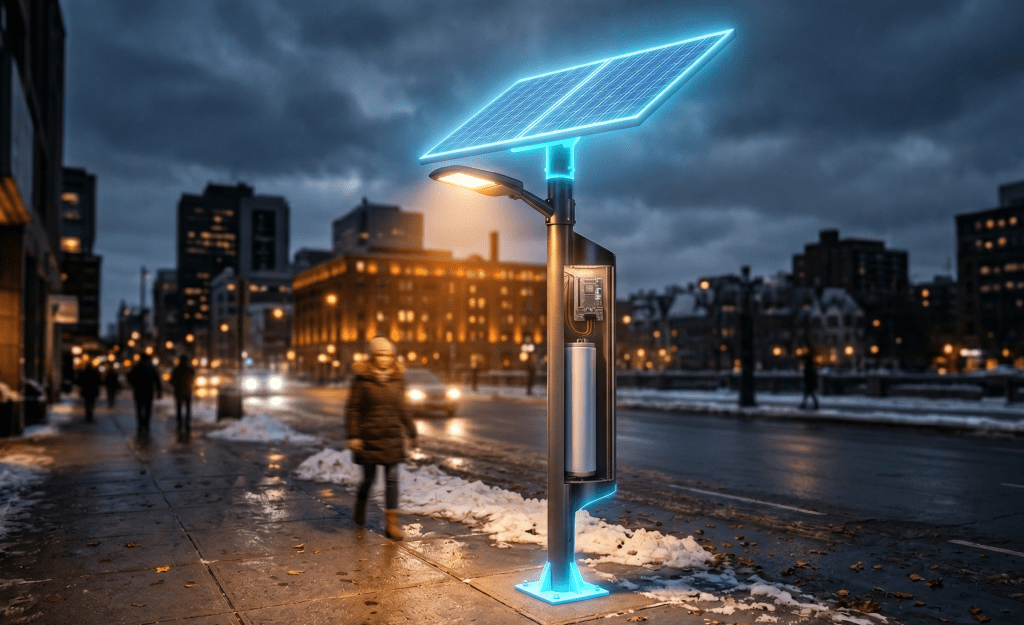
The next solar street light may look identical from the outside. The battery will be denser. The panel will be more efficient. The controller will be smarter. None of those things show up in the render. All of them show up in January.
Sources and Where to Verify
- Lithium Manganese Iron Phosphate energy density: technical reviews report roughly 10 to 20 percent higher energy density than Lithium Iron Phosphate, with one review describing a theoretical gain near 21 percent
- Sodium-ion commercialization: Reuters, major 60 GWh sodium-ion energy storage supply agreement reported in 2026
- Perovskite-silicon tandem efficiency: commercial-size cells reaching 28.6 percent in independently verified testing; outdoor durability and manufacturing scale remain the adoption gatekeepers
Piotr Mikus is a roadway lighting designer and specifier focused on solar powered street lighting and controls.
Quick FAQ
Is this post about a 40 Watt light? No. The 40 Watt load is a table example. The post is about how new battery, panel, and control technologies may change what the same solar lighting package can do regardless of the specific load.
Does the panel get physically bigger? Not necessarily. Higher-efficiency panels produce more energy from the same physical area. That is the point.
Does the battery get physically bigger? Not necessarily. Better chemistry can increase usable storage in a similar enclosure class, or allow the same load with a smaller battery.
Is sodium-ion better than Lithium Iron Phosphate? Not across the board. Lithium Iron Phosphate is proven. Sodium-ion is interesting because of material abundance and possible low-temperature recovery advantages in cold climates.
Is tandem PV ready for every solar light? Not yet. The efficiency numbers are strong. Outdoor durability, cost, and warranty confidence still decide when it becomes a standard specification item.
Views are the author’s own and do not represent any employer or affiliated organization. See site Disclaimer.
Browse the series: Off-Road Tech

