On the Lighter Side of the Sun | By Piotr Mikus
RP-43-25, Pedestrian Lighting (Series): • Browse the series: RP-43-25, Pedestrian Lighting • Previous: The Trip Hazard Is 10mm Tall. Your Solar Light Probably Can’t See It.
(What to demand in a solar mixed-path lighting proposal when cyclists share the route):
- Application category stated explicitly: mixed cycling and pedestrian path, not generic walkway
- Illuminance targets pulled from RP-43-25 Table A-3, Mixed Cycling and Pedestrian Paths, not from a pedestrian-only row
- Uniformity ratio demonstrated at the dimming floor, not at full output
- Dimming floor validated against cyclist detection requirements, not pedestrian scan distance
- Glare control documented: cyclists fixate ahead at speed and are highly sensitive to high-angle luminance
- CCT stated as a maximum, within the 2400 K to 4000 K range for the applicable lighting zone
- Terrain transition detection confirmed: surface changes, grade breaks, and path intersections checked at minimum operating level
- Battery protection behavior modeled: what does the path deliver after two consecutive cloudy days, and does it still serve the faster user?
There Are Two Users on That Path. Your Proposal Only Interviewed One.
A dimming profile set for a pedestrian walking at 5 km/h is not a mixed-path lighting plan. It is a pedestrian lighting plan that forgot to read the sign at the entrance.
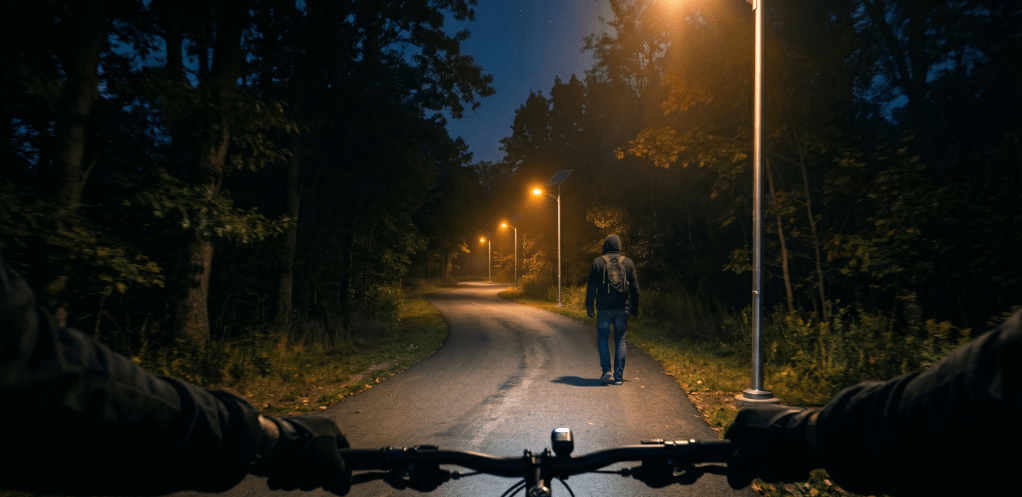
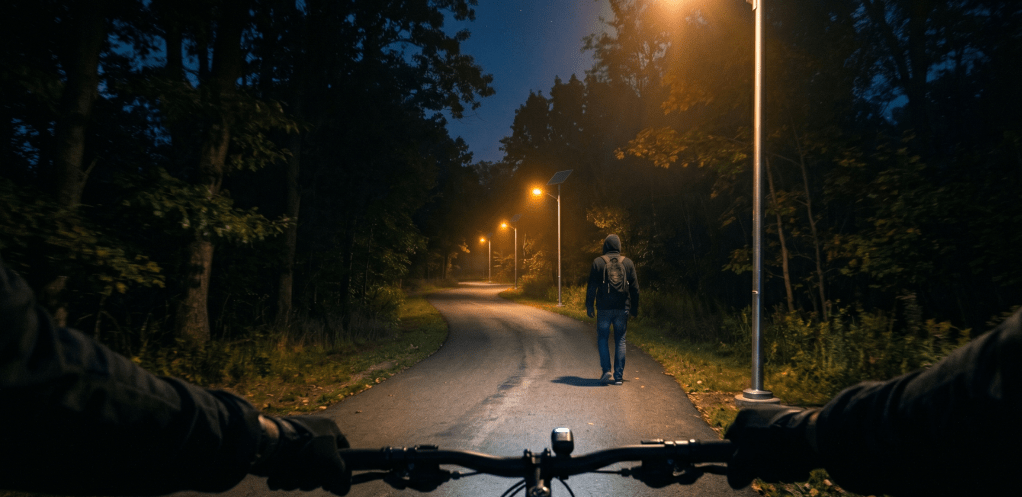
The path looks the same from above. Same asphalt, same poles, same fixtures. But at night, a cyclist doing 25 km/h and a pedestrian doing 5 km/h are living in completely different visual worlds. The pedestrian is scanning 3 to 4 metres ahead for the next curb edge. The cyclist is reading the path horizon for intersections, obstacles, and other users well before arrival. Different speed, different gaze, different hazard profile, different lighting obligation.
ANSI/IES RP-43-25 knows this. Section 8.6.1.3 is not subtle about it: cyclists travel at higher speeds than pedestrians and tend to fixate on the path ahead rather than peripheral regions. They require navigation information at further distances. Horizontal illuminance uniformity and low glare are identified as extremely important. The standard even flags the terrain transition problem specifically: surface changes from concrete to chipped gravel, grade breaks, path crossings. These need to be illuminated and detectable at whatever the system is actually delivering at 2 a.m., not at the output the proposal used to pass the photometric check.
Most solar proposals for mixed paths do none of this. They pull illuminance targets from a pedestrian walkway row, program the dimming schedule against a pedestrian operating floor, and deliver a system that technically lights the path without ever checking whether it lights it for the person going fastest on it.
RP-43-25 Has a Separate Row in Table A-3. Most Proposals Have Never Seen It.
Mixed Cycling and Pedestrian Paths are listed as a distinct application in Annex A, Table A-3, with their own illuminance targets by lighting zone. In Lz2, the range is 8 to 15 lux average. In Lz3, 15 to 30 lux. The uniformity ratio is 5:1 Avg:Min. Uplight is capped at 50 lumens in Lz3 and Lz4, and 10 lumens in Lz1 and Lz2. Spectrum is bounded by CCT, with the upper limit at 4000 K in higher zones and 3000 K in Lz1 and Lz2.
These are not dramatically different numbers from a pedestrian walkway. The distinction is not the target on paper. The distinction is what the standard is asking you to verify: that the system delivers against those targets for the user with the least reaction time, at the operating condition that occurs most nights, not the condition used to generate the photometric report.
Table A-3 also includes a controls column for mixed paths. The recommended dimming range is 20% to 50%. That is the floor. Not a suggestion. If the solar proposal is dimming below 20% during cyclist hours to save battery, the system is operating outside the criteria the standard sets for this application type. That is a specification failure, not a solar failure.
The Solar Dimming Problem Is Worse on a Mixed Path Than Anywhere Else.
The battery doesn’t know a cyclist just entered the path. It knows how much charge is left and what the programmed schedule says to do with it.
A solar energy budget is set at commissioning. The controller calculates how much output the system can sustain across the design night, accounts for seasonal solar availability, and distributes that energy according to a programmed profile. In most proposals, that profile was designed for a pedestrian. The operating floor, the step-down schedule, the battery protection threshold: all of it was sized for a person walking, not a person riding.
Nobody checked whether the floor that keeps a pedestrian safe also keeps a cyclist safe. And the two are not the same number, because the hazards are not the same hazards. A pedestrian who misses a surface transition can catch themselves. A cyclist at speed on an unlit grade break is already on the ground before the reaction starts.
There is also the glare problem, which hits cyclists harder than pedestrians. A cyclist approaching a fixture head-on has that source in their direct forward sightline for longer than a pedestrian walking past it. RP-43-25 Section 8.6.1.3 calls this out directly: other cyclists’ headlamps can cause confusing glare, and the fixed lighting needs to balance that contrast, not add to it. A fixture with marginal high-angle luminance control that squeaks past a pedestrian comfort check may be actively blinding the cyclist riding toward it.
Cycling Season Is Not Year-Round. Your Controls Commissioning Should Know That.
November through March in most northern markets, the path belongs to pedestrians. The cyclists are gone. A solar system sized for mixed-path criteria is carrying capacity it does not need for half the year, which is actually a good thing. More reserve energy in winter means the pedestrian operating floor is more comfortable to maintain through short days and long nights.
The problem comes in spring when the cyclists return. If the controller was commissioned once with a single year-round profile, nobody changed anything. The system is running whatever it was programmed to run. That may or may not reflect mixed-path criteria during cycling hours.
A correctly specified solar system for a mixed-use path has two commissioning profiles built into the controls plan from the start: one for cycling season, one for pedestrian-only season. The hardware does not change. The panel and battery sizing reflects the design worst case, which is winter. The controller is programmed at commissioning with both profiles, with the handoff dates documented in the O+M package. The spec has to ask for this explicitly, because if it does not, the contractor programs one profile at commissioning and drives away.
What to Require in a Solar Mixed-Path Specification
If the proposal does not name the application type, it used the wrong design criteria. Start there.
- Application type declared as mixed cycling and pedestrian path, with RP-43-25 Table A-3 mixed-path criteria applied throughout, not pedestrian walkway criteria
- Illuminance targets referenced to the correct lighting zone row in Table A-3, with lower and upper limits stated
- Uniformity demonstrated at 5:1 Avg:Min across the full path including midpoint gaps between fixtures, at the programmed operating floor, not at full output
- Dimming floor set at or above 20% per Table A-3 controls guidance during cyclist operating hours
- Dimming floor validated against cyclist terrain detection requirements: surface transitions, grade breaks, and path crossings confirmed above minimum detection threshold at operating floor
- Glare control documented with BUG rating or equivalent, with forward-sightline high-angle emission addressed for an approaching cyclist
- Seasonal controls commissioning documented: separate profiles for cycling season and non-cycling season, both verified in the commissioning and O+M plan
- Battery autonomy modeled against cycling-season worst-case solar availability, not annual average
Three Questions That Expose Mixed-Path Design Gaps
These are not trick questions. A proposal designed for this path has the answers already in the file.
Which row of RP-43-25 Table A-3 was used, and can you show the uniformity calculation at the dimming floor?
What is the dimming floor during cycling season, and what is the minimum point illuminance at a terrain transition at that level?
How are the controls commissioned differently for the period when cycling stops, and who is responsible for that seasonal adjustment?
If the answers are vague, the proposal was designed for a pedestrian path. The cyclist was not consulted.
Closing Thought
A solar system that adequately serves a pedestrian and fails a cyclist is not a compromise. It is a spec that only counted one of the two users on the path. The standard counted both. The spec should too.
Sources and Where to Verify
- ANSI/IES RP-43-25 (2025), Section 8.6.1.3 (Nonadjacent Mixed-Use Paths: cyclist speed and fixation behavior; detection distance requirements; terrain transition identification; glare from headlamps and fixed sources; reference to Table A-3 for illuminance criteria)
- ANSI/IES RP-43-25 (2025), Section 8.6.2 (Object Hazards: peripheral detection threshold of 2 lux; moving object hazards on shared paths including cyclists and skateboarders)
- ANSI/IES RP-43-25 (2025), Annex A, Table A-3 (Mixed Cycling and Pedestrian Paths: illuminance targets by lighting zone, 5:1 Avg:Min uniformity ratio, uplight limits, CCT guidance, dimming control range 20% to 50%)
- ANSI/IES RP-43-25 (2025), Annex A, Table A-1 (Weighting Factors: mixed travel types as an explicit factor in selecting target illuminance within the recommended range)
- ANSI/IES RP-43-25 (2025), Section 3.1 (Glare: disability glare mechanism and its effect on forward-sightline visibility at speed)
- ANSI/IES RP-43-25 (2025), Section 3.3 (Adaptation: mesopic adaptation range and implications for path lighting design at low to moderate illuminance levels)
Piotr Mikus is a roadway lighting designer and specifier focused on solar powered street lighting and controls.
Quick FAQ
Does RP-43-25 actually separate mixed cycling and pedestrian paths from regular walkways?
Yes. Table A-3 in Annex A has a dedicated row for Mixed Cycling and Pedestrian Paths with its own illuminance targets, uniformity ratio, uplight limits, and CCT guidance. Applying pedestrian walkway criteria to a mixed-use path means using the wrong row.
Why does a cyclist need more from the lighting than a pedestrian?
Speed changes everything. A cyclist needs to detect hazards, intersections, and other path users at greater distance because their reaction window is shorter. A pedestrian who misses a terrain cue can slow down and recover. A cyclist at speed may not get the chance.
What dimming floor does RP-43-25 recommend for mixed paths?
Table A-3 lists a controls range of 20% to 50% for mixed cycling and pedestrian paths. That means 20% is the floor, not a suggestion. A solar system dimming below that threshold during cyclist hours is operating outside the criteria the standard sets for this application.
What is the most common solar specification error on mixed-path projects?
Calling it a pedestrian path and pulling criteria from the wrong row of Table A-3. Everything downstream of that decision: the dimming floor, the operating profile, the commissioning plan, is set against the wrong reference user.
Continue reading the series: RP-43-25, Pedestrian Lighting

