After Dark | By Piotr Mikus
After Dark (Series): • Browse the series: https://solarlightingnightshift.com/category/after-dark/
(What to demand in a solar street lighting proposal when winter reliability is on the line):
- The state of charge the battery is assumed to hold when a cloudy stretch begins, not just the days-of-autonomy count
- A sequential hourly simulation of battery state of charge across a full year, not a single worst-case day
- Unmet load reported as hours dark per year, with the design target stated
- Cloudy-stretch frequency for the actual service territory, not a national average
- Battery protection floor behavior: what the light does when state of charge is low
- The irradiation basis used to set the autonomy figure: annual average or worst month
- The worst single event from the simulation, named by date and depth
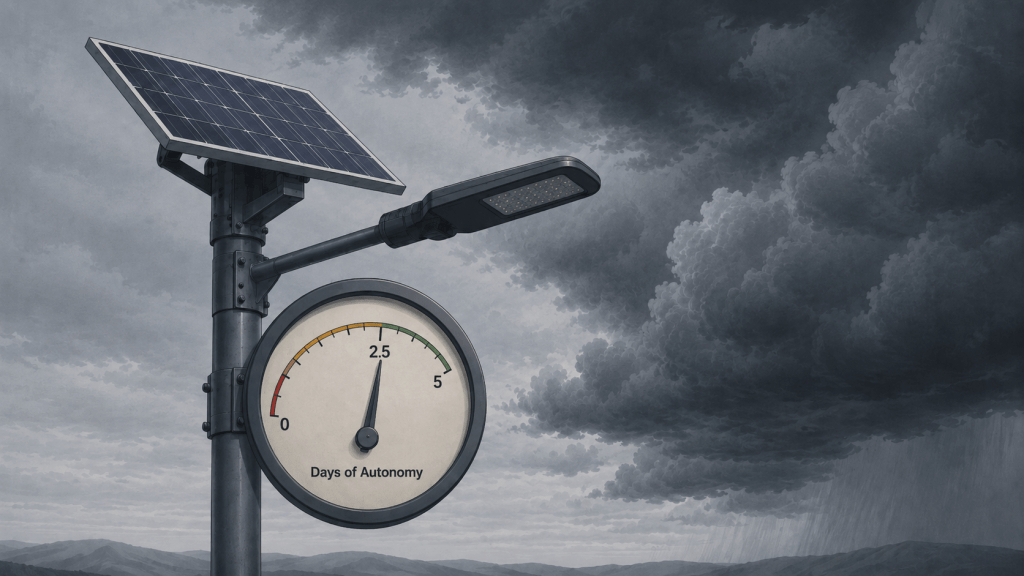
Five days of autonomy is the most quoted number in solar street lighting. It is also the number least likely to show up the one night you need it.
Where the Phrase Came From, and Why It Worked There
Days of autonomy made perfect sense when the battery was always full. That was the grid’s job.
The term did not start in solar. It comes from backup power and UPS system design, where battery banks sit on a grid charger at continuous float, maintained at 100 percent state of charge around the clock. When the grid drops, the battery starts discharging from a known, full state. Every single time. Days of autonomy is the right question in that world because the starting condition is guaranteed. The grid keeps the tank full. The only variable is how long the outage lasts.
Solar street lighting borrowed the phrase but left the starting condition behind. There is no grid charger. There is a panel and the weather. The weather is not predictable, does not promise a full battery, and does not check the forecast before sending three cloudy days in a row. The term traveled from a system where the starting condition is controlled to a system where the starting condition is whatever the sky decided to give you that week. The math stayed the same. The assumption underneath it stopped being true.
Five Days of Reserve Is Not Five Days of Weather
The spec measures the battery you wish you had. The weather shows up for the one you actually have.
Days of autonomy is the maximum number of consecutive days a battery can carry the load with no solar input. The industry standard claim is five. It sounds like a promise. Five sunless days, no problem, walk away.
Then comes the fine print nobody prints: the battery has to enter the storm at 100 percent. Start full and the five-day clock starts at five. Start at 70 percent and the clock starts wherever a 70 percent battery can take you. The number is true. The condition attached to it is the whole story.
Real Weather Has Never Read Your Spec Sheet
Clouds do not check your battery level before they roll in. And they travel in packs.
Take a modeled 30W system on common hardware: a 205W derated panel, a 105Ah LiFePO4 battery at 80 percent depth of discharge, panel tilted 30 degrees, Atlanta, Georgia. Feed it 8,760 hours of real sequential weather and track battery state of charge every hour for the full year. Then catch every cloudy stretch as it begins and write down where the battery sat.
Across the whole year, 59 cloudy stretches, the battery was full exactly once. Once. Every other time the weather showed up to find the tank already drained.
| Battery state when the cloudy stretch began | How often per year (of 59 stretches) |
| Fully charged (95 to 100 percent) | 1 time |
| Slightly low (85 to 95 percent) | 32 times |
| Significantly low (70 to 85 percent) | 24 times |
| Nearly empty (below 70 percent) | 2 times |
Fifty-eight of 59 cloudy stretches, 98 percent of them, started with a battery already down. The five-day spec is describing a unicorn and selling it as a workhorse.
Atlanta Is Not Special. That Is the Problem.
Swap the city, the numbers move. The bad news does not.
Atlanta sees 147 cloudy days a year and is the measured anchor here. Other Southeast territories carry different counts but tell the same story: the weather almost always beats the battery back to full. Scaling the measured Atlanta partial-charge rate by local cloudy-day counts gives the picture below. Read it straight. Atlanta is measured from the simulation. The other three are projections scaled from the Atlanta rate, not independent runs.
| Utility territory | City | Cloudy days/yr | Cloudy stretches/yr | Stretches starting partly charged |
| Georgia Power (measured) | Atlanta, GA | 147 | 59 | 58 of 59 (98%) |
| Alabama Power | Birmingham, AL | 168 | 67 | 66 of 67 (98%) |
| Mississippi Power | Hattiesburg, MS | 152 | 61 | 60 of 61 (98%) |
| TVA (reference area) | Chattanooga, TN | 198 | 79 | 77 of 79 (98%) |
Do Not Blame the Sun for This One
The panel showed up to work every sunny day. The spec wrote a check the weather refused to cash.
None of this is a solar weakness. The hardware charges when the sun is up and keeps what it gathers, exactly as designed. The fault sits in a spec convention that quotes a best-case reserve like it is an everyday guarantee. Averaged sizing quietly assumes the battery climbs back to full between storms. Real weather does not wait that long, because the next cloudy stretch usually arrives before the battery is back on top. The autonomy number is honest arithmetic from a full battery. Winter just rarely hands you a full battery. Bad assumption, not bad sunlight.
One Slogan, or Three Numbers That Mean Something
One number alone is a slogan. Three numbers together are an engineering claim.
Days of autonomy is fine as one input among several. Standing alone, it is marketing. Put it next to three things a real simulation actually produces: the spread of starting state of charge across the year, the unmet load in hours dark per year, and the single worst event by date and depth. The modeled 30W Atlanta system dipped to a low of 23.4 percent on December 23 and logged zero hours dark all year. That is defensible because something counted every hour. Five days, on its own, counted nothing.
When the Battery Fails, So Does the Standard
RP-8-25 does not have an exception for the battery ran out. The roadway still has to meet its criteria. Every night.
This is where the conversation stops being about sizing methodology and becomes about safety. ANSI/IES RP-8-25 (2025), Part 1, Section 6.10.2 is explicit: adaptive lighting reductions cannot go below the lowest applicable criteria for the roadway classification. Collectors have a floor. Arterials have a floor. Freeways have a floor. These are not suggestions. They are the minimum illuminance levels the roadway must maintain to be considered safely lit under the standard.
When a solar street light goes dark because the autonomy assumption failed, because the battery entered the storm at 70 percent instead of 100 and ran out on night three, the roadway is not dimmed. It is dark. That is a safety system that stopped performing its function on a public roadway. RP-8-25 does not care why the light is off. It asks one question: does the roadway meet its minimum criteria? If the answer is no, the roadway is operating outside the standard it was designed to meet.
This is exactly the kind of outcome that proper sizing methodology is designed to prevent. When a system goes dark on a roadway that was supposed to be lit, the questions that follow are predictable: what standard was it designed to, what methodology was behind the sizing, and did anyone verify that the system could survive the weather conditions it would actually face. Those are reasonable questions, and a sequential simulation gives you documented answers to all of them before the system is ever installed. A spec built on five days of autonomy alone does not.
The point is not that solar is risky. Solar street lighting works. The point is that the sizing methodology has to be as rigorous as the safety obligation. RP-8-25 treats roadway lighting as a safety system with enforceable criteria, and the specification behind any solar deployment should be able to demonstrate, with simulation data, that those criteria are maintained through the conditions the system will actually encounter. That is what separates a defensible design from one that looked good on the submittal sheet.
What to Require in a Specification
If a proposal leads with autonomy and never mentions starting state of charge, it was written for the brochure, not the December storm.
- Starting state of charge assumed at the onset of each cloudy stretch, with the source of that assumption stated
- A sequential hourly state-of-charge simulation across a full year, not a single worst-case day calculation
- Unmet load reported in hours dark per year, with the design target named (zero is the right target)
- Cloudy-stretch frequency for the specific service territory, not a national or regional average
- Battery protection behavior at low state of charge: what output the light holds and at what threshold
- The irradiation basis behind the autonomy figure: annual average or worst month, plane-of-array or horizontal
- The single worst event in the simulation, identified by date and by the depth state of charge reaches
Three Questions That Expose the Autonomy Gap
The questions are polite. Watch how fast the room goes quiet.
At what state of charge does your model assume the battery starts each cloudy stretch, and where did that assumption come from?
How many cloudy stretches per year does this service territory see, and how many of them does your model show starting below 90 percent state of charge?
What is the single worst event in the simulation: which date, how deep does state of charge go, and how many hours dark?
If the answers are vague, autonomy was a sticker, not a design.
Closing Thought
Five days of autonomy is accurate the way a parachute rated for a 200-pound jumper is accurate. Comforting on the label. The real question is what you weigh on the way down.
Sources and Where to Verify
- NASA POWER hourly meteorological and solar database (sequential hourly irradiation for a specified location)
- HOMER Pro sequential simulation methodology (8,760-hour state-of-charge tracking and unmet load reporting)
- ANSI/IES RP-8-25 (2025), Part 1, Section 6.10.2 (adaptive lighting design considerations: minimum criteria floors by roadway classification, prohibition on reducing below lowest applicable criteria)
- NREL PVWatts (plane-of-array irradiance and performance ratio reference)
- NOAA National Centers for Environmental Information, climate normal (cloudy day counts by location)
- IEEE 485, IEEE Recommended Practice for Sizing Lead-Acid Batteries for Stationary Applications (origin of days-of-autonomy sizing methodology for grid-connected backup battery systems)
- IEEE 1562, Guide for Array and Battery Sizing in Stand-Alone Photovoltaic Systems
Piotr Mikus is a roadway lighting designer and specifier focused on solar powered street lighting and controls.
Quick FAQ
What does five days of autonomy actually mean?
It is the maximum number of consecutive days the battery can carry the load with no charging, measured from a fully charged battery.
Why is it misleading?
Because it assumes the battery is full when bad weather hits. In the Atlanta simulation, that happened in 1 of 59 cloudy stretches all year.
What should I ask for instead?
The spread of starting state of charge across the year, unmet load in hours dark per year, and the worst single event by date and depth from a sequential simulation.
Continue reading the series: https://solarlightingnightshift.com/category/after-dark/

