On the Lighter Side of the Sun | By Piotr Mikus
RP-8-25 Solar Edition (Series): Browse the series: https://solarlightingnightshift.com/category/rp-8-25-solar-edition/ | Previous: Residential and Local Streets: Why the Lowest RP-8-25 Classification Is the Hardest Solar Target to Hold
(What to demand in a specification when the lighting application is isolated rather than continuous):
- Confirmation that the design references RP-8-25 Section 10.5.2.2 (partial highway lighting) or Section 12.3.2.4 (isolated intersections), whichever applies to the site
- Illuminance criteria from Table 10-2 for partial interchange lighting or Table 12-2 for isolated intersections, matched to the correct roadway classification and pavement type (R1, R2/R3, or R4)
- Uniformity ratio Eavg/Emin stated for the main road classification, not borrowed from continuous-lighting design
- Recognition that veiling luminance ratio does not apply and cannot be calculated for isolated locations, per Section 12.3.2.4
- Luminaires with low high-angle candlepower specified explicitly to control glare, per Section 12.3.2.4 recommendation for partial intersection lighting
- Pole placement per Figure 12-5 for three-leg, four-leg, or T-intersections, not per continuous-lighting pole spacing rules
- A HOMER Pro sequential simulation for the project location proving the isolated luminaire meets Table 12-2 average maintained illuminance every hour of every night, not only at rated output
The standard runs 20 chapters on continuous lighting. Isolated lighting gets a table, a figure, and a shrug.
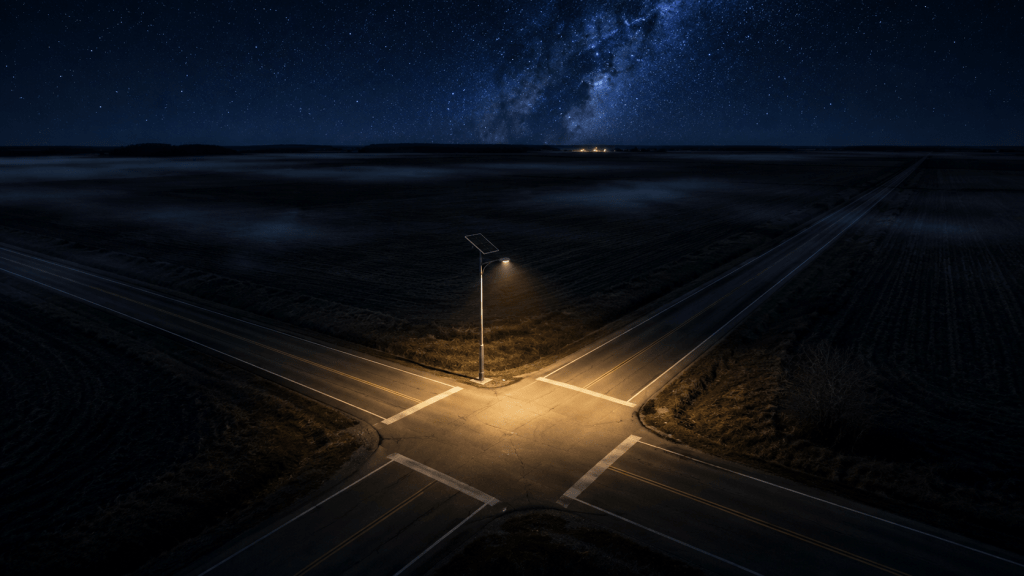
Solar street lighting exists because grid-tied lighting could not economically reach isolated locations. Trenching a single pole two miles from the nearest utility pole was cost-prohibitive for decades. The application went dark, literally, because nobody would pay for the copper. Solar changed that math overnight. Isolated intersections, standalone crosswalks, rural interchange ramps, remote park entrances, transit stops on county roads, all of it became affordable the moment the panel and battery replaced the trench and the meter.
That is the market solar dominates. And it is the market ANSI/IES RP-8-25 barely addresses.
What the Standard Says About Isolated Lighting
RP-8-25 is a continuous-lighting standard with isolated-lighting appendices. Chapter 10 covers highways and interchanges. Section 10.5.2.1 provides the continuous lighting criteria in Table 10-1. Section 10.5.2.2 covers partial lighting for isolated interchanges, and Table 10-2 provides its illuminance criteria. Chapter 12 covers intersections. Section 12.3.2.3 provides the full intersection criteria in Table 12-1 for continuously lit intersections. Section 12.3.2.4 covers partial lighting for isolated intersections, and Table 12-2 provides its illuminance criteria.
So the criteria exist. But look at the depth of coverage. Continuous lighting design gets multiple chapters of guidance on pavement classification, uniformity ratios, veiling luminance calculations, adaptive lighting, adverse weather, spectral considerations, and worked design examples. Isolated intersection lighting gets one section, one table, one figure showing pole placement for three-leg, four-leg, and T-intersections, and a note reminding the designer that the veiling luminance ratio cannot be calculated because there is no meaningful adjacent roadway luminance to reference against.
That single reminder is a tell. RP-8-25 acknowledges that its own most rigorous design metric, veiling luminance ratio, does not apply to isolated locations. The standard is telling the reader, in the middle of Section 12.3.2.4, that isolated lighting operates outside the framework the rest of the document was built around.
The Numbers, and the Sudden Silence After Them
Table 12-2 sets partial intersection illuminance criteria at 6 lux for Major roadways on R1 pavement, 4 lux for Collector, 3 lux for Local. R2 and R3 pavements bump the numbers to 9, 6, and 4 lux respectively. R4 sits between. Uniformity ratio Eavg/Emin runs 3.0 for Major, 4.0 for Collector, 6.0 for Local. Table 10-2 for partial interchange lighting sets 6, 9, or 8 lux depending on pavement class for Freeway Class A and Expressway, with a 3.0 uniformity ratio.
Those are the numbers. That is the entirety of the isolated-lighting criteria in RP-8-25. No adaptive lighting guidance for isolated locations. No spectral quality recommendations for isolated conflict areas. No worked design example for an isolated intersection. No discussion of what happens when a single luminaire is asked to light a stop-controlled rural intersection with no adjacent lighting to blend with. The designer is handed a target illuminance and a uniformity ratio and left to figure out the rest.
For a grid-tied designer that gap is inconvenient. For a solar designer it is the entire design space.
What the Industry Does When the Standard Runs Out
Three things happen when a designer confronts an isolated location with a thin standard. Option one, apply continuous-lighting criteria to the isolated site. Over-lights the location, over-sizes the solar system, wastes the energy budget on illuminance the site does not need. Option two, guess at reduced criteria. No defensible math, no traceable methodology, no way to review the design against a fixed target. Option three, skip lighting design entirely. Drop a pole, hope for the best, let the field decide whether the light was adequate.
Option three is not a hypothetical. It is what happens on most rural DOT projects where solar is spec’d as a low-lumen roadway luminaire without a photometric package. The approved product list carries the day. Nobody runs the calculation grid because there is no calculation grid to run against. The luminaire lands where the pole location allows, which for solar is wherever the sun clears the tree line, which is often not where the intersection actually needs the light. And because Section 12.3.2.4 does not require verification against continuous-lighting criteria, no one flags it.
Why Solar Deserves the Standard It Does Not Yet Have
The isolated-lighting market that solar dominates deserves engineering treatment on par with continuous roadway lighting. RP-8-25 provides the illuminance targets, and those targets are the correct starting point. But an isolated intersection is a fundamentally different lighting problem than a continuously lit corridor. There is no adjacent luminaire to blend with. There is no continuous pavement luminance to weight the design against. There is no fallback pole 200 feet down the road to catch the shortfall. The single luminaire is the entire lighting system. That system either meets Table 12-2 every hour of every night or it does not.
A solar system asked to hold Table 12-2 across a full year of sequential weather has a much tighter design margin than a grid-tied system asked to hold Table 12-1 continuously. Grid-tied fixtures do not run out of energy. Solar fixtures do. When the isolated luminaire is a solar luminaire, the standard’s silence on adaptive behavior at isolated locations becomes an opening for every default dimming profile and every energy-management strategy the manufacturer wants to ship. The specification asks for Table 12-2 illuminance. The delivered product provides Table 12-2 illuminance for three hours and then whatever the battery has left. Nothing in RP-8-25 currently closes that loop.
Until the standard closes it, the specifier has to close it. That means requiring a HOMER Pro sequential simulation proving that the isolated solar luminaire holds Table 10-2 or Table 12-2 criteria across every hour of every night of the design year, not just at rated output on installation day.
What to Require in a Specification
If a specification cites RP-8-25 for an isolated lighting application, the following belongs in writing.
- Correct RP-8-25 section cited: Section 10.5.2.2 for partial interchange lighting, Section 12.3.2.4 for isolated intersections, Section 12.6 for midblock crosswalks
- Illuminance criteria pulled from the correct table: Table 10-2 for interchanges, Table 12-2 for intersections, Table 12-4 for midblock crosswalks
- Pavement classification (R1, R2/R3, or R4) documented for the specific site, not assumed
- Roadway classification (Major, Collector, Local, Freeway Class A/B, Expressway) documented for the specific approach road, since Table 12-2 reads directly from that classification
- Uniformity ratio Eavg/Emin stated per the table, and photometric verification submitted showing the ratio holds across the calculation grid
- Luminaire selection with low high-angle candlepower to control glare, per Section 12.3.2.4 recommendation
- Vertical illuminance calculated separately if pedestrians are present, per Section 12.5 and Section 12.6.3.1
- HOMER Pro sequential simulation demonstrating the isolated solar luminaire holds the required Table 12-2 or Table 10-2 average maintained illuminance every hour of every night across a full year at the project location, with unmet load reported in hours dark per year
Three Questions That Expose the Gap
Polite questions. They tend to produce very long silences.
Which section of RP-8-25 governs this specific location, and which table provides the illuminance criteria being designed to?
What is the pavement classification and roadway classification for the approach road, and how were they determined for this site?
Can the proposed solar luminaire hold the required Table 12-2 or Table 10-2 average maintained illuminance across every hour of every night, verified by HOMER Pro sequential simulation for the project location?
If the submittal cannot answer all three, the specification cited RP-8-25 the way a real estate listing cites a school district. The address is right. The details are missing.
Closing Thought
Solar built the isolated lighting market that RP-8-25 barely acknowledges. The standard provides tables and figures. The specification has to provide everything else. Until the standard catches up, the specifier is the last line of defense between a spec sheet and a rural intersection that thinks it is lit.
Sources and Where to Verify
- ANSI/IES RP-8-25 (2025), Part 2, Chapter 10, Section 10.5.2.2 (Partial Lighting for isolated interchanges)
- ANSI/IES RP-8-25 (2025), Part 2, Chapter 10, Table 10-2 (Illuminance Criteria for Partial Interchange Lighting)
- ANSI/IES RP-8-25 (2025), Part 2, Chapter 12, Section 12.3.2.4 (Partial Intersection Lighting / Isolated Intersections)
- ANSI/IES RP-8-25 (2025), Part 2, Chapter 12, Section 12.3.2.5 (Intersection Delineation / Beacon Lighting)
- ANSI/IES RP-8-25 (2025), Part 2, Chapter 12, Table 12-2 (Pavement Design Criteria for Partial Isolated Intersection Lighting)
- ANSI/IES RP-8-25 (2025), Part 2, Chapter 12, Figure 12-5 (Typical pole placement for partial intersection lighting)
- ANSI/IES RP-8-25 (2025), Part 2, Chapter 12, Section 12.6 and Table 12-4 (Midblock Crosswalks)
- AASHTO Roadway Lighting Design Guide (referenced by RP-8-25 for warranting information on partial lighting)
- HOMER Pro sequential simulation methodology (8,760-hour state of charge tracking and unmet load reporting)
Piotr Mikus is a roadway lighting designer and specifier focused on solar powered street lighting and controls.
Continue reading the series: https://solarlightingnightshift.com/category/rp-8-25-solar-edition/
Quick FAQ
What is isolated lighting under RP-8-25?
Isolated lighting refers to partial lighting installed at points of potential conflict where continuous lighting does not exist. RP-8-25 Section 10.5.2.2 covers partial interchange lighting and Section 12.3.2.4 covers isolated intersections. The criteria come from Tables 10-2 and 12-2 respectively.
Why does solar dominate the isolated lighting market?
Grid-tied lighting requires trenching and utility service, which is cost-prohibitive at isolated locations far from existing infrastructure. Solar removes that cost entirely, making standalone rural intersections, remote crosswalks, and isolated ramps economically feasible to light for the first time.
Does the veiling luminance ratio apply to isolated lighting?
No. RP-8-25 Section 12.3.2.4 explicitly states that the veiling luminance ratio is not a valid requirement for isolated intersection lighting because it cannot be calculated. The standard recommends luminaires with low high-angle candlepower to control glare instead.
 Solar Lighting Night Shift