Pedestrian Lighting | On the Lighter Side of the Sun | By Piotr Mikus
Browse the series: Pedestrian Lighting
Previous: Pedestrian Lighting Isn’t Road Lighting Shrunk Down
What to demand in a motion-controlled pedestrian solar lighting proposal before you sign anything:
- Photometric calculations showing horizontal and vertical illuminance at the minimum background output, not only at the temporary motion-triggered level
- Uniformity results at every programmed operating state that pedestrians will actually experience
- Motion detection zones shown on the project plan, including pedestrian approach directions and the expected activation point
- Background output, triggered output, activation duration, transition time, and timer reset behaviour stated in writing
- Confirmation of whether one fixture or several adjacent fixtures activate from each detection event
- Energy modelling based on a documented number of nightly activations and realistic activation duration
- A higher traffic scenario showing the effect of repeated or overlapping activations on the battery
- Low state of charge behaviour disclosed, including any reduction or suspension of motion triggered output
- Sequential annual energy simulation confirming that the proposed operating profile remains available during the worst solar period
- Commissioning that verifies sensor coverage, timing, output levels, and photometric performance at the minimum operating state
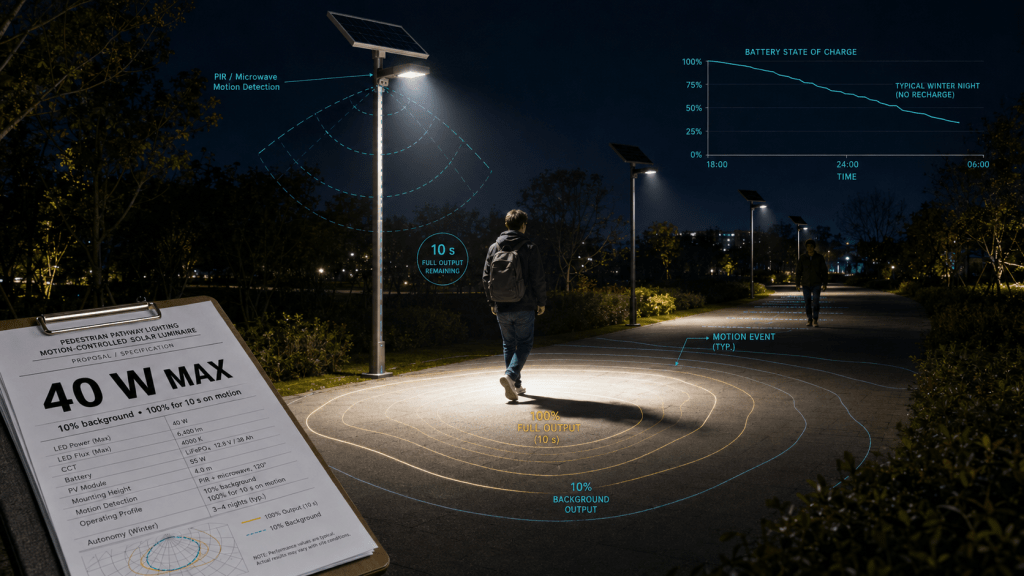
A bright ten-second demonstration proves the sensor works. It says very little about the other eleven hours, fifty nine minutes, and fifty seconds.
Motion sensing can be an effective part of a pedestrian solar lighting design. It can reduce energy consumption, increase output as people approach, and help preserve battery capacity during periods of low activity.
It can also be used to make an undersized solar system look much more capable than it is.
The proposal advertises the fixture at full output. The photometric calculation is completed at full output. The salesperson demonstrates full output. The battery survives because full output lasts only a few seconds and occurs far less often in the energy model than the headline suggests.
The buyer is shown the event.
The pedestrian lives with the operating profile.
What RP-43-25 is actually trying to protect
People need to understand a space before they enter it. Waiting for them to walk into darkness first is a peculiar interpretation of reassurance.
Pedestrian lighting serves visual tasks that begin before a person reaches the pole or enters the sensor zone.
A pedestrian needs to understand where the path continues, whether another person is approaching, whether the walking surface changes, and whether an obstacle or conflict point lies ahead. Those tasks depend on the overall luminous environment, not merely the output produced after motion has already been detected.
RP-43-25 treats outdoor pedestrian lighting as a human scale application. The physical characteristics of the space, visibility of people and surroundings, glare, adaptation, orientation, reassurance, and the way light is distributed all matter.
A temporary jump to full output does not automatically protect any of those conditions.
The system has several operating states:
- The pedestrian approaches while the fixture remains at its background level
- The sensor detects movement
- The fixture transitions to its triggered output
- The pedestrian moves through the illuminated area
- The timer expires
- The fixture returns to its background level
Every part of that sequence affects the pedestrian experience.
Most solar proposals show only one of them.
Conveniently, it is always the brightest one.
A fixture operating at 10 percent may provide a useful background condition when the luminaire, optic, mounting height, spacing, and surrounding environment were designed around that level.
It may also create a row of visible fixtures over a path that remains dark between poles.
The controller percentage does not answer the lighting question.
Ten percent of a well designed system and ten percent of a poorly designed system are still two different environments.
The minimum operating state has to be calculated and evaluated as its own lighting condition.
The solar specific reality nobody puts in the headline
The maximum fixture wattage is the number used to sell the system. The minimum operating wattage is the number used to make the energy budget survive.
Solar lighting suppliers often lead with the fixture’s maximum output.
Thirty watts. Forty watts. Sixty watts.
The number is simple, familiar, and easy to compare across proposals. It also implies a level of performance that the system may deliver only briefly after activation.
The actual operating profile may keep the fixture at 10 or 20 percent for most of the night. When movement is detected, the fixture rises to full output for a short period and then returns to the reduced level.
That may be a valid adaptive lighting strategy.
The problem begins when the proposal presents the temporary output as though it represents the lighting system’s normal performance.
A 40 watt fixture operating at four watts for most of the night is not providing 40 watt lighting through the night. It is providing a four-watt background condition interrupted by short periods at 40 watts.
Whether that produces a suitable pedestrian environment depends on the actual photometric results at both levels.
The full output calculation cannot prove the minimum output condition.
The minimum output calculation cannot be replaced by a percentage printed beside a clock icon.
Apparently, a control schedule became a photometric report while nobody was looking.
Motion sensing also changes the energy model.
Every activation adds load. The magnitude of that load depends on:
- The difference between background and triggered output
- The duration of the triggered period
- Whether additional movement restarts the timer
- Whether adjacent fixtures activate together
- The number of pedestrians
- The direction and speed of travel
- False activations
- Seasonal patterns of site use
- Low-battery control overrides
A supplier can make the system look extremely efficient by assuming very little pedestrian activity.
Six activations per night may produce an excellent battery simulation.
Sixty activations may tell a different story.
The system may still be capable of supporting the higher use. The buyer should not have to guess.
The activation assumptions belong in the proposal because they are part of the electrical load.
Without them, the energy result cannot be audited.
Where the disconnect usually lives
The sensor diagram has circles, dimensions, arrows, and enough technical decoration to look convincing. The pedestrian still has to reach the circle before any of it matters.
The first disconnect is the photometric submission.
Most suppliers provide a calculation at full fixture output. It may show average horizontal illuminance, minimum illuminance, and uniformity. Some submissions may include vertical illuminance.
Very few repeat those calculations at the background level.
That omission matters because the reduced state is often the condition present for most of the night. It is also the condition pedestrians encounter before they activate the system.
A full output calculation shows what the fixture can deliver temporarily.
It does not show:
- What the pedestrian sees while approaching
- Whether the path remains visually continuous between poles
- Whether faces and body movement remain visible
- Whether changes in grade or surface remain apparent
- Whether glare becomes more dominant against a darker background
- Whether the next illuminated area can be understood before the person reaches it
The proposal passes because the numbers are good. The numbers are good because the fixture is operating in a mode it rarely uses.
The second disconnect is sensor coverage.
A manufacturer’s detection diagram describes the component under defined conditions. It is not a project specific design.
Actual detection can be affected by:
- Mounting height
- Sensor angle
- Direction of movement
- Vegetation
- Signs and fencing
- Benches and site furniture
- Parked vehicles
- Snowbanks
- Ambient temperature
- Sensor technology
- Field sensitivity settings
- Movement outside the intended path
A person walking across a detection pattern may be detected differently from someone walking directly toward the sensor.
The site plan should show where pedestrians are expected to be detected from every likely approach direction. It should also show the distance between that activation point and the area requiring elevated output.
The question is simple:
What can the pedestrian see before the fixture reacts?
A generic sensor radius does not answer it.
The third disconnect is activation frequency.
The energy model assumes the pathway will be used occasionally. The municipality is probably hoping for something more ambitious.
A motion controlled system consumes more energy as the site receives more activity.
That sounds obvious. It is rarely made visible in the proposal.
The model may assume ten activations per night, with each activation lasting thirty seconds. Actual use may repeatedly restart the timer or activate several fixtures at once.
A busy period may hold part of the system at full output for twenty minutes rather than thirty seconds.
Cyclists, animals, nearby traffic, vegetation, or poorly aimed sensors may add further activations.
The system may still operate successfully under those conditions, but the energy analysis needs to demonstrate it.
A higher use scenario is not an exotic worst case. It is a test of whether the design has enough margin to tolerate normal uncertainty.
The fourth disconnect is low battery behaviour.
Solar controllers frequently modify the operating profile when the battery reaches a defined state of charge. Depending on the system, the controller may:
- Reduce the background output
- Reduce the triggered output
- Shorten the activation period
- Prevent adjacent fixtures from activating
- Disable motion response
- Shut the fixture off before dawn
Those actions may be necessary to protect the battery.
They also change the lighting performance.
The sales demonstration normally occurs with a charged battery.
The most important operating conditions occur after several poor solar days, during the longest nights, when the battery no longer has the same freedom.
The customer bought adaptive lighting. The controller adapts by quietly withdrawing the feature that closed the sale.
What to Require in a Specification, especially for solar
If the fixture has several operating states, one photometric calculation is not a complete submission. It is the best looking page from an incomplete submission.
Require photometric calculations showing horizontal and vertical illuminance at the declared minimum background level, using the actual luminaire, optic, mounting height, pole spacing, tilt, orientation, and light-loss assumptions proposed for the installation.
Require a second calculation showing the motion triggered state at the proposed elevated output.
Require uniformity results for both states.
Require the background output and triggered output to be stated in actual fixture watts or delivered lumens, not only as controller percentages.
Require the complete control sequence in writing, including:
- Background output
- Triggered output
- Activation duration
- Transition or fade time
- Timer reset behaviour
- Coordination between adjacent fixtures
- Seasonal profile changes
- Low state of charge overrides
Require sensor coverage to be shown on the actual project drawing.
The drawing should include every intended pedestrian approach direction and the expected activation location. It should identify any areas where landscaping, structures, grade changes, snow storage, or other site conditions could affect detection.
Require the energy model to state:
- Number of assumed activations per night
- Duration of each activation
- Number of fixtures activated per event
- Whether repeated motion restarts the timer
- Energy consumption of sensors, controls, and communications
- Background energy consumption
- Triggered energy consumption
- Assumptions for false or non pedestrian activations
Require a higher use scenario.
The scenario should demonstrate how the system performs when activity exceeds the initial assumption. The purpose is not to predict the exact number of pedestrians. It is to prove that normal variation does not collapse the operating profile.
Require sequential annual simulation showing:
- Solar production
- Fixture load
- Control and communication load
- Battery state of charge
- Unmet load
- Lowest battery condition
- Recovery after poor solar periods
- Any changes to the lighting profile caused by battery protection
Require commissioning to verify:
- Sensor orientation
- Detection distance
- Detection from each approach direction
- Activation timing
- Triggered output
- Background output
- Coordination between fixtures
- Transition timing
- Photometric performance at the minimum state
Require acceptance testing before motion activation.
A person waving beneath a bright fixture demonstrates the feature customers already know exists.
The more useful test is what the site provides while nobody is moving.
Three Questions That Separate Adaptive Lighting from Battery Life Support
The salesperson walks beneath the pole. The fixture gets brighter. Everybody has now witnessed electricity.
What horizontal and vertical illuminance does the system maintain before motion is detected, using the actual minimum output, optic, mounting height, and pole spacing proposed for this project?
If the answer refers only to the full output calculation, the supplier has not demonstrated the lighting condition pedestrians will experience for most of the night.
The temporary triggered state may look excellent. The background condition remains unknown.
Where is the pedestrian when the sensor first detects movement, and what can that person see before reaching that point?
If the answer is a generic detection radius copied from a datasheet, the sensor has not been integrated into the site design.
The proposal describes the component.
It does not describe the sequence experienced by the pedestrian.
How many nightly activations were used in the energy model, what happens when actual traffic exceeds that number, and does low battery state of charge change the promised response?
If the supplier cannot show the assumptions, a higher use case, and the low battery control logic, the full output claim is conditional.
The proposal simply has not disclosed the conditions.
Closing Thought
Full output for ten seconds is useful. So is a flashlight. Neither one, by itself, is a pedestrian lighting design.
Motion sensing can improve a solar lighting system.
It can maintain a useful background level, detect people before they enter the area, coordinate several fixtures, increase output smoothly, and reduce unnecessary energy consumption during quiet periods.
That requires the controls to be designed around the pedestrian environment.
The minimum state must be calculated.
The detection sequence must be mapped.
The activation assumptions must be visible.
The battery model must include actual use.
The low state of charge behaviour must be disclosed.
The field installation must be commissioned against the design.
A large fixture wattage followed by a very small duty cycle is not proof of performance.
It is an operating profile.
Treat it like one.
The supplier should show what the system provides before activation, during activation, after repeated use, and after several poor solar days.
If those conditions are absent from the submission, the motion sensor may be doing more than saving energy.
It may be saving the proposal from the battery and solar capacity it should have included in the first place.
Sources and Where to Verify
ANSI/IES RP-43-25: Recommended Practice for Lighting Design for Outdoor Pedestrian Applications. Review the guidance applicable to the expected pedestrian environment, physical characteristics of the space, illumination, visibility, glare, and pedestrian reassurance.
Illuminating Engineering Society: Applying ANSI/IES RP-43-25 to the Environments We Light. Overview of the updated framework for outdoor pedestrian applications and the need to tailor the luminous environment to the nighttime task.
Illuminating Engineering Society: RP-43, Lighting for People in Outdoor Environments. Educational overview discussing pedestrian reassurance, physical characteristics of outdoor space, and the principle that better results do not always require more light.
U.S. Department of Energy: Exterior Lighting Control Guidance. Review occupancy-based exterior control strategies and their intended operating behaviour.
U.S. Department of Energy: Outdoor Lighting Control System Fundamentals. Review outdoor sensor technologies, application considerations, and control-system architecture.
Manufacturer documentation for the proposed sensor and controller. Verify mounting height limits, coverage pattern, direction of travel sensitivity, activation timing, transition settings, environmental limits, and low battery behaviour.
Project specific photometric files and sequential solar energy simulation. Verify every proposed operating state rather than relying on maximum output product data.
Quick FAQ
Q: Is motion sensing inappropriate for pedestrian solar lighting?
A: No. Motion sensing can be an effective energy management strategy when the background condition remains useful, detection occurs before the pedestrian reaches the area requiring additional light, and the solar system is sized using realistic activation assumptions.
Q: Does a full output photometric calculation prove that the design is acceptable?
A: It proves the operating state represented in that calculation. When the fixture spends most of the night at a lower level, that minimum state also has to be calculated and evaluated.
Q: Is 10 percent background output always too low?
A: No. The percentage alone is not enough information. The result depends on fixture output, optic, mounting height, spacing, surrounding conditions, and the horizontal and vertical illuminance delivered at that level.
Q: Why does activation frequency matter to solar sizing?
A: Each activation adds energy consumption. Repeated traffic, timer resets, overlapping sensor zones, and coordinated fixture response can create a much larger nightly load than a low use model assumes.
Q: What should happen when the battery reaches a low state of charge?
A: The supplier should disclose the exact control response. The system may reduce output, shorten activation periods, alter the background level, or suspend motion response. Those changes affect lighting performance and belong in the proposal.
Q: What is the simplest way to test the supplier’s claim?
A: Ask for photometric calculations at the minimum operating level and a higher use energy simulation. Those two documents usually reveal whether motion sensing is improving the design or carrying an undersized system.
Piotr Mikus, MIES, is a roadway lighting designer and solar lighting specifier. He writes about solar street and area lighting standards, system sizing, and real world performance at solarlightingnightshift.com.
Views are the author’s own and do not represent any employer or affiliated organization. See site Disclaimer.

