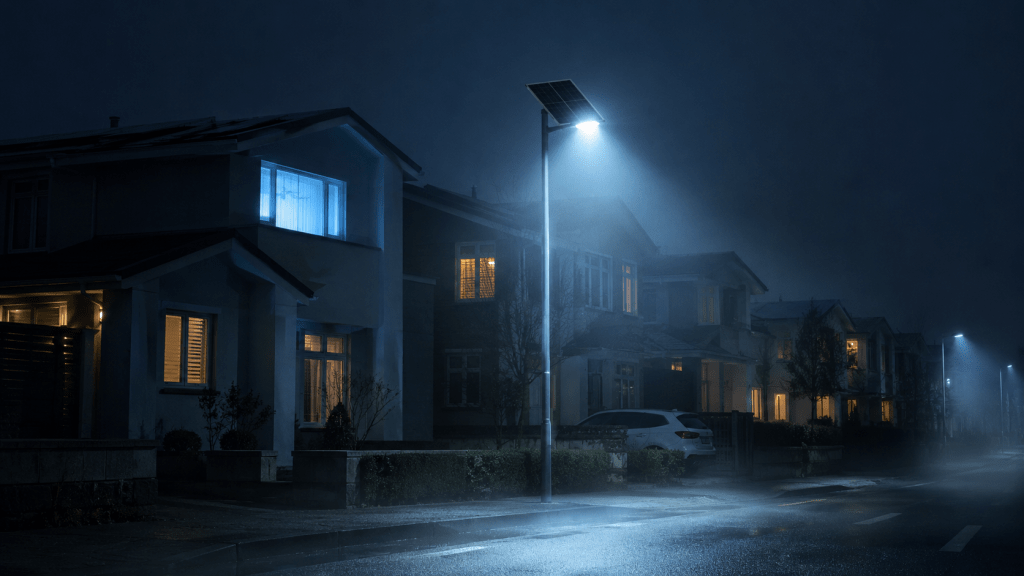
After Dark | On the Lighter Side of the Sun | By Piotr Mikus
(What to demand in a specification before a submittal claims lumen and efficacy compliance):
CCT stated on the submittal cover page in Kelvin, with ANSI C78.377 tolerance disclosed
Delivered lumen output calculated at the specified CCT, not at the manufacturer’s highest-efficacy bin
Efficacy in lm/W at the specified CCT, with the LM-80 report referenced
BUG rating per IES TM-15 recalculated at the specified CCT and fixture geometry
Local dark sky ordinance, MLO zone, or municipal CCT cap explicitly cited, with fixture CCT confirmed against the local requirement
Wattage, battery size, and panel size on the bid recalculated at the specified CCT, not at a warmer reference bin
The industry knows how to build a solar street light at 3000K that meets the illuminance target, the uniformity ratio, and the veiling luminance criterion. It costs more panel. It costs more battery. It costs more optic. The low-end vendor takes a shortcut instead. Bin the LED at 5700K, sometimes 6000K. Efficacy on the datasheet climbs 10 to 15 percent. Lumen output on the cover page swells by the same. Battery shrinks. Panel shrinks. Price drops. Bid wins.
Nothing on the pavement got better. The number on the paper did.
The Efficacy Inflation Trick
Higher Kelvin bin, higher datasheet efficacy, lower price, same fixture. That is the whole trick.
LED efficacy climbs with Kelvin, and the climb is significant. A mid-power LED at 3000K sits around 155 to 170 lm/W. The same LED at 4000K reaches 170 to 185. At 5700K, 185 to 205. At 6000K, past 210. Blue pump light converts more efficiently than the phosphor conversion required for warm output. The chemistry punishes red and rewards blue. Physics behaving as physics.
The datasheet is where the abuse lives.
A vendor pricing against a 4000K competitor picks the 6000K bin. Publishes efficacy at the 6000K bin. Publishes delivered lumens at the 6000K bin. Cover page reads “12,000 lumens, 200 lm/W, 60 watts.” The honest 4000K competitor reads “10,000 lumens, 175 lm/W, 57 watts.” Same silicon. Same driver. Same optic. Different bin, different marketing.
The 6000K fixture wins on pole-per-mile math. The specifier reads the lumen number and assumes more light on the pavement. The pavement gets the same photons the honest 4000K competitor would have delivered, only shifted deep into the blue, at a Kelvin range where every downstream constraint the specifier did not ask about begins to fail.
The Sizing Spreadsheet Rewards the Cheat Twice
Once on the efficacy line. Once on the balance of system. The customer writes both cheques.
A solar sizing spreadsheet takes lumens and watts as inputs, returns panel size, battery size, and pole count. Every output scales with wattage. Cut watts by 15 percent through a Kelvin bin change and the spreadsheet cuts panel, battery, and mount class in proportion. Bill of materials drops. Shipping weight drops. Foundation loading drops. Price drops.
Somebody bumped the Kelvin bin from 4000K to 6000K. The spreadsheet recalculated. The bid came in 18 percent lighter. The fixture is identical.
The 4000K competitor arrives with a larger battery, larger panel, taller pole class, higher price. Loses the bid. The customer picks the 6000K stadium fixture on a residential street and cannot understand why the neighbours are calling by month two.
The Downstream Carnage Nobody Priced Into the Bid
The savings on the invoice fund the removal contract eighteen months later. Roughly.
Dark sky ordinances almost universally cap street and area lighting at 3000K, sometimes 2700K. The Model Lighting Ordinance caps LZ1 through LZ3 at 3000K, covering most residential and mixed-use municipal applications. Flagstaff, Tucson, most of Hawaii, national park adjacencies, and an expanding list of Canadian municipalities enforce that ceiling. A 6000K fixture violates it the day it lights up. The removal cost was not in the bid.
Blue-shifted light scatters more aggressively in the human eye through the same short-wavelength Rayleigh mechanism that makes the sky blue. A 6000K fixture at a given lumen output produces measurably more perceived glare at the window across the street than a 3000K equivalent. The specifier hears about it from the neighbourhood association. The vendor hears about it never.
Wildlife impact is on the books in an expanding number of jurisdictions. Blue-rich light disrupts nocturnal wildlife, disorients migrating birds, and shreds pollinator populations that municipal landscaping depends on. Sea turtle beaches, migratory corridors, and dark sky preserves are typically capped at 2700K. A 6000K fixture is a permit violation before the switch is thrown.
Melatonin suppression scales with the blue content of ambient exposure. Bedrooms facing a 6000K street light receive an evening dose a 3000K equivalent would not deliver at the same illuminance. The AMA position statement from 2016 specifically names outdoor lighting above 3000K as a public health concern. IES echoed it in PS-09-16.
BUG G-scores per TM-15 do not escape the CCT effect either. A fixture that passes G at 4000K can fail the same local glare cap at 6000K without a single geometry change. The datasheet BUG and the enforceable BUG end up in different places once Kelvin is honestly accounted for.
Every one of these costs was invisible in the bid. Every one landed on the customer.
Why Solar Vendors Reach for the Cheat Harder Than Grid Vendors
Grid-tied fixes the wattage gap with more watts. Solar tries to fix it with more Kelvin.
Grid-tied has been trending warmer for a decade. Most major municipal retrofits specify 3000K, some 2700K. The grid does not care about the wattage difference between 3000K and 6000K per fixture. The utility bill is the utility bill.
Solar cares about every watt. Watts drive battery size. Battery size drives cost. Cost drives whether the bid wins. A solar vendor at 4000K meeting a 40W load barely fits inside a competitive price envelope. The same vendor at 6000K meeting the same photometric target on paper drops to 35W, drops the battery a full class, drops the panel a full class, drops the price 15 to 20 percent. The temptation is structural, and the entire low-end segment has organised itself around exploiting it.
Look at the CCT column on any solar streetlight priced 30 percent below market. It will say 5700K or 6000K. Look at the CCT column on any manufacturer that publishes LM-80 at the specified CCT. It will say 3000K or 4000K. Kelvin arbitrage, in one column.
What to Require in a Specification
If CCT is not stated on the cover page, and efficacy is not stated at that CCT, the vendor is selling the arbitrage, not the fixture.
CCT stated on the submittal cover page in Kelvin, with ANSI C78.377 tolerance disclosed
Delivered lumens at the specified CCT, not the highest-efficacy bin
Efficacy in lm/W at the specified CCT, with LM-80 report referenced
Local dark sky ordinance, MLO zone, or municipal CCT cap cited, with fixture CCT confirmed compliant
BUG rating per TM-15 recalculated at the specified CCT and geometry, with G-score compliance against the local glare cap confirmed
Manufacturer statement confirming wattage, battery, and panel sizing on the bid were calculated at the specified CCT, not a higher-CCT reference bin
Three Questions That Expose the CCT Arbitrage
Send them by email. Watch the sales rep suddenly remember a meeting.
What is the CCT of the proposed fixture, and is the delivered lumen output on the cover page calculated at that CCT or at a higher-efficacy reference bin?
If the specified CCT is 3000K or 4000K, what is the recalculated wattage, battery, and panel size at that CCT, and how does that compare to the numbers on the bid?
Does the proposed fixture CCT comply with the local dark sky ordinance or municipal CCT cap for the project location, and if the fixture is 5000K or higher, what is the vendor’s warranty position if it is ordered removed after installation for non-compliance?
If the answers do not line up, the bid was won on Kelvin arbitrage.
Closing Thought
Kelvin selection commits the fixture to a dark sky ordinance, a residential glare profile, a wildlife impact rating, a circadian exposure, and a BUG score. The vendor at 6000K quoting an inflated efficacy has sold the customer a different product than the vendor at 3000K quoting honestly, for a different set of downstream consequences. Ask which one is on the bid.
Sources and Where to Verify
ANSI C78.377 (Chromaticity of Solid State Lighting Products)
IES LM-80 (Luminous Flux and Color Maintenance of LED Packages)
IES TM-15 (BUG Rating Methodology)
IES/IDA Model Lighting Ordinance, CCT ceilings by lighting zone LZ0 through LZ4
International Dark-Sky Association Fixture Seal of Approval, CCT criteria
AMA Council on Science and Public Health, Report 2-A-16 (2016)
IES Position Statement PS-09-16 (Community Conversion to LED Street Lighting)
Piotr Mikus is a roadway lighting designer and specifier focused on solar powered street lighting and controls.
Continue reading the series: https://solarlightingnightshift.com/category/after-dark/
Quick FAQ
Why does higher CCT publish higher efficacy?
Blue LED pump light converts to visible output more efficiently than the phosphor conversion required for warm CCTs. A 6000K bin can publish 10 to 15 percent higher lm/W than a 3000K bin of the same LED family. The physics is real, and vendors ride it hard to inflate spec sheets.
Is a 6000K fixture actually brighter?
On the pavement, no. The delivered lumen count depends on the honest wattage, and once that is stated correctly the 6000K fixture matches the 4000K fixture at the same watts. What the 6000K version delivers extra is blue content, glare, and ordinance violations.
What is the correct CCT for solar street lighting?
3000K where a dark sky ordinance or MLO zone applies, and for any residential or wildlife-adjacent application. 4000K where a jurisdiction explicitly allows it and no dark sky compliance is in scope. Above 4000K sits outside best practice per the AMA and IES.
 Solar Lighting Night Shift