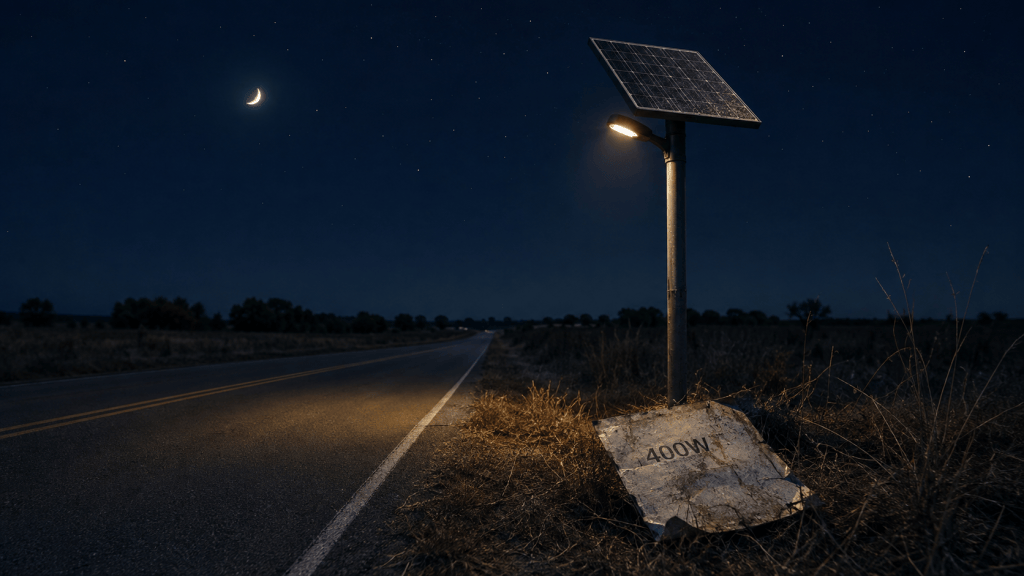
After Dark | By Piotr Mikus
After Dark (Series): Browse the series: Solar Lighting Night Shift, After Dark | Previous: The Cold Physics Chain: Every Battery Decision Rewrites the Whole Pole
(What to demand in a solar street lighting specification when panel wattage is being used as the sizing input):
- STC rating conditions disclosed alongside calculated field output for the project’s hottest and lowest-resource periods
- Temperature coefficient of maximum power applied against modeled cell temperature through the simulation
- Soiling loss stated numerically, with its source and assumed maintenance cycle
- Wiring, charge-controller, mismatch, and battery-conversion losses shown as separate line items
- Sequential 8,760-hour simulation using a documented weather year, with hourly panel output, battery state of charge, and load
- Unmet load reported in hours per year against a stated target
- Written confirmation that panel nameplate watts were never multiplied by an annual-average peak-sun-hours figure and called a design
The number on the sticker is what the panel does in a laboratory. The number on the road is what the panel does in July, in September, in January, on a Tuesday, at 11 am or 6 pm.
The wattage printed on a solar module label describes one condition: Standard Test Conditions.
STC means 1,000 watts per square meter of irradiance, 25°C cell temperature, and the AM1.5 reference solar spectrum. It is a controlled measurement used to compare one module with another. It is useful. It is necessary. It is also a very poor description of what a solar street-lighting panel produces over a year.
STC can occur briefly in the field. It is not a design condition. Nobody gets to size a lighting system around the best few minutes of a panel’s life.
The bench does not have weather. The road does.
The Label Is a Test Condition, Not a Field Condition
At STC, a 400 W panel produces 400 W.
At a 60°C cell temperature, a level crystalline-silicon modules routinely reach under strong summer sun, that same panel produces roughly 340 to 350 W before anyone has counted wiring, dirt, shade, controller efficiency, or battery losses.
Most monocrystalline modules list a maximum-power temperature coefficient between roughly -0.35% and -0.45% per degree Celsius above 25°C. Raise cell temperature by 35°C and 12% to 16% of nameplate power disappears. The panel has not failed. The label remains correct. The operating condition changed.
The nameplate never met a real summer.
This is the first place weak sizing begins. The calculation starts with panel wattage, then treats that wattage as if it were available whenever the sun is visible. It is not.
A panel does not see “sunny.” It sees irradiance on its actual surface, at its actual angle, through its actual temperature, under its actual sky.
The Derating Stack Nobody Puts on the Datasheet
Temperature is only the first cut.
Soiling removes energy. Dust, pollen, grime, bird droppings, and whatever accumulates between cleaning events all reduce the light reaching the cells. A clean-panel assumption has a wonderful way of surviving in a spreadsheet long after the panel has met its first year outdoors.
Wiring losses take another share. A properly designed run may be small, but it is still there.
The MPPT charge controller is efficient, not perfect. A controller operating at 95% efficiency has kept 5% of the power from reaching the battery. Module mismatch, low-light behavior, spectral variation, battery charging efficiency, and battery discharge efficiency take their turns after that.
A 400 W nameplate panel can readily deliver something closer to 250 to 300 W of usable charging power under ordinary full-sun operating conditions, depending on temperature, geometry, and the rest of the system. On poor days, the number drops much further.
Every loss is small. All of them together are the difference between a working light and a dark pole.
The small-loss argument is how weak systems get sold. Two percent here. Three percent there. Five percent somewhere else. Then the design reaches the battery with a great deal less energy than the panel label suggested, and the spreadsheet politely calls it a derate.
The battery calls it Tuesday night.
Why a Single Derate Factor Hides the Actual Problem
A common sizing method takes the panel wattage, multiplies it by peak sun hours, then applies one broad derate factor. Perhaps 0.75. Perhaps 0.80. The calculation produces one respectable-looking number and moves on.
That number averages away the only periods that matter.
It is too optimistic for the shortest, cloudiest, lowest-resource stretch of the year, when the night is long and the panel has little opportunity to recharge the battery. It can also be too pessimistic during high-resource months, where irradiance is abundant but cell temperature becomes the larger performance penalty.
The annual average cannot tell the designer whether the battery survives a run of bad winter days. It cannot show when the system first enters deep discharge. It cannot identify the point where dimming begins early, or the point where the light turns off.
Annual averages are where weak solar designs go to look healthy.
The design year has a sequence. The battery starts one night at a certain state of charge, discharges against the actual load, recharges against the next day’s available energy, and carries that result into the following night. A flat multiplier has no memory. The battery does.
Why Sequential Hourly Simulation Catches What Averages Miss
An hourly simulation follows that sequence for the entire year.
It applies solar resource data hour by hour, models the panel output at the relevant irradiance and temperature conditions, moves that energy through stated system losses, and tracks battery state of charge against the operating profile. HOMER Pro can do this when it is given the actual project inputs and loss assumptions.
At the end of the run, the designer can see the hours where the battery approached its low limit, the periods where production did not recover, the actual unmet load, and the operating profile the system could realistically support.
A peak-sun-hours calculation cannot produce that answer. It has averaged the weather before the battery has had a chance to react to it.
The specification either asks for the sequential model, or it accepts the annual-average answer and hopes the difficult week behaves like the spreadsheet.
The Road Does Not Run on Nameplate Watts
Roadway lighting compliance is measured at the road surface. The system has to maintain the required lighting performance during the hours it is scheduled to operate.
A panel label does not establish that.
A battery capacity label does not establish that either.
The proposal may list a 400 W panel, a 100 Ah battery, and a 40 W luminaire. Those are components. They become a lighting system only when someone demonstrates that the actual available energy can support the actual operating profile while preserving the required photometric performance.
A system that dims aggressively to protect a weak battery may remain visibly illuminated. That is not the same as delivering the design criteria. A system that turns off for two hours before dawn may have an excellent annual energy average. The road will not care.
The driver does not travel on a wattage label.
What to Require
- STC rating disclosed alongside calculated panel output under actual modeled conditions
- Module temperature coefficient applied hour by hour, using the same weather year as the irradiance data
- Plane-of-array irradiance calculated for the proposed panel orientation and tilt
- Soiling loss tied to an actual maintenance assumption
- Wiring, controller, mismatch, charging, and discharge losses listed separately with their basis
- Sequential 8,760-hour simulation submitted as part of the sizing package
- Hourly battery state of charge and unmet-load result included in the submittal
- Written confirmation that the system was not sized from annual-average peak sun hours
Three Questions
- What is the panel output during the project’s hottest period, at the cell temperature it actually reaches, and how was that temperature derived?
- What is the value of every loss in the energy chain, what is the total, and what evidence supports each assumption?
- Where is the sequential hourly simulation, and if it does not exist, why is an annual average being treated as protection against a winter failure?
Closing Thought
The label is a promise made in a laboratory. The road collects on that promise every night for twenty years. The specification decides which of the two the sizing calculation was built for.
Sources and Where to Verify
- IEC 61215-1:2021, terrestrial photovoltaic modules, design qualification and type approval
- NREL, SAM Photovoltaic Model Technical Reference
- Sandia PV Performance Modeling Collaborative, plane-of-array irradiance
- NREL, using measured plane-of-array data in photovoltaic modeling
- IEEE 1562, Guide for Array and Battery Sizing in Stand-Alone Photovoltaic Systems
- HOMER Pro documentation for hourly simulation, battery state-of-charge tracking, and unmet-load reporting
Piotr Mikus is a roadway lighting designer and specifier focused on solar-powered street lighting and controls.
Quick FAQ
Q: Is Standard Test Conditions a bad standard?
A: No. STC is a comparison tool that lets one panel be evaluated against another on equal terms. The problem is not the test standard. The problem is using the STC number as the field production number.
Q: What is a reasonable total derate for a solar street lighting installation?
A: Total derate is not a single number. It varies by climate, mounting, orientation, tilt, wiring run length, and maintenance schedule. A specification that lists the individual losses and their sources is defensible. A specification that lists one lumped multiplier is not.
Q: Does a bigger panel solve this?
A: A bigger panel raises the ceiling of what is possible on a good day. It does not change how the panel behaves on a bad day. The derating stack still applies. The winter still arrives. The simulation still has to be run.
Continue reading the series: https://solarlightingnightshift.com/category/after-dark/

