After Dark
After Dark | By Piotr Mikus
Browse the series: After Dark
A young tree is easy to ignore. It has years to prove you wrong.
A solar lighting design usually describes a site at one moment in time.
The panel has clear sky. The pole location works. The energy calculation passes. The battery has enough capacity. Somebody takes a few photographs, everybody approves the layout, and the project moves forward.
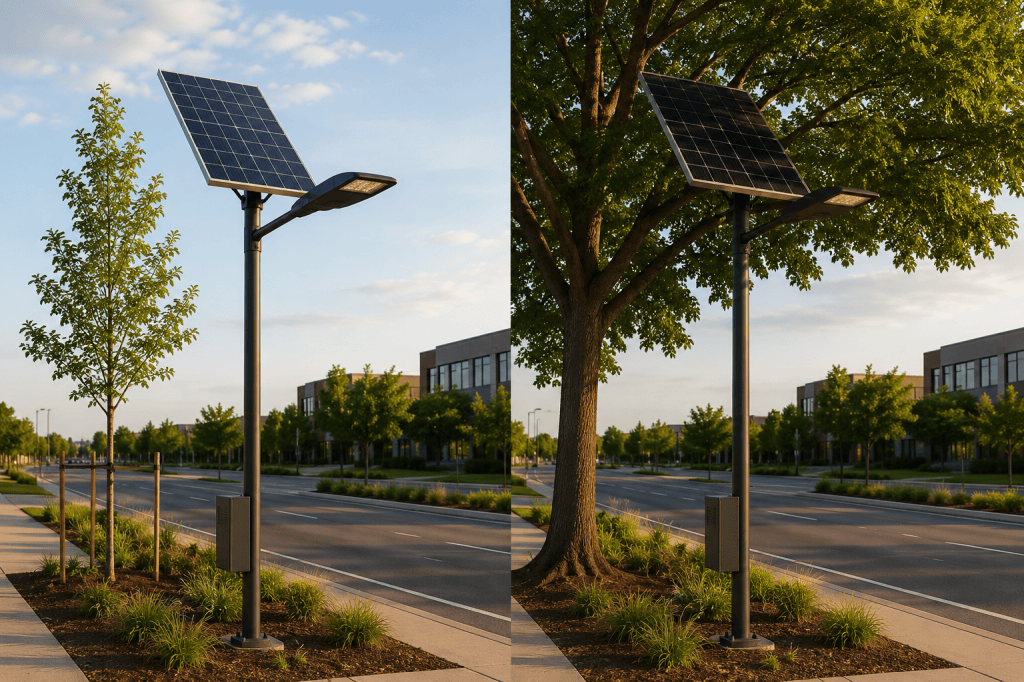
The tree beside the pole does not stay frozen in that drawing.
It grows.
So does the hedge behind it. Landscaping fills in. A sign appears. A building gets expanded. The empty parcel next door becomes Phase Two.
Five or ten years later, the solar module may be operating under conditions that look very different from the ones used to size the system.
The hardware may still be exactly where the drawing put it.
The sunlight may not be.
The Site Plan Has a Future
Solar calculations can model ten years of weather and still miss the tree twenty feet away.
We spend a lot of effort refining the electrical side of solar lighting.
Solar resource. Module output. Temperature. Battery capacity. Controller efficiency. Luminaire load. Autonomy. Dimming schedules. System losses.
All legitimate inputs.
Then somebody places a young tree beside the pole and treats it like scenery.
At installation, its canopy may sit well below the solar module. A decade later, that same canopy may occupy a large part of the southern sky.
Nothing failed in the software.
The battery specification did not suddenly become wrong. The controller did not become defective. The photovoltaic module did not forget how to generate electricity.
The physical environment around the system changed.
That matters because solar lighting does not simply need daylight. It needs usable solar access during the portions of the day and year that support the energy model.
A tree does not need to cover the entire module to become relevant. It only needs to start taking away enough useful charging time.
Two Drawings, One Problem
The lighting plan can be correct. The landscape plan can be correct. The finished project can still be wrong.
This is one of the easiest coordination problems to miss.
The lighting drawing identifies the pole.
The landscape drawing identifies the tree.
Each discipline can produce a perfectly reasonable plan when viewed independently.
Put the two together after the vegetation matures and the geometry may tell a different story.
Roadway lighting practice already recognizes this problem from the lighting side. ANSI/IES RP-8-25 addresses the effect of mature vegetation when evaluating site conditions and roadway lighting design. Section 5.2.6 discusses site conditions, while Sections 5.2.8, 11.4.7, and 11.5.2 address the impact of trees and mature canopy on lighting performance.
The logic is straightforward.
Do not design only around the tree standing there today.
Solar adds another consequence to the same geometry.
For conventional roadway lighting, a mature canopy can block light leaving the luminaire.
For solar powered street lighting, that same canopy can also block energy trying to reach the panel.
One tree can interfere with both sides of the system.
That second problem is easier to miss because it does not necessarily show up immediately.
The Shade Arrives Quietly
Solar shading rarely announces itself with a dead light on Tuesday morning.
A tree begins taking away part of the charging window and the system may continue operating normally.
There may be enough margin in the original design to absorb the loss. The battery still reaches a useful state of charge. The luminaire still runs through the night. Nothing looks unusual from the road.
Then the canopy grows.
Daily harvest falls a little more.
A poor-weather period arrives.
Battery recovery takes longer.
The controller begins protecting state of charge earlier than it once did.
Eventually one pole starts dimming sooner, shortening its operating period, or behaving differently from another pole using exactly the same equipment.
That is usually when somebody starts blaming the battery.
The battery is simply where the energy shortage finally became visible.
Persistent shading may have been reducing available charging energy for years.
Partial shading also deserves more respect than a quick visual estimate of “twenty percent of the panel is covered.”
Photovoltaic modules are electrical systems, not painted rectangles. The effect depends on where the shade falls, cell and module architecture, bypass-diode arrangement, electrical configuration, and system design.
The more useful question is simpler:
How much usable energy reached the battery today?
If that number keeps falling while the nightly load stays the same, the energy margin is being spent.
Eventually it runs out.
The Customer Was Never Told
“Sized for this location” sounds permanent. The sky above the panel is not.
This is where the engineering discussion becomes a customer discussion.
A municipality, developer, landscape architect, or property owner sees a proposal stating that the solar lighting system has been sized for the site.
Most of them are not going to stand beside a six-foot tree and calculate where its mature canopy may cross the solar path in 2036.
They are relying on somebody else to recognize that risk.
Future shading can be inconvenient to raise during design.
It may require moving a pole.
It may force a different module orientation or location.
It may establish a vegetation-maintenance requirement.
It may expose a site where solar is simply a poor fit.
None of those are attractive discoveries after the layout has already been sold.
They are much cheaper discoveries before concrete is poured.
Nobody can guarantee that the sky above a photovoltaic module will remain unchanged for twenty years. A future building, replacement tree, new sign, fence, or unexpected land-use change may be impossible to predict.
But that is different from ignoring what is already foreseeable.
If the landscape plan shows trees beside the proposed poles, review it.
If young trees already exist, consider mature canopy.
If a future construction phase is already shown on the master plan, look at it.
If the uncertainty cannot reasonably be resolved, document the assumption.
A specification or proposal can say something as simple as:
System performance assumes continued solar access at the proposed installation location. Future vegetation growth, construction, signage, landscaping, or other obstructions may reduce available solar energy and affect system performance.
That sentence will not stop a tree from growing.
It will stop everybody from pretending the possibility never existed.
The Drawing Everybody Forgot to Open
Sometimes the best shading software on the project is the landscape plan.
Not every site needs LiDAR, a three-dimensional obstruction model, or a detailed annual shading simulation.
Sometimes somebody simply needs to open the other drawing.
The tree species may already be identified.
Its planting location may already be dimensioned.
The landscape architect may already know the expected mature height and canopy width.
The future obstruction may already exist in the project documents before the solar supplier chooses a pole location.
More complicated sites deserve more work.
Solar path analysis can identify when an obstruction enters the seasonal solar window. Site photography can establish existing conditions. Horizon surveys can identify permanent obstructions. Three-dimensional models and LiDAR can help where terrain, buildings, or dense vegetation make the geometry difficult to judge from the ground.
The level of effort should match the site.
An open rural roadway surrounded by prairie probably does not need an elaborate vegetation study.
A landscaped boulevard with young trees every thirty feet deserves more attention.
So does a park.
So does a campus.
So does a multi-phase development where today’s open parcel becomes next year’s building.
The question is not complicated:
What is likely to occupy this piece of sky during the life of the system?
It takes a few minutes to ask.
It can take considerably longer to answer after installation.
What to Demand in a Solar Street Lighting Site Assessment
Where vegetation or foreseeable obstructions may affect solar access, require the site review to address:
- Existing trees and vegetation near proposed solar locations
- Mature canopy height and width where vegetation could enter the solar window
- Planned landscaping before pole locations are finalized
- Seasonal solar path and obstruction geometry where shading risk exists
- Buildings, signs, fences, terrain, and reasonably foreseeable development
- Current solar access documented with site photographs or equivalent records
- Clear identification of continued solar access as an operating assumption
- Vegetation-management responsibility where trimming or clearance may eventually be required
The goal is not to predict every change that might occur over twenty years.
It is to stop treating foreseeable changes as surprises.
Closing Thought
Solar lighting systems are designed around an energy source that arrives through open sky.
That sky is part of the system whether it appears on the bill of materials or not.
RP-8-25 already asks roadway lighting designers to think about the mature tree rather than only the tree standing beside the pole today. Solar powered street lighting has even more reason to do the same because the canopy can eventually reach into the energy budget itself.
A solar calculation can remain perfectly accurate.
The assumptions around it may not.
Trees grow. The model is still waiting where we left it.
Sources and Where to Verify
- ANSI/IES RP-8-25, Recommended Practice: Lighting Roadway and Parking Facilities, Part 1, Section 5.2.6, Site Conditions
- ANSI/IES RP-8-25, Part 1, Section 5.2.8, Impact of Trees on Lighting
- ANSI/IES RP-8-25, Part 2, Section 11.4.7, Effects of Trees on Lighting
- ANSI/IES RP-8-25, Part 2, Section 11.5.2, Trees Adjacent to Roadway
- National Renewable Energy Laboratory research and photovoltaic modelling resources addressing partial shading, obstruction modelling, and shade-related production losses
Piotr Mikus is a roadway lighting designer and specifier focused on solar powered street lighting and controls.
Continue reading the After Dark series.
Piotr Mikus is a roadway lighting designer and specifier focused on solar powered street lighting and controls.
Continue reading the series: https://solarlightingnightshift.com/category/after-dark/

