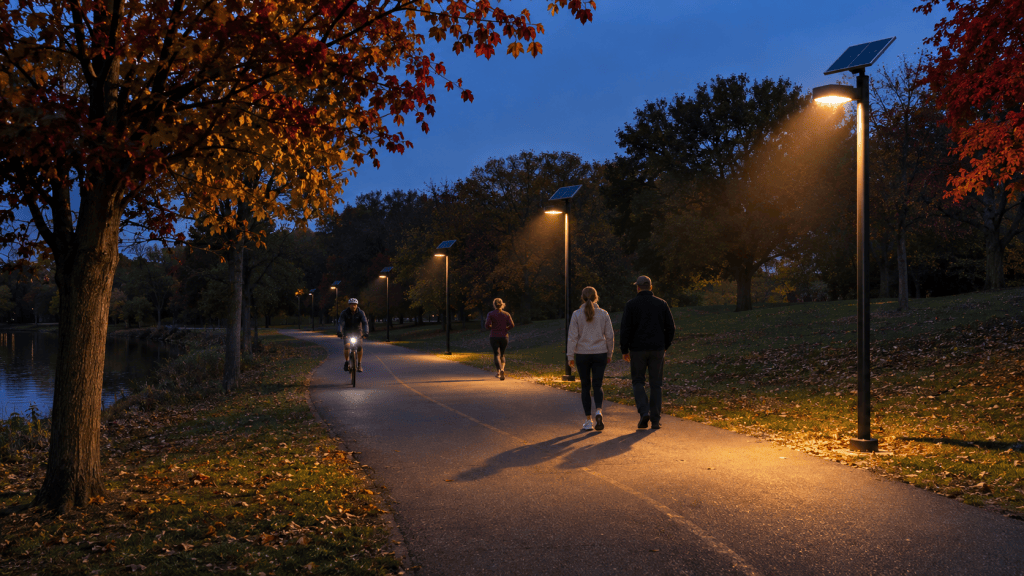
On the Lighter Side of the Sun | By Piotr Mikus
RP-43-25, Pedestrian Lighting (Series): • Browse the series: RP-43-25, Pedestrian Lighting • Previous: The Trip Hazard Is 10mm Tall. Your Solar Light Probably Can’t See It.
(What to demand in a solar mixed use path proposal when bikes, joggers and strollers share the same strip of light):
- The Table A-3 row named: Mixed Cycling and Pedestrian Paths, not a walkway row borrowed from a nicer project
- Minimum light between poles, not just the average, at full output and at the dimming floor
- A dimming floor checked against the standard, not just against the battery
- Merges, curves, bridges and surface changes marked on the plan with their own checks
- Glare control spelled out, including what an oncoming rider’s headlamp does to everyone else
- Hours of use stated by the owner, because a path closed at night may not need light at all
- Battery protection behavior shown for several cloudy days in the worst month
Design a bike path to sidewalk numbers and the first rider to find the dark gap files the inspection report with their elbows.
The Trail Is the New Main Street
The trail used to be the nice extra at the end of the project. Now it is the project, and somebody still wants it lit with leftovers.
Sidewalks, greenways and multi use trails are no longer the strip left over beside the road. New developments are drawing the trail network into the master plan on day one, cities fund it as transportation, and people use it at sunrise and after dinner, which in a northern winter means a big part of every trip happens in the dark. Where the grid is far away, solar gets the call, and solar is a perfectly good answer.
The problem is the proposal that treats a trail like a long sidewalk. RP-43-25 gives these paths their own rules. Section 8.6.1.3 covers nonadjacent mixed use paths, and Table A-3 has a row for them by name: Mixed Cycling and Pedestrian Paths. Quote the sidewalk row for a trail with bikes on it and you quoted the wrong page.
Four Users, Three Speeds
A jogger, a stroller, an e bike and a dog walk onto a path. Nobody gets the punchline, because the punchline is a collision.
RP-43-25 describes the problem in one plain idea: pedestrians, animals and cyclists move at different speeds in different patterns, and the lighting has to let each of them spot the others in time. Riders are faster and stare down the path instead of scanning the sides, so they need to read the route much further out. They are hunting for an intersection, another rider, a runner in dark clothes, a dip in the surface. The standard calls even light and low glare extremely important for exactly that job.
It also wants small obstacles, depressions, elevation changes and surface changes, like concrete turning into chipped gravel, to show up clearly. And it names a glare source no proposal ever mentions: the headlamp of the rider coming the other way. Your pole lights have to share the stage with that.
From a bike seat, a dark gap between two poles is a guess with wheels.
The Row Nobody Reads
Same park, different row, different answer.
In Lz1, the plain walking surfaces row asks for 2 to 4 lux. The Mixed Cycling and Pedestrian Paths row asks for 4 to 8 lux, and it wants the light twice as even: 5:1 where the walkway gets 10:1. Put bikes on the path and the standard doubles the light and halves the tolerance for dark spots.
Annex A leans the same direction. Mixed travel types is one of the factors that pushes the target up, and the annex says a narrow path with fast bikes may need more light so riders can see people on foot. The brochure photo never shows the narrow part.
Where Solar Pays the Bill
The battery has no idea the Tuesday group ride is coming.
Solar fits trails well, and sometimes it is the only sensible answer when a kilometer of trenching makes no sense. The trouble in proposals shows up in three places.
The dimming floor gets picked from the energy budget instead of from the standard. Aim a design at 4 lux, the low end of Lz1, and dim it to a 30 percent floor. If output follows the dimming level, the path averages 1.2 lux. RP-43-25 reports that detecting moving objects in peripheral vision levels off at 2 lux when there is no glare (Section 8.6.2). At 1.2 lux the rider sits below the point where more light stops helping, which means less light really does hurt. Table A-3 lists 20% to 50% in its controls column for this row, so dimming is part of the picture. The proposal owes you a picture of what the path looks like once it gets there.
The spacing is next. Pole counts get trimmed to hold the budget, and the gaps between fixtures are where 5:1 quietly stops being true. The standard ties even light and low glare to how well eyes adapt across the whole scene, and a rider rolling out of a bright pool into a dim gap is adapting at speed.
Then the optics. Light thrown high and forward lands in the rider’s eyes instead of on the surface, right where the standard wants small dips and surface changes to show. The battery paid for every one of those lumens and got glare in return.
Spend the Lumens on Decisions
Lighting every meter equally is a great way to light the wrong meters.
Here the standard works for solar. For paths away from roads and buildings (Section 8.6.1.2), continuous lighting is not always needed, and if nighttime use is not permitted the path need not be lit at all. Where the lighting is not continuous, the standard asks you to look at the surrounding lighting zones and light levels so eyes stay adapted, with even light and low glare protecting that adaptation.
It also names where light earns its keep: stairs, abrupt elevation changes, intersections, merging paths, bridges and curves, plus the end points and resting points that tell people where they are headed. A solar design that puts its output on those spots and handles its transitions on purpose follows the standard. A design that spreads a thin average over the whole length and hopes for the best follows a brochure.
What to Require in a Specification (Especially for Solar)
If the proposal has one number for the whole path, nobody designed the merge.
Keep it enforceable:
- Lighting zone assigned per RP-43-25 Section 7.3, and the Table A-3 row cited by name: Mixed Cycling and Pedestrian Paths for shared use
- Average, minimum point and Avg:Min ratio at full output and at every dimming step
- Dimming floor justified against the 2 lux detection level, with the battery budget kept out of the argument
- Pole spacing shown, and the darkest point between fixtures marked on the plan
- Merges, curves, bridges, intersections and surface changes located, each with its own check
- Glare and uplight limits stated, with optic data (BUG rating or equivalent) and a word on headlamp glare from oncoming riders
- Hours of use stated by the owner, and battery protection behavior shown for several cloudy days in the worst month
Three Questions That Expose Path Gaps
Polite questions. Uncomfortable silences.
Which Table A-3 row did you design this path to, and what lighting zone did you assign?
What is the minimum point illuminance between fixtures at the dimming floor, and where is it on the plan?
How were merges, curves and surface changes treated, and can I see those calculations separately?
If the answers are vague, the path got a pole count instead of a design.
Closing Thought
A dark gap on a quiet path is a nuisance. On a path with bikes it is an incident report. Light the gaps.
Sources and Where to Verify
- ANSI/IES RP-43-25 (2025), Section 7.3 (Lighting Zone Definitions)
- ANSI/IES RP-43-25 (2025), Section 8.6.1.2 (Nonadjacent Walkways: noncontinuous illumination, no lighting where nighttime use is not permitted, hazard locations, termination and resting points)
- ANSI/IES RP-43-25 (2025), Section 8.6.1.3 (Nonadjacent Mixed Use Paths: cyclist speed and fixation, uniformity and glare, small obstacles and surface transitions, headlamp glare, reference to RP-8-25 for paths adjacent to illuminated roadways)
- ANSI/IES RP-43-25 (2025), Section 8.6.2 (Object Hazards: peripheral detection of moving objects plateaus at 2 lux in the absence of glare)
- ANSI/IES RP-43-25 (2025), Annex A, Table A-1 (Weighting Factors for Selecting Target Illuminance, mixed travel types)
- ANSI/IES RP-43-25 (2025), Annex A, Table A-3 (Mixed Cycling and Pedestrian Paths; general walking surfaces)
- ANSI/IES RP-8-25 (2025) (bicycle lanes and mixed use pathways adjacent to illuminated roadways, as referenced in RP-43-25 Section 8.6.1.3)
Piotr Mikus is a roadway lighting designer and specifier focused on solar powered street lighting and controls.
Quick FAQ
Which standard covers a trail that is not next to a road? RP-43-25, Section 8.6.1.3 and the Mixed Cycling and Pedestrian Paths row of Table A-3. Paths next to illuminated roadways are covered by RP-8-25.
Does a mixed use path have to be lit all night, or at all? Not necessarily. RP-43-25 says paths away from roads and buildings need not be continuously illuminated, and need not be lit if nighttime use is not permitted. Where light is provided, uniformity and glare control still apply.
How much more light does a shared path need than a plain walkway? In Lz1, Table A-3 lists 4 to 8 lux at 5:1 for mixed cycling and pedestrian paths against 2 to 4 lux at 10:1 for general walking surfaces.
Continue reading the series: RP-43-25, Pedestrian Lighting

