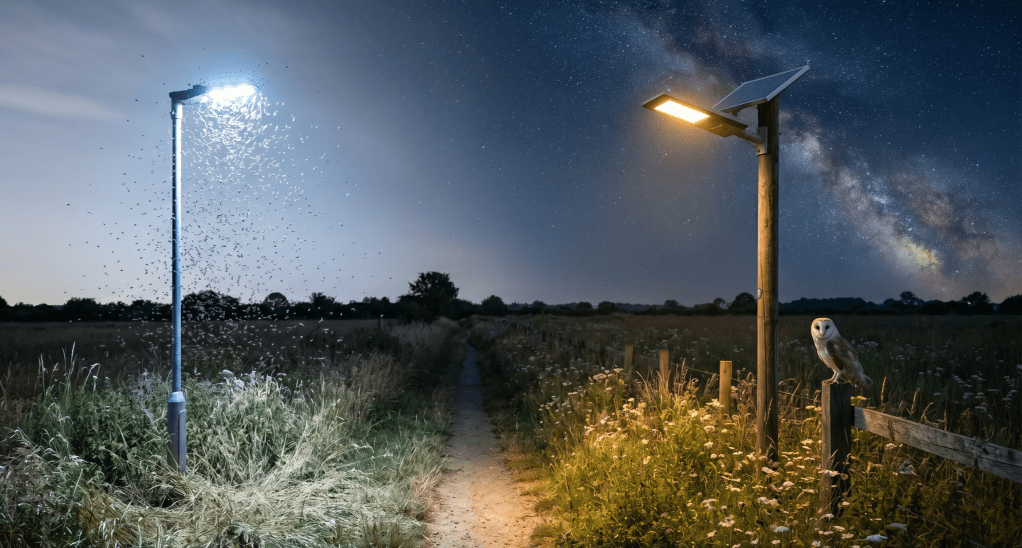
After Dark | Solar Lighting Night Shift
After Dark (Series): Browse the series: After Dark Previous: Nobody taught the engineer how to read a solar submittal
(What to ask for when a project site borders natural habitat, green space, or any area where ecological impact is a concern):
- CCT stated as a maximum in the specification, not a range or “equivalent”
- Spectral power distribution (SPD) curve submitted as part of the photometric package
- Short-wavelength content (400-500 nm) quantified separately from CCT
- Uplight strictly controlled: BUG U0 or equivalent, confirmed in the photometric model
- Perimeter illuminance documented at the boundary of the illuminated zone, not just at center
- Dimming schedule documented with time windows and rationale, not just percentage levels
- Fixture optics evaluated for spill beyond the target area, not just average footcandles within it
- Source type noted: amber / PC amber / narrowband sources flagged as preferred on ecologically sensitive sites
Lux targets on a plan tell you what the light does to the ground. They say nothing about what it does to everything else.
A lighting specification that ignores what happens beyond the target zone is not an incomplete spec. It is a choice to not look.
The Problem Nobody Put in the RFP
Exterior lighting has one job in most specifications: make the space bright enough for the people using it. That framing is reasonable for roadway safety, for crosswalk visibility, for parking lot security. It is also incomplete in a way that is increasingly hard to ignore.
Artificial light at night (ALAN, as the research community calls it) has been accumulating documented ecological consequences for two decades. The science is not speculative. It is peer-reviewed, replicated across multiple continents and dozens of species groups, and now reaching a tipping point where regulatory bodies are starting to formalize it into guidelines. The International Dark-Sky Association has been publishing fixture and spectral guidance for years. The European Union’s biodiversity strategy has flagged light pollution as a measurable threat to insect populations. Researchers at institutions including UCLA, UC Davis, and the University of Exeter have active programs studying how spectrum, intensity, and timing of exterior lighting affect nocturnal species. The evidence base has matured to the point where the question is no longer whether artificial light disrupts ecosystems after dark. The question is what specifiers are going to do about it.
For lighting designers and specifiers, the practical question is not whether to care. It is whether to understand the mechanism well enough to write better specifications before someone else writes the regulation.
What the Research Actually Shows
The foundational papers on ALAN read like a slow-motion inventory of disruption. Longcore and Rich, writing in Frontiers in Ecology in 2004, were among the first to systematically catalogue the documented effects: disorientation in sea turtle hatchlings navigating to the ocean, suppressed firefly signaling and mating success, fatal attraction of insects and migratory birds to lit structures, disrupted foraging behavior in bats, and altered reproductive timing in birds triggered by photoperiod cues that artificial light corrupts.
Gaston and colleagues, in a 2013 review in Biological Reviews, built on that foundation and named the mechanism more precisely. It is not just the presence of light at night that causes harm, but specific spectral and intensity characteristics interacting with species-specific photoreceptor sensitivities. Insects are overwhelmingly sensitive to ultraviolet and short-wavelength blue light. Bats that hunt in open space tend to avoid lit areas, while edge-space foragers get drawn in and exposed to predation. Migratory birds navigate by star patterns and magnetic cues that artificial light at the wrong intensity and wavelength actively competes with.
Falchi and colleagues published the New World Atlas of Artificial Night Sky Brightness in Science Advances in 2016. Their finding was stark: more than 80% of the world’s population, and 99% of the population of the United States and Europe, lives under light-polluted skies. The atlas made the scale of the problem visible in a way that a species-by-species study list cannot.
The insect connection is where the evidence has become most urgent. A widely cited review by Hallmann and colleagues in PLOS ONE (2017) documented a 75% decline in total flying insect biomass over 27 years in German protected nature areas, in areas with no pesticide exposure and no habitat change. The authors identified multiple likely drivers, and ALAN was among them. A study by Eisenbeis and Hassel estimated that a single street lamp can attract and kill up to 150 insects per night. Scale that across a continent of installed streetlights running every night, and the arithmetic becomes uncomfortable.
Pollinators are the group where this connects most directly to the specification table. Fireflies are the obvious case: males signal with species-specific flash patterns in specific spectral windows, and females respond from the ground. Ambient light from nearby sources suppresses both the signal and the response. Davies and colleagues (2012, Journal of Applied Ecology) showed that artificial light at night reduces caterpillar abundance on oak trees, a measure of the disrupted moth population that drives the next trophic level. Pollinators that operate at night represent a share of pollination activity that daytime counts consistently underestimate.
Why Spectrum Matters More Than Brightness
The persistent misconception in ecological lighting discussions is that reducing intensity is the primary lever. Intensity matters. But spectrum matters more, and at lower absolute values than most people assume.
The reason is photoreceptor biology. Most insects have peak sensitivity in the ultraviolet (around 350 nm) and blue-green range (around 440-500 nm). Cool white LEDs, the 4000K and 5000K sources that dominated the first wave of LED streetlight conversions, emit disproportionate energy in exactly that range. A 5000K LED can deliver ten times more short-wavelength energy per lumen than a 2200K amber source. Both can produce the same horizontal footcandles at the target surface. They do not produce the same ecological footprint.
This is why CCT alone is insufficient as a specification parameter. Two sources at 3000K can have meaningfully different blue peaks depending on phosphor composition. A product marketed as “warm white” can still carry a spectral signature that is significantly more disruptive than a narrowband amber source at the same output level. The only way to know is to look at the spectral power distribution curve, which most specifications have never asked for.
The research on amber and narrowband sources is consistent. Stone and colleagues (2012, Philosophical Transactions of the Royal Society B) compared bat foraging activity under white versus amber street lighting and found that greater horseshoe bats, a species that severely avoids white light, foraged normally under amber. Wakefield and colleagues (2016, Proceedings of the Royal Society B) showed that amber LED sources caused significantly less disruption to a range of bat species than broadband white sources at equivalent illuminance. The mechanism is the same in both cases: narrow spectral output that does not stimulate the photoreceptors most sensitive to disruption.
Where Solar Fits Into This
Solar-powered off-grid lighting is not an ecological solution by default. A solar fixture running a 5000K source with poor optics and maximum output creates the same disruption as a grid-tied unit doing the same thing. The system does not know it is running on stored sunlight. The photons do not know either.
But the design constraints of solar create structural pressure toward ecological alignment in ways that grid-tied systems do not share. A battery is a hard budget. Every lumen of uplight, every photon scattered beyond the target zone, every hour of over-illumination drains capacity and reduces design margin. The engineering discipline that makes a solar design efficient (tight optics, appropriate output levels, well-designed dimming schedules, warm narrow-spectrum sources that deliver visibility per watt) is exactly the discipline that biologically appropriate lighting requires.
Off-grid solar lighting is also uniquely positioned to implement temporally aware dimming. Because the control system is already managing a battery, programming a dimming profile that responds to biological activity windows (reducing output during peak pollinator flight hours, for example, or stepping down after 2 a.m. when most insect activity drops) is not a new hardware requirement. It is a software and specification question. Grid-tied systems can do this too, but there is rarely budget pressure to think carefully about it.
What to Require in a Specification (Especially for Solar)
If the specification does not ask about spectrum, it is not asking about ecology. It is asking about lux.
Keep it enforceable:
- CCT stated as a maximum, not a range: “3000K maximum” is not the same as “3000K or equivalent”
- SPD curve required in the photometric submittal, not available on request
- Short-wavelength content (400-500 nm relative energy fraction) stated numerically, not implied by CCT
- BUG rating U0 required on ecologically sensitive sites, confirmed in the photometric model, not just written in the spec language
- Perimeter illuminance documented at the site boundary, especially where it borders natural habitat or dark corridors
- Dimming schedule documented with ecological rationale where applicable, not just “50% after midnight”
- Source type noted: amber and PC amber sources flagged as preferred for sites adjacent to habitat, water, or migration corridors
Three Questions That Expose Ecological Spec Gaps
What is the short-wavelength content of this source, and is the SPD curve included in the submittal?
Does the dimming schedule reflect any consideration of biological activity windows on or adjacent to this site, or was it built purely around battery life?
Has the perimeter illuminance been calculated at the site boundary, and is that result included in the photometric package?
If the answers are vague, the design was optimized for the target zone. What happens beyond it was not part of the calculation.
Closing Thought
The specification did not ask what the light does to the moths, because nobody thought the moths were part of the brief. They were always part of the brief. The brief just did not know it yet.
Sources and Where to Verify
- California Energy Commission, Biologically Appropriate Lighting research project (UCLA / UC Davis, 2024-2025; monitor CEC energy research portal for published outputs)
- Longcore T, Rich C. Ecological light pollution. Front Ecol Environ. 2004;2(4):191-198. DOI: 10.1890/1540-9295(2004)002[0191:ELP]2.0.CO;2
- Gaston KJ, Bennie J, Davies TW, Hopkins J. The ecological impacts of nighttime light pollution: a mechanistic appraisal. Biol Rev. 2013;88(4):912-927. DOI: 10.1111/brv.12036
- Falchi F, et al. The new world atlas of artificial night sky brightness. Sci Adv. 2016;2(6):e1600377. DOI: 10.1126/sciadv.1600377
- Hallmann CA, et al. More than 75 percent decline over 27 years in total flying insect biomass in protected areas. PLOS ONE. 2017;12(10):e0185809. DOI: 10.1371/journal.pone.0185809
- Davies TW, Bennie J, Gaston KJ. Street lighting changes the composition of invertebrate communities. Biol Lett. 2012;8(5):764-767. DOI: 10.1098/rsbl.2012.0216
- Stone EL, Jones G, Harris S. Street lighting disturbs commuting bats. Curr Biol. 2009;19(13):1123-1127. DOI: 10.1016/j.cub.2009.05.058
- Wakefield A, et al. Light-emitting diode street lights reduce last-ditch evasive manoeuvres by moths to bat echolocation calls. R Soc Open Sci. 2016;3(10):160520. DOI: 10.1098/rsos.160520
- Eisenbeis G, Hassel F. Attraction of nocturnal insects to street lamps: a study of municipal lighting systems in a rural area of Rheinhessen (Germany). Natur und Landschaft. 2000;75(4):145-156
- Boyes DH, et al. Street lighting has detrimental impacts on local insect populations. Sci Adv. 2021;7(35):eabi8322. DOI: 10.1126/sciadv.abi8322
- International Dark-Sky Association, Model Lighting Ordinance and Fixture Seal of Approval: current guidance at darksky.org
- Florida Fish and Wildlife Conservation Commission, Marine Turtle Lighting Guidelines for Florida
Piotr Mikus is a roadway lighting designer and specifier focused on solar powered street lighting and controls.
Quick FAQ
What is ALAN and why does it matter for lighting specifiers? ALAN stands for artificial light at night. It is the collective term used in ecological research for the documented effects of artificial lighting on nocturnal species, ecosystems, and human health. It matters for specifiers because the same fixture decisions that determine lux targets also determine ecological footprint, and those decisions are starting to show up in guidelines and regulations.
Is reducing brightness enough to protect nocturnal wildlife? Intensity is one factor, but spectrum is often the more important variable. Insects and many nocturnal species are most sensitive to short-wavelength blue and UV light. A cooler, brighter source can be more ecologically disruptive than a warmer one at the same output level. Reducing CCT and short-wavelength content matters more than dimming alone.
Why are solar-powered lights well suited to biologically appropriate lighting? The energy budget discipline inherent in off-grid solar design (tight optics, appropriate output, minimal waste) aligns naturally with the precision that ecologically sensitive sites require. The control systems that manage battery life also enable biologically aware dimming schedules without additional hardware.
What does “biologically appropriate lighting” actually mean as a design concept?
It is an approach to exterior lighting specification that accounts for documented effects on nocturnal animals, pollinators, and ecosystems by controlling spectrum, intensity, directionality, and timing. Several research institutions and regulatory bodies are actively developing guidelines in this area. The science is mature enough that specification language is starting to follow. Worth tracking if your projects touch natural habitat, green corridors, or ecologically sensitive sites.
After Dark (Series): Browse the series: After Dark
 Solar Lighting Night Shift