After Dark | By Piotr Mikus
After Dark (Series): • Browse the series: https://solarlightingnightshift.com/category/after-dark/ •
Previous: Four Right Tools, Four Different Answers
(What to demand in a solar street lighting proposal when the fine print is on the line):
- The warranty document, not the datasheet summary, with every exclusion listed and explained
- Wind load exclusions compared against the actual AASHTO design wind speed for the project site
- A clear cost-responsibility matrix for parts, labor, freight, lifts, travel, and reinstallation under warranty
- The energy sizing methodology named: static formula or sequential hourly simulation
- Unmet load in hours dark per year, with the design target stated
- Whether the published dimming or motion-sensing profile is a design choice or a battery conservation strategy
- Complete-assembly wind load design including the solar panel mounting hardware, not just the pole
- Project-specific photometric analysis proving the fixture meets RP-8-25 or RP-43-25 criteria at the proposed mounting height and spacing, not just a wattage claim
- The application list on the spec sheet matched against the roadway standard the buyer is required to meet
Every solar street light looks roughly the same on a one-page spec sheet. Panel watts, battery watt-hours, lumen output, color temperature, an application list, and a warranty headline. The differences do not show up on page one. They show up in the documents nobody reads until after the purchase order is signed.
Two Documents, Two Stories
The spec sheet sells the system. The warranty tells you what the manufacturer actually stands behind.
A spec sheet is a marketing document. It shows the system at its best: full output, full battery, perfect conditions. It lists applications the manufacturer believes the product can serve. It quotes a warranty term that sounds like a promise. It is designed to win a bid.
The warranty document is a legal document. It defines what is covered, what is excluded, who pays for what, and under which conditions the coverage disappears. When the spec sheet and the warranty disagree, the warranty is the honest one. It was written by lawyers, not by sales engineers. And it is the document that governs what happens after the purchase order is signed.
The pattern that shows up across the solar street lighting industry is not complicated. The spec sheet makes a broad claim. The warranty carves out the conditions that would test it. The buyer sees the headline. The exclusions do the rest.
Wind Load Exclusions That Contradict the Installation Site
If the warranty excludes the wind speed the site actually sees, the warranty is not protecting the buyer. It is protecting the manufacturer.
Wind load is one of the clearest examples. A solar street light is a tall, top-heavy assembly. The panel, battery enclosure, mounting frame, arm, and luminaire all contribute to the effective projected area the wind acts on. AASHTO provides design wind speeds by region, and any installation in a moderate to high wind zone requires the complete assembly to be engineered for those loads.
What shows up in some warranty documents across the industry is a wind speed exclusion well below the AASHTO design basis for the regions where the product is sold. A product marketed for installation in areas with design wind speeds of 100 mph or more may carry warranty terms that exclude damage from winds far lower than that. The exclusion is buried in the legal language. It does not appear on the spec sheet. The buyer installs the product in good faith, and the warranty quietly does not apply to the conditions the site will actually experience.
This is not a hypothetical. It is a pattern visible in publicly available terms and conditions from multiple manufacturers. The question a specifier should ask is simple: does the warranty wind exclusion cover the AASHTO design wind speed for this site? If the answer is no, the warranty headline on the datasheet is not what the buyer thinks it is.
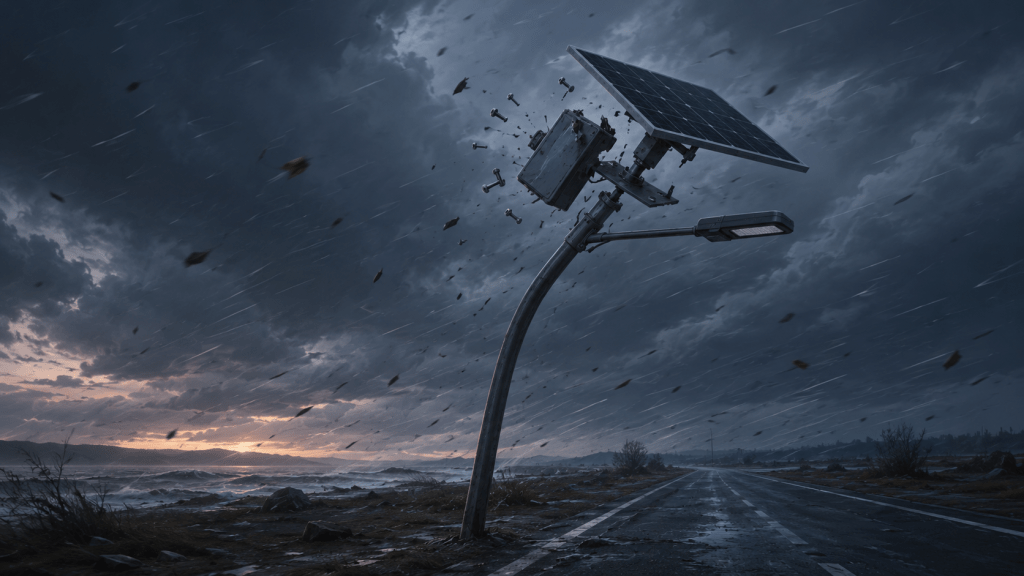
There is a second wind load problem that is even easier to miss. A pole may be properly specified for a given wind speed, and most people stop there. The assumption is that if the pole can handle the wind, the rest takes care of itself. It does not. The solar panel, battery enclosure, and mounting frame bolted to the top of that pole add significant effective projected area and weight at the worst possible location, the top of the structure where the moment arm is longest. If the mounting assembly was not independently designed and engineered to withstand the same wind loads as the pole, the pole specification is irrelevant. A properly rated pole carrying a mounting system that was never designed for the same loads is not a wind-rated installation. It is a wind-rated pole with an unverified load sitting on top of it.
Warranty Cost Transfers Hidden in the Legal Terms
An 8-year warranty sounds like a promise. The cost-responsibility clause tells you who actually pays when something breaks.
The warranty headline on a solar street light datasheet typically reads as a number of years of parts-and-labor coverage. That sounds comprehensive. The legal terms behind it sometimes tell a different story.
In some published warranty documents, the cost of removal, return shipping, field labor, lift equipment, travel, accommodation, and reinstallation falls on the purchaser. The manufacturer covers the replacement part. The buyer covers everything it takes to get the old part off the pole and the new part back on. On a 25-foot pole that requires a bucket truck, a crew, and a site visit, the labor and access costs can exceed the cost of the replacement component itself.
The practical result is a warranty that covers the least expensive part of the failure. The component is replaced. The field cost is not. A specifier comparing warranty terms across proposals should require a written cost-responsibility matrix that names every line item: parts, labor, freight to and from site, lift equipment, travel, reinstallation, and recommissioning. If that matrix does not exist, the warranty term is a number, not a commitment.
When the Motion Sensor Is Not a Feature. It Is a Survival Strategy.
If the dimming profile exists because the battery cannot carry the load, it is not smart lighting. It is rationing.
Motion-activated dimming is a legitimate energy management tool. Reducing output when no pedestrians or vehicles are present conserves energy and extends battery life. When the dimming profile is criteria-driven and tied to actual roadway conditions, it is good adaptive lighting practice, consistent with the framework in RP-8-25 Annex K.
But there is another version of this story. When a system is undersized and cannot carry its published load through the full night at full output, the motion sensor stops being an optimization tool and becomes a survival mechanism. The light dims not because the roadway conditions changed, but because the battery does not have enough energy to maintain full output. The distinction matters because one is a design decision and the other is an energy shortfall dressed up as a feature.
The question that separates the two: can the system deliver full rated output from dusk to dawn on the worst month of the year without the motion sensor active? If the answer is no, the dimming schedule is not optional. It is structural. The system cannot function without it, and the buyer is depending on reduced traffic to save the battery, not a deliberate lighting design.
Application Lists That Invoke Standards the System Cannot Meet
If the spec sheet lists collector roads, it just invoked RP-8. Whether it knows it or not.
Solar street light spec sheets routinely list application types: local roads, collector roads, two-lane roads, parking lots, parks, pathways. These are not casual suggestions. In the United States and Canada, roadway classifications carry specific lighting standards. A product listed for collector roads or two-lane roads invokes ANSI/IES RP-8 by virtue of those classifications, regardless of whether the spec sheet references the standard directly.
RP-8, across every edition, establishes minimum maintained illuminance criteria by roadway classification. That criteria must be maintained through the night. When a system is sized using averaged peak sun hours and a static formula, and the resulting energy architecture cannot deliver the published load through winter weather without outages, the application list on the front of the spec sheet is making a claim the energy behind the system cannot support.
There is a more fundamental problem underneath the energy question. A fixture listed at 40W, 60W, or 80W is stating a power consumption, not a photometric result. Wattage does not tell you whether the fixture meets the illuminance, uniformity, or glare criteria for any roadway classification. Only a proper photometric analysis, using the actual optic distribution, mounting height, spacing, and roadway geometry, can determine whether the fixture delivers the light levels required by RP-8-25 for roadway applications or RP-43-25 for pedestrian and pathway applications. A manufacturer listing collector roads or local roads as applications without providing project-specific photometric evidence is making a claim that has not been tested against the standard it invokes. The wattage on the spec sheet is not a lighting design. It is a power draw.
A specifier seeing collector roads or local roads on an application list should ask one question: has this configuration been tested through sequential hourly simulation for this project location, and what is the reported unmet load? If the answer is a formula, an average, or silence, the application list is aspirational. It is not validated.
Why the Right System Always Looks Expensive
The expensive system is not overpriced. The cheap one is under-built. The price difference is the margin between a system that survives December and one that does not.
A properly sized solar street light uses a larger panel and a larger battery than a system designed to win on price. That is not overengineering. That is the margin between 0% unmet load and 3, 4, or 5 percent unmet load. It is the difference between a system that delivers light every night of the year and one that goes dark 30 or 40 nights in winter.
When a buyer compares two proposals side by side and one costs significantly less, the question is not why the larger system is expensive. The question is what the smaller system left out. Smaller panel means less daily harvest. Smaller battery means less reserve. Less reserve means less margin for consecutive cloudy days. Less margin means the system hits the battery protection floor earlier, and the light goes off earlier in the night, earlier in the winter, and more often than anyone expected.
The price gap between a properly sized system and an undersized competitor is not profit. It is physics. The larger system costs more because it carries more panel, more battery, and more engineering. That is the cost of reliability. The alternative is a lower price and a warranty document that quietly excludes the conditions that would test it.
What to Require in a Specification
If the warranty headline does not survive a reading of the warranty document, the headline is decoration.
- The full warranty document, not the datasheet summary, with every exclusion listed, explained, and compared against actual site conditions
- Wind load warranty exclusion compared against the AASHTO design wind speed for the project location
- A written cost-responsibility matrix covering parts, labor, freight, lifts, travel, reinstallation, and recommissioning under warranty
- The energy sizing methodology named: static formula with the PSH basis stated, or sequential hourly simulation with unmet load reported
- Unmet load in hours dark per year for the project location, with zero as the design target
- Confirmation of whether the motion-sensing or dimming profile is required for the system to survive the worst month, or whether it is an optional energy optimization
- Complete-assembly wind load design that includes the solar panel, battery enclosure, mounting frame, arm, and luminaire as a single engineered package, not just the pole
- Project-specific photometric analysis at the proposed mounting height and spacing, demonstrating compliance with RP-8-25 or RP-43-25 criteria for the listed application, not just fixture wattage
- Each application listed on the spec sheet matched against the applicable roadway standard and supported with simulation data for the project location
Three Questions That Separate the Spec Sheet from the Small Print
The spec sheet answers the questions you asked. The warranty answers the questions you did not.
Does the warranty wind exclusion cover the AASHTO design wind speed for this project site, and if not, what happens to the warranty when the site experiences its design wind event?
Can this system deliver full rated output from dusk to dawn through the worst month of the year without motion-sensing or dimming active, and what sequential simulation data supports that answer?
Who pays for removal, shipping, field labor, lift equipment, travel, reinstallation, and recommissioning under warranty, and is that documented in a written cost-responsibility matrix?
If the answers are on the spec sheet but not in the warranty document, the spec sheet is the pitch. The warranty is the product.
Closing Thought
The cheapest system on the bid sheet is rarely the cheapest system on the roadway. The difference just shows up later, in dark poles, denied warranty claims, and questions nobody wants to answer at 2 AM in December.
Sources and Where to Verify
- ANSI/IES RP-8-25 (2025), Part 1, Section 6.10.2 (adaptive lighting design considerations, minimum maintained criteria by roadway classification)
- ANSI/IES RP-8-25 (2025), Part 2, Annex K (adaptive methodology, conflict-area coordination, adverse-weather cautions)
- AASHTO LRFDLTS-1 (wind speed mapping and structural design loading for luminaire support structures)
- HOMER Pro sequential simulation methodology (8,760-hour state-of-charge tracking and unmet load reporting)
- IEEE 485 (origin of days-of-autonomy sizing methodology for grid-connected backup battery systems)
- Publicly available terms and conditions, warranty documents, and product specification sheets from multiple solar street lighting manufacturers
Piotr Mikus is a roadway lighting designer and specifier focused on solar powered street lighting and controls.
Quick FAQ
Why should I read the warranty document instead of the datasheet warranty summary?
Because the datasheet shows the headline term. The legal document shows the exclusions, cost transfers, and conditions that define what the warranty actually covers. The two do not always agree.
How can a warranty exclude the wind speed the product is installed in?
Some manufacturers set a wind speed threshold in the legal terms below the AASHTO design basis for the regions where the product is sold. The exclusion does not appear on the spec sheet. It appears in the terms and conditions.
How do I know if the motion sensor is a feature or a battery survival strategy?
Ask whether the system can deliver full rated output dusk to dawn through the worst month without motion sensing active. If the answer is no, the dimming profile is not optional. It is required for the system to survive.
Continue reading the series: https://solarlightingnightshift.com/category/after-dark/

