After Dark | By Piotr Mikus
After Dark (Series): Browse the series: https://solarlightingnightshift.com/category/after-dark/ | Previous: Four Right Tools, Four Different Answers: The PSH Problem Nobody Names
(What to demand in a solar street lighting specification when an approved product list is all the procurement team thinks they need):
- A HOMER Pro sequential simulation for the project location, not a static peak sun hours formula and not an annual average irradiation value. The simulation must track battery state of charge across 8,760 hours and report unmet load in hours dark per year at the project site
- Battery chemistry named explicitly, with its manufacturer stated charging temperature floor documented. If that floor is at or above the minimum ambient temperature the project location experiences, a battery heating system is required, and its power consumption must be included in the HOMER simulation load
- Default lighting profile behavior disclosed at full night operation, not just at rated output
- Confirmation that the default or specified profile meets the applicable minimum criteria floor for the application at every hour of the night. RP-8-25 is the preferred edition for this evaluation. Specifications referencing older editions, like RP-8-21, are still valid but may not reflect the expanded adaptive lighting framework that the current edition uses
- A sequential hourly simulation for the project location showing state of charge across a full year, not a single worst case calculation
- Unmet load reported in hours dark per year, with the design target stated
- Luminaire photometric data submitted at the specified mounting height, not a different mounting height used in the manufacturer’s standard documentation
- Confirmation that RP-8-25 is the preferred and referenced edition, with submitted products evaluated against its current adaptive lighting framework, not only against the requirements of an earlier edition
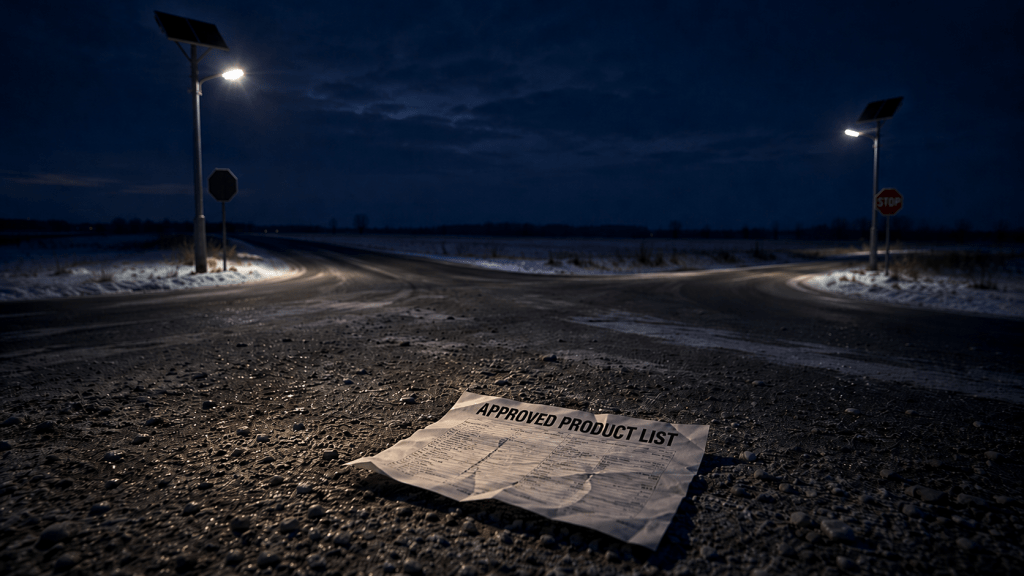
An approved product list tells you who passed the paperwork review. It does not tell you what happens to the roadway at 2 a.m. in January.
A publicly available state DOT specification landed on my desk recently. The format was correct. The standard was cited. Three manufacturers were listed as pre-approved. A licensed engineer stamped and signed the drawings. By every procedural measure, the specification was complete.
So I read the datasheets for the approved products.
What I found came down to a procurement process that treats an approved list as the end of the quality control chain, when it is actually just the beginning. The specification told contractors which companies to call. It did not ask whether any of those companies had modeled the project site in winter, verified that their default controls actually meet the standard they were approved against, or disclosed that one of their battery chemistries stops accepting charge at a temperature this region sees on a routine basis.
None of that information was required. None of it was submitted. None of it was checked.
This post is about the questions the specification did not ask.
RP-8-25 Is the Preferred Edition
The specification cites a roadway lighting standard that was the current edition when it was written. The drawings carry a signature date from late 2025. RP-8-25 has been available since 2025 and is now the preferred edition. Specifications referencing the earlier edition are not wrong. They are simply behind.
Where the edition reference does matter is in the adaptive lighting language. RP-8-25 expanded the framework around when dimming is appropriate and how minimum levels should be maintained. Solar lighting systems live downstream of that framework, because every solar control profile is, in effect, an adaptive lighting strategy. A specification citing an earlier edition should still confirm that the products approved against it respect the current adaptive lighting expectations. This specification did not.
One Approved Product Has a Battery That Cannot Charge on a Cold Day
The datasheet did not lie. It just was not read against the climate the product was approved for.
One of the pre-approved products uses a battery chemistry whose manufacturer published charging temperature floor sits at exactly 32 degrees Fahrenheit, zero Celsius. That number is printed in the technical specifications table on the product datasheet, in the environmental requirements section, right where any reviewer would look if they were looking.
Solar batteries discharge through the night and recharge during the day from sunlight. The charging temperature floor matters during the daytime charging window, not at night. If the daytime ambient temperature stays below 32 degrees Fahrenheit, which it routinely does for weeks at a time in northern climates, the battery management system blocks charging while the sun is in the sky. The panel produces. The controller has somewhere to send the power. The battery refuses to accept it. The cell chemistry physically cannot absorb charge below freezing without plating lithium and degrading itself. The BMS is doing its job by stopping. The system is doing exactly what it should. The light still goes dark.
There is a second compounding problem. Battery capacity itself derates in cold weather. The rated amp/hours stamped on the datasheet are measured at 77 degrees Fahrenheit. At freezing, usable capacity drops by at least five percent for most lithium chemistries, often more depending on cell quality and discharge rate. A specification that sized the system against rated capacity is sizing against a number the battery will not actually deliver in January. The solar irradiation calculation may be correct. The battery capacity assumption is not. Together they pretend the system has reserve it does not have.
The mitigation for the charging temperature problem is a battery heating blanket or pad that warms the cells enough to permit charging. That heater needs power. The only source of power in an off-grid solar system is the battery itself. The heater is therefore a parasitic load that draws from the same energy reserve the luminaire depends on. In a DOT roadway application, the light is the critical load. The battery exists to keep the light running. When a heating system is installed to protect the battery, the heater takes priority over the light, because if the battery dies the light dies anyway. The roadway lighting becomes the secondary load behind battery thermal management. The submittal did not disclose this load. The solar irradiation simulation, if one was run, did not include it. The energy budget the engineer reviewed was missing the line item that decides whether the light stays on.
Stack the three failures together. The daytime charging window is blocked by the temperature floor. The cell capacity that survives is derated by at least five percent. A heater added to lift the cells above freezing draws from that already reduced reserve. A run of cold cloudy days, which is exactly what a northern winter delivers, becomes a compounding deficit that the static sizing math never sees. The first night runs the battery down. The next day the panel cannot recharge it because the cells are still cold. The heater drains what is left trying to warm the pack. The light enters night two on a depleted, derated, partially heated battery, and goes out before sunrise. The DOT specification’s stated guarantee of all night operation depends on a battery that the same DOT specification did not require to be sized for the climate it will operate in.
In a roadway application, the luminaire is a protected component. The submittal package should have shown what fraction of harvested energy goes to thermal management, what the derated winter capacity actually is, and how the system maintains output to the critical load when the parasitic heater is active. None of that was required, so none of it was submitted. The approved list put the product on the project. The specification protected nothing.
One Approved Product Dims the Conflict Area by Default
The default profile is what the light does every night unless someone changes it. Most specifications never change it.
A second pre-approved product ships with a factory default lighting profile that dims the output to 30 percent after three hours of operation. The profile is documented in the order matrix on the product’s own specification sheet. It is labeled as the default. It is what the contractor will install unless the specification explicitly requires a different profile to be programmed.
This project is specifying lighting for set of intersections. Intersections are conflict areas under ANSI/IES RP-8-25. Conflict areas have a defined minimum illuminance floor that cannot be reduced below the lowest applicable criteria for the roadway classification. ANSI/IES RP-8-25 Part 1 Section 6.10.2 is explicit on this point. The floor exists because conflict areas are where the highest risk interactions between vehicles and pedestrians occur, and the roadway must maintain safe illuminance levels through the entire night, not just the first three hours of it.
At 30 percent of rated output, this product delivers a fraction of what the photometric design assumed. The specification lists photometric compliance as a requirement. The default profile delivers a light that is operating below any photometric design the engineer could have run at full output. Those two things are in direct conflict and the specification does not notice, because the specification does not ask what the product does after hour three.
The dimming behavior is an energy management strategy. The product conserves battery capacity by reducing output during what the manufacturer assumes are low-traffic hours. That assumption is reasonable for many applications. At a conflict area that RP-8-25 requires to be maintained at minimum criteria through the entire operating period, it falls apart.
The product was approved. The profile was never questioned. The intersection will dim after midnight and the specification will consider itself satisfied.
One Approved Product Was Designed for a Different Application
The datasheet has a section called Key Applications. The DOT specification is not on the list.
Another pre-approved product is a pedestrian and pathway luminaire. Its own specification sheet says so. The listed applications are parking lots, pathways, and area lighting. The photometric documentation is calculated at a mounting height that is several feet lower than what the DOT specification requires for this project.
Pedestrian pathway luminaires and roadway intersection luminaires serve different visual tasks, require different photometric distributions, and are evaluated against different criteria. One lights the path. The other lights the conflict. Approving a pedestrian pathway fixture for a rural intersection conflict area without documented photometric verification at the correct mounting height is a fundamental mismatch between the product and the application.
The product ended up on the approved list. Nobody asked what it was designed for.
The Specification Did Everything the Process Asked
That is the problem.
The DOT engineer named a standard, listed approved products, specified a pole and foundation, and got a licensed engineer’s signature on the drawings. The specification is procedurally complete. It satisfies every administrative requirement the procurement process imposes.
It does not require a HOMER Pro sequential simulation of the project location with battery state of charge tracked across 8,760 hours. It does not require battery chemistry verification. It does not require confirmation of which lighting profile will be installed and whether that profile meets the roadway classification floor at every hour of the night. It does not require photometric documentation at the specified mounting height. It does not check whether the products on the approved list were designed for this application.
The process produced a specification that looks complete and has holes in it large enough to drive a failure through without anyone knowing until the first December storm.
Solar street lighting is not a plug and play product category. Every solar installation is a custom energy system sized for a specific load, a specific location, and a specific set of weather conditions. A product that works reliably in one climate can fail routinely in another. A default profile that makes sense for a pathway can violate RP-8-25 at an intersection. A battery chemistry that performs well above freezing becomes a liability in a northern winter.
None of those failure modes show up in a procurement process that evaluates manufacturers instead of methodologies. The approved list is a starting point. It is not a simulation. It is not a performance guarantee. It is not a climate analysis. It is not a controls review.
The roadway does not care whose name is on the approved list at 2 a.m. on a January night when the battery is depleted, the default profile has the light running at 30 percent, and the intersection is technically lit but practically dark.
What to Require in a Specification
If a solar lighting specification lists manufacturers but does not ask these questions, it is approving products without approving performance.
- A sequential hourly simulation run in HOMER Pro or equivalent tool covering 8,760 hours at the project location, with battery state of charge tracked every hour, unmet load reported in hours dark per year, and the design target stated explicitly. A static peak sun hours formula is not an acceptable substitute. An annual average PSH value is not an acceptable substitute. The simulation must survive the actual sequential weather the project location experiences, not an averaged version of it
- Battery chemistry identified by name with the manufacturer-published charging and discharging temperature range documented as part of the submittal. If the chemistry’s charging temperature floor is at or above the minimum ambient temperature the project location experiences, the specification must require a battery heating blanket or thermal management system as part of the installation. The power consumed by that heating system must be included in the total load calculation and must be accounted for in the HOMER Pro simulation. A system that keeps the battery warm by drawing power from the same battery it is trying to protect, without modeling that draw, has not solved the problem. It has hidden it
- The lighting profile that will be programmed at installation, with confirmation that the output level at every hour of the operating period meets the minimum criteria for the roadway classification under RP-8-25
- A sequential hourly simulation covering a full year at the project location, with state of charge behavior reported and unmet load stated in hours dark per year
- Photometric documentation submitted at the specified mounting height and arm geometry, not a default height used in the manufacturer’s standard datasheets
- Confirmation that the product is specified for roadway intersection applications, not redirected from a pathway or area lighting application
- Confirmation that RP-8-25 is the preferred and referenced edition for this project, with documentation that submitted products have been evaluated against its current adaptive lighting framework, not only against the requirements of an earlier edition
Three Questions That Expose the Gap
Polite questions. They tend to produce very long silences.
What battery chemistry does this product use, and what is the manufacturer stated minimum charging temperature for that chemistry?
What is the factory default lighting profile, and what is the output level delivered at the intersection after hour three of a winter night? Does that level meet the RP-8-25 minimum criteria for this roadway classification?
Was this product designed and documented for roadway intersection applications, and are the photometric submittals calculated at the mounting height and arm geometry specified in this contract?
If the submittal cannot answer all three, the approved list did its job. The sizing methodology did not.
Closing Thought
A PE stamp certifies that a licensed engineer reviewed the drawings. It does not certify that the solar energy budget survives a northern winter, that the default dimming profile respects RP-8-25, or that the approved products were designed for this application. Those questions live in a different column, and most specifications never open it.
Sources and Where to Verify
- ANSI/IES RP-8-25 (2025), Part 1, Section 6.10.2 (adaptive lighting design considerations: minimum criteria floors by roadway classification, prohibition on reducing below lowest applicable criteria)
- ANSI/IES RP-8-21 (2021), Illuminating Engineering Society Recommended Practice: Lighting Roadway and Parking Facilities (earlier edition; RP-8-25 is now the preferred edition)
- HOMER Pro sequential simulation methodology (8,760-hour state-of-charge tracking and unmet load reporting)
- IEEE 1562, Guide for Array and Battery Sizing in Stand-Alone Photovoltaic Systems
- Manufacturer product datasheets (battery chemistry, charging temperature range, default lighting profiles, photometric documentation, and stated applications: all publicly available on manufacturer websites)
Piotr Mikus is a roadway lighting designer and specifier focused on solar powered street lighting and controls.
Continue reading the series: https://solarlightingnightshift.com/category/after-dark/

