On the Lighter Side of the Sun | By Piotr Mikus
RP-8-25 Solar Edition (Series): Browse the series: https://solarlightingnightshift.com/category/rp-8-25-solar-edition/ | Previous: Isolated Lighting: The Application Nobody Wants to Talk About
(What to demand in a specification when a submittal claims RP-8 compliance):
- Full citation of every applicable RP-8 section, chapter, and table used to justify the design, not just the ones that flatter the product
- Uniformity ratio Lavg/Lmin AND maximum-to-minimum uniformity ratio Lmax/Lmin, calculated and reported per Table 10-1 or Table 11-1
- Veiling luminance ratio LV,max/Lavg calculated and reported per Section 3.5.1 and the applicable classification table
- Maintained illuminance across the entire operating period, not just at rated output on installation day
- Pavement classification (R1, R2/R3, R4) documented, matched to the actual road surface, and used consistently in the calculation
- Photometric calculation performed at the specified mounting height and arm geometry, not the manufacturer’s default test configuration
- Adaptive lighting profile disclosed per Section 6.10.2, with confirmation that the lowest operating level meets the minimum criteria floor for the roadway classification
- HOMER Pro sequential simulation showing that all RP-8 criteria, cited above, are maintained across every hour of every night of the design year, not only at rated output
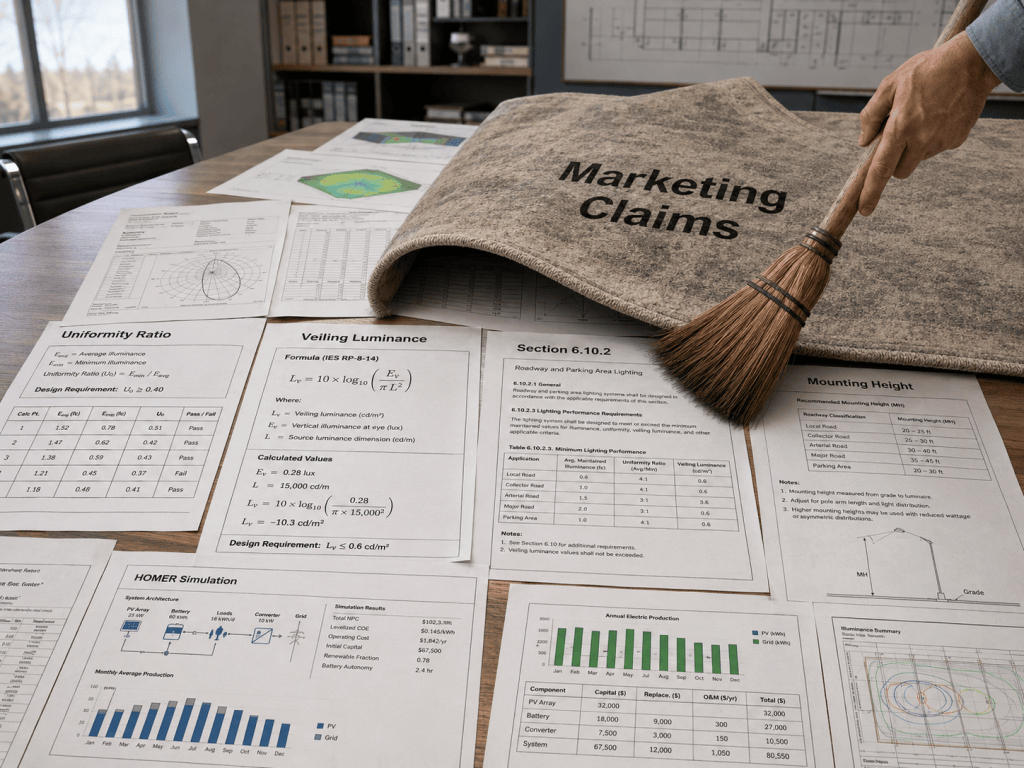
We all know Occam’s Razor. Nobody in solar lighting seems to know about Occam’s Broom.
Occam’s Razor says the simplest explanation that fits the evidence is usually the right one. Common ground. Textbook stuff. Every design review has that person invoking it to shut down an overcomplicated theory.
Occam’s Broom is a different rule. Coined by biologist Sydney Brenner, it describes the trick of sweeping inconvenient facts under the rug so the simple explanation still looks correct. Keep the data that fits. Quietly discard the data that does not. The theory stays clean. The evidence does not.
In solar street lighting, Occam’s Broom is not a philosophical curiosity. It is the operating manual for how manufacturer submittals cite ANSI/IES RP-8. The core lighting design tables in RP-8 have carried forward essentially unchanged across at least the last four editions of the standard. The tables have not changed. The way manufacturers cite the tables has not changed either. And what they choose to leave out has not changed.
Cite the Table. Skip the Ratios.
Manufacturers love the average luminance column. It is the only column they can spell without help.
Every solar roadway submittal I have read in the last twelve months cites Table 10-1 or Table 11-1 for the average luminance target. Freeway Class B at 0.4 cd/m2. Collector with medium pedestrian activity at 0.6 cd/m2. Local street at 0.3 cd/m2. The target number is right there in bold type in the manufacturer’s presentation. The design meets it.
Table 10-1 does not stop at the luminance target. It has four columns. Average luminance is the first. The next three are uniformity ratio Lavg/Lmin, maximum-to-minimum uniformity ratio Lmax/Lmin, and veiling luminance ratio LV,max/Lavg. All four are required criteria. All four are part of the same table cited to prove compliance.
The submittal shows the first column. The submittal does not show the other three. The broom swept them under the rug. If you ask, you will be told the calculations were run. If you ask to see the calculations, you will be told the software output is proprietary. If you insist, you will be told that the numbers are being verified. That verification email arrives approximately never.
Cite Section 12.3.2.4. Skip Section 12.3.2.4’s Warning.
Same paragraph, same standard, same page. The broom does not need to travel far to do its work.
For isolated intersections, submittals routinely cite Table 12-2 for the average maintained illuminance target. Major roadway on R2 or R3 pavement, 9 lux average. Collector, 6 lux average. Local, 4 lux average. The design lands the number. The design gets approved.
What Section 12.3.2.4 also says, in the same paragraph, is that in order to minimize glare, the use of luminaires with low high-angle candlepower is recommended in all instances of partial intersection lighting. That sentence is a specification requirement. It rarely appears in a submittal. The broom prefers the illuminance number and finds the glare recommendation inconvenient because low high-angle candlepower means tighter optics, tighter optics means fewer lumens per pole covering less pavement, less pavement per pole means either more poles or a shortfall against the illuminance target the submittal just claimed to meet.
The manufacturer cannot honor both the illuminance target and the glare recommendation with the same wide-optic fixture. So the illuminance number gets bold type in the presentation. The glare recommendation gets swept.
Cite the Roadway Classification. Skip Section 6.10.2.
Classification comes up because it flatters the product. The floor stays hidden because it does not.
Submittals love roadway classification because it lets the manufacturer position the product against the lowest applicable criteria. A default lighting profile that dims to 30 percent after three hours looks fine when the manufacturer claims Local Street Low pedestrian activity as the design condition, target 0.3 cd/m2 average luminance, achievable at reduced output.
Section 6.10.2 of ANSI/IES RP-8-25 Part 1 says adaptive lighting reductions cannot go below the lowest applicable criteria for the roadway classification. It is explicit. It is one of the most consequential sentences in the entire standard for solar lighting design, because it defines the operating floor that a battery-limited system must respect through the entire night, not just the first three hours.
Manufacturer submittals that cite roadway classification to justify the design target almost never cite Section 6.10.2 to justify the default dimming profile. The classification comes into the submittal because it flatters the product. The section that governs the minimum floor stays under the broom, because engaging with it would force the manufacturer to prove that the default profile still meets the classification’s criteria at hour four, at hour six, at 3 a.m. on a January night with a partially discharged battery.
Nobody asks. So the broom keeps working.
Cite the Photometrics. Skip the Mounting Height.
The plot is beautiful at 20 feet. The specification asks for 24. The broom does the rest.
Manufacturer photometric documentation is calculated at a specific mounting height. Every plot, every isolux contour, every uniformity number depends on the mounting height the test was run at. When a project specifies a different mounting height, the photometric documentation stops applying. New calculations are required, at the specified mounting height, using the same IES file but a different geometry input.
Submittals rarely include those recalculated numbers. The manufacturer’s brochure plots at 20 feet get attached to a project specifying 24 feet. The brochure plots pass at 20 feet. Nobody verifies whether they pass at 24. The broom sweeps the mounting height difference under the assumption that the numbers will be close enough. Sometimes they are. Often they are not. The specifier has no way to tell because the required calculation was never submitted.
Why the Broom Works in Solar and Not in Grid-Tied
Grid-tied solves trade-offs with a bigger wire. Solar solves them with a smaller broom.
Grid-tied roadway lighting design does not need Occam’s Broom. If a fixture cannot honor uniformity and veiling luminance and mounting height and Section 6.10.2 all at the same time, the designer adds a pole, tightens the optics, or increases the wattage. Grid-tied systems have unlimited energy. The trade-offs get solved by throwing more product at the problem until every column of every table passes.
Solar cannot do that. Every extra pole is a full battery, panel, mount, foundation, and shipping cost. Every wattage increase eats into the energy budget. Every tighter optic means fewer lumens per fixture and a bigger system to compensate. The math forces trade-offs that grid-tied never has to face. And when the trade-offs cannot be closed honestly, the broom comes out. Cite the criterion that passes. Sweep the criteria that do not. Present the design as compliant because it meets one column of one table and hope nobody reads the other three columns.
The broom is not a solar problem. The broom is a solar-industry response to the fact that RP-8’s full requirements are harder to meet with a battery-limited system than manufacturers want to admit. Solar can meet the full standard. It just requires larger panels, larger batteries, tighter optics, and honest disclosure. All of that costs money. The broom is cheaper.
What to Require in a Specification
A specification that wants full RP-8 compliance, not just the parts that flatter the product, needs to demand every column of every cited table.
- Every RP-8 section, chapter, and table cited in the submittal, with the design values matched to each criterion in each table, not just the average luminance or average illuminance column
- Uniformity ratios Lavg/Lmin and Lmax/Lmin calculated and reported for the design, per Section 3.4 and the applicable classification table
- Veiling luminance ratio LV,max/Lavg calculated and reported per Section 3.5.1
- Section 6.10.2 compliance demonstrated at every hour of the operating period, including the lowest dimmed state, with the minimum criteria floor stated explicitly for the roadway classification
- Section 12.3.2.4 low high-angle candlepower recommendation honored for isolated intersection applications, with luminaire selection documented against it
- Photometric calculation submitted at the project’s specified mounting height and arm geometry, not the manufacturer’s default test configuration
- HOMER Pro sequential simulation demonstrating that all cited RP-8 criteria are maintained across every hour of every night of the design year, with state of charge and unmet load reported
Three Questions That Expose the Broom
Polite questions. They produce very long silences.
Which RP-8 sections and tables are being cited in this submittal, and for each cited table, what are the calculated values for every criterion column, not just the average luminance or average illuminance?
What is the default lighting profile at installation, and does the output level at every hour of the operating period meet the minimum criteria floor for the roadway classification under Section 6.10.2?
Is the photometric calculation submitted at the project’s specified mounting height, and are the uniformity ratios and veiling luminance ratio calculated for the design as specified, or for the manufacturer’s default test configuration?
If the submittal cannot answer all three, the standard was cited. The standard was not honored.
Closing Thought
RP-8 was written to be read in full, cited in full, and honored in full. A submittal that cites the standard to sell the design should be prepared to cite the standard to defend it. Every column of every table. Every section of every chapter. If the submittal on your desk only quotes the parts that pass, the broom is already in the room. Ask which parts got swept.
Sources and Where to Verify
- ANSI/IES RP-8-25 (2025), Part 1, Section 3.4 (Uniformity Ratios)
- ANSI/IES RP-8-25 (2025), Part 1, Section 3.5.1 (Veiling Luminance)
- ANSI/IES RP-8-25 (2025), Part 1, Section 6.10.2 (Adaptive Lighting Design Considerations, minimum criteria floors by roadway classification)
- ANSI/IES RP-8-25 (2025), Part 2, Chapter 10, Table 10-1 (Lighting Design Criteria for Highways)
- ANSI/IES RP-8-25 (2025), Part 2, Chapter 10, Section 10.5.2.2 and Table 10-2 (Partial Interchange Lighting)
- ANSI/IES RP-8-25 (2025), Part 2, Chapter 11, Table 11-1 (Design Criteria for Streets, Bicycle Lanes, and Shared Streets)
- ANSI/IES RP-8-25 (2025), Part 2, Chapter 12, Section 12.3.2.4 and Table 12-2 (Partial Isolated Intersection Lighting)
- Brenner, S. Occam’s Broom (attributed origin of the concept in scientific reasoning)
- HOMER Pro sequential simulation methodology (8,760-hour state of charge tracking and unmet load reporting)
Piotr Mikus is a roadway lighting designer and specifier focused on solar powered street lighting and controls.
Continue reading the series: https://solarlightingnightshift.com/category/rp-8-25-solar-edition/
Quick FAQ
What is Occam’s Broom?
A concept attributed to biologist Sydney Brenner describing the tendency to sweep inconvenient facts under the rug in order to keep a simple explanation looking correct. The evidence that fits gets cited. The evidence that does not gets discarded.
Are solar manufacturers deliberately misrepresenting RP-8?
Not necessarily deliberately, but the pattern is consistent. Submittals cite the criteria their products can meet and quietly omit the criteria their products cannot. The standard is cited for marketing. The standard is not cited comprehensively for engineering verification.
How does the specifier fight back?
Require full disclosure of every column of every cited table. Require Section 6.10.2 compliance at every hour of the operating period, not just at rated output. Require photometric calculations at the specified mounting height. Require a HOMER Pro sequential simulation demonstrating that all cited criteria are maintained across the design year.

